



LUNG CANCER
Latest News
Advertisement
Latest Videos






































Advertisement
More News
Dr. Florez and Dr. Sabari delve into areas of progress, unmet needs, and future research in NSCLC, encompassing novel biomarkers and targeted therapies such as CEACAM5.
Findings from a study published in JAMA Oncology showed no survival difference in fixed duration immune checkpoint inhibitor group vs the indefinite-duration group among patients with non–small cell lung cancer
Approval of pralsetinib for the treatment of RET fusion-positive non–small cell lung cancer in based on positive results from the phase 1/2 ARROW trial.
A positive association with progression-free survival in patients with advanced non–small cell lung cancer who were treated with first-line pembrolizumab was observed using a multiomics approach.
Important findings from the CARMEN-LC05 study evaluating tusa in combination with pembrolizumab and chemotherapy in NSCLC are discussed, highlighting their implications for clinical practice.
An overview of the CARMEN-LC03 and CARMEN-LC04 trials investigating tusa in different treatment settings for NSCLC and their impact on treatment approaches is provided.
Patients with RET fusion-positive advanced or metastatic non–small cell lung cancer had a survival benefit when treated with selpercatinib in the LIBRETTO-431 study.

In an interview with Targeted Oncology™, Patricia Rich, MD, discussed the data presented at ASCO 2023 and other recent trials that she found most exciting and important to the field of NSCLC treatment.
The transformative potential of antibody drug conjugates in NSCLC treatment is discussed, encompassing their design, bystander effect, biomarkers, and impact on the treatment landscape.
Dr. Florez and Dr. Sabari discuss standards of care for different patient populations in NSCLC.
Jonathan W. Goldman, MD, discusses the use of osimertinib in the first line setting for patients with non–small cell lung cancer.
Hatim Husain, MD, discussed with participants the case of a patient with lung adenocarcinoma.

In the second part of a 2-part article series, Kartik Konduri, MD, discusses the outcomes of targeting the KRAS G12C mutation in patients with metastatic NSCLC.

During a Targeted Oncology™ Case-Based Roundtable™ event, Garrett B. Sherwood, MD, discussed with participants what therapy to use, including adjuvant immunotherapy, for a patient with stage III non–small cell lung cancer. This is the second of 2 articles based on this event.
During a Targeted Oncology™ Clinical Case Forum™ event, Ronan J. Kelly, MD, MBA, discussed the significance of the CheckMate 9LA, KEYNOTE-407, EMPOWER-Lung 3, and POSEIDON studies which all explored immunotherapies in patients with advanced non–small cell lung cancer.
Without requiring additional therapy, 2 patients with non–small cell lung cancer treated with THIO and cemiplimab remained free of disease progression in the phase 2 THIO-101 study.
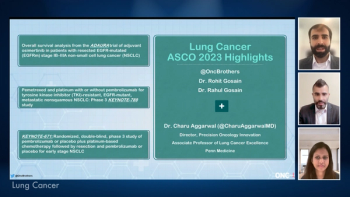
Rohit Gosain, MD, and Rahul Gosain, MD, provide a summary of the key NSCLC data updates discussed following the 2023 ASCO Annual Meeting.
A review of recently updated data from KEYNOTE-671, focused on perioperative use of pembrolizumab in early-stage non–small cell lung cancer.
Following ASCO 2023, experts in oncology review recent data updates from KEYNOTE-789 on chemotherapy with or without pembrolizumab for TKI-resistant nonsquamous NSCLC.
Charu Aggarwal, MD, MPH, joins the Oncology Brothers, Rohit Gosain, MD, and Rahul Gosain, MD, to discuss recent data updates from the ADAURA trial, an overall survival analysis of osimertinib in non–small cell lung cancer (NSCLC).

David S. Hong, MD, discusses which disease subgroups may benefit from treatment with larotrectinib.
In the first of a 2-part article series, Kartik Konduri, MD, discusses the data behind the use of adagrasib and sotorasib for patients with advanced non–small cell lung cancer harboring a KRAS G12C mutation.

During a Targeted Oncology™ Case-Based Roundtable™ event, Garrett B. Sherwood, MD, discussed options including concurrent chemoradiation therapy and neoadjuvant therapy for a patient with stage IIIA lung adenocarcinoma.
During a Targeted Oncology™ Case-Based Roundtable™ event, Christopher G. Azzoli, MD, discussed treatment options appropriate for a patient who received surgical resection for stage IIB lung adenocarcinoma.
Data from a phase 1 dose escalation study showed tolerability and antitumor activity with IBI351 in patients with advanced non–small cell lung cancer harboring a KRAS G12C mutation.
Advertisement
Advertisement
Trending on Targeted Oncology - Immunotherapy, Biomarkers, and Cancer Pathways
1
SOT106 Receives New FDA FTD and ODD in Sarcoma
2
Iberdomide Doubles MRD-Negative CR Rate in Phase 3 EXCALIBER-RRMM Trial
3
IMS 2026 Day 4 Recap: MRD-Guided Regimens Highlight Final Sessions
4
Trispecifics: A New Strategy to Prevent Antigen Escape
5