





LUNG CANCER
Latest News
Advertisement
Latest Videos








































Advertisement
More News

Expert oncologist Anne Tsao, MD, shares her excitement for an upcoming precision medicine program focused on the evolving role of TROP2-directed antibody drug conjugates in metastatic non-small cell lung cancer.
Topline results from MARIPOSA reveal a survival advantage with amivantamab plus lazertinib vs osimertinib in patients with EGFR-mutant non–small cell lung cancer. Additional follow-up is planned.
Treatment with CAN-2409 produced promising survival data and continues to show a favorable safety and tolerability profile for the treatment of non-resectable, stage III/IV non–small cell lung cancer.

During a Targeted Oncology™ Case-Based Roundtable™ event, Timothy F. Burns, MD, PhD, discussed the use of sotorasib and adagrasib for patients with KRAS-mutated non–small cell lung cancer including those with brain metastases.
In the phase 3 CheckMate-77T trial, a neoadjuvant and adjuvant treatment strategy including nivolumab and chemotherapy improved survival in resectable stage IIA to IIIB non–small cell lung cancer.
The phase 3 LEAP-006 study of pembrolizumab plus lenvatinib and chemotherapy has missed its dual primary end points.

Following their review of data from the IASLC 2023 World Conference on Lung Cancer with expert Stephen Liu, MD, Oncology Brothers Rohit Gosain, MD, and Rahul Gosain, MD, highlight key takeaways and future directions in care.
Shared insight into data from the EVOKE-02 study of sacituzumab govitecan in combination with pembrolizumab in patients with non–small cell lung cancer stratified by PD-L1 expression.
Switching their focus to the mesothelioma treatment space, Stephen Liu, MD, and Oncology Brothers Rohit Gosain, MD, and Rahul Gosain, MD, consider the role of surgical resection following data from MARS2.
Key opinion leaders review data from the CHRYSALIS-2 trial and consider the optimal utilization of amivantamab and lazertinib in combination in the setting of non–small cell lung cancer management.
Expert Stephen Liu, MD, joins the Oncology Brothers to share insight into updated data from the FLAURA2 trial of osimertinib with or without chemotherapy in patients with metastatic non–small cell lung cancer.
During a Targeted Oncology™ Case-Based Roundtable™ event, Sandip P. Patel, MD, discussed which patients with non–small cell lung cancer should receive immunotherapy-containing regimens. This is the second of 2 articles based on this event.
With a minimum of 73.5 months of follow-up, nivolumab plus ipilimumab showed a benefit in overall survival in patients with treatment-naive stage IV or recurrent non–small cell lung cancer with no known EGFR/ALK alterations.
Atezolizumab, carboplatin, and pemetrexed demonstrated efficacy and safety in patients with advanced lung cancer with untreated brain metastases.
According to research led by Tetsuya Mitsudomi, MD, perioperative durvalumab plus chemotherapy may be better than placebo plus chemotherapy for the treatment of resectable non–small cell lung cancer.
During a Targeted Oncology™ Case-Based Roundtable™ event, Martin F. Dietrich, MD, discussed subgroup analysis and safety of osimertinib based on the FLAURA trial. This is the second of 2 articles based on this event.

Datopotamab deruxtecan for the treatment of advanced non–small cell lung cancer is ongoing investigation in multiple clinical trials.
In patients with metastatic non–small cell lung cancer given sacituzumab govitecan-hziy with pembrolizumab, positive response rates were observed.
According to Shirish M. Gadgeel, MD, adagrasib demonstrated durable clinical benefit [and] there were no new safety signals.
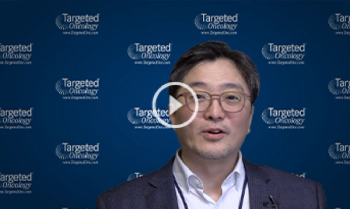
Se-Hoon Lee, MD, an oncologist at the Samsung Medical Center in Seoul, Korea, discusses his focus of research in the lung cancer space, including the phase 1 CHRYSALIS study of amivantamab and lazertinib in patients with EGFR-mutated non–small cell lung cancer.
As determined by phase 1 of the ARROS-1 study, patients with ROS1-positive non–small cell lung cancer and other solid tumors will be further assessed with the recommended phase 2 dose of NVL-520 in phase 2 of the trial.
Alectinib is the first and only ALK inhibitor to demonstrate a reduction in disease recurrence among patients with early-stage ALK-positive non–small cell lung cancer, based on data from the phase 3 ALINA study.
In season 4, episode 13 of Targeted Talks, Benny Weskler, MBA, MD, FACS, FACCP, discusses neoadjuvant therapy for patients with non–small cell lung cancer.
During a Targeted Oncology™ Community Case Forum™ event in partnership with The Arizona Clinical Oncology Society, Sujith R. Kalmadi, MD, reviewed data from the most important recent phase 3 trials of chemoimmunotherapy in advanced non–small cell lung cancer.
Advertisement
Advertisement
Trending on Targeted Oncology - Immunotherapy, Biomarkers, and Cancer Pathways
1
SOT106 Receives New FDA FTD and ODD in Sarcoma
2
Iberdomide Doubles MRD-Negative CR Rate in Phase 3 EXCALIBER-RRMM Trial
3
IMS 2026 Day 4 Recap: MRD-Guided Regimens Highlight Final Sessions
4
Trispecifics: A New Strategy to Prevent Antigen Escape
5