Joe DePinto, MBA, discusses some of the key challenges to equitable access to cell and gene therapies, especially in underserved populations.


Your AI-Trained Oncology Knowledge Connection!
Joe DePinto, MBA, discusses some of the key challenges to equitable access to cell and gene therapies, especially in underserved populations.
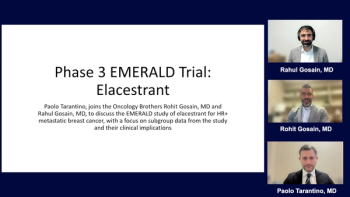
Along with the Oncology Brothers, Paolo Tarantino, MD, provides an overview of the phase 3 EMERALD study that evaluated the efficacy of elacestrant as a second-line treatment for ER+, HER2- MBC, particularly in patients with tumors harboring an ESR1 mutation.
Panelist discusses how the future treatment landscape for EGFR-mutant advanced non–small cell lung cancer is evolving to address current unmet needs and offers clinical pearls to community oncologists for optimizing patient care in this rapidly changing field.

Evan Lipson, MD, discusses feedback he’s received from colleagues about responses in patients with melanoma.

Santhosh K. Sadashiv, MD, discusses the role of chimeric antigen receptor T-cell therapy in patients with multiple myeloma.
Harry Erba, MD, PhD, discusses the specific substudies included in myeloMATCH.

Erika P. Hamilton, MD, discusses antibody-drug conjugates in multiple types of breast cancer, and when to use these drugs in sequence.
Noah S. Kalman, MD, MBA, discusses how oncologists can determine the best course of action for the treatment and management of a patient with thyroid cancer.

Barbara O’Brien, MD, discusses the background behind the phase 2 TBCRC049 study investigating the combination of tucatinib, trastuzumab, and capecitabine for the treatment of patients with HER2-positive breast cancer and leptomeningeal metastasis.
Jaime Merchan, MD, discusses the background and findings from the LITESPARK-013 trial of belzutifan for the treatment of patients with advanced clear cell renal cell carcinoma.

Joshua K. Sabari, MD, describes the mechanism of action of lurbinectedin as a synthetic alkaloid that binds to guanine residues in the minor groove of DNA, forming adducts that disrupt DNA repair mechanisms and promote apoptosis in cancer cells, noting that its action contrasts with traditional alkylating agents by specifically interfering with DNA-protein interactions and transcription processes.
Joshua K. Sabari, MD, evaluates the potential of ifinatamab deruxtecan in combination with atezolizumab, with or without platinum-based chemotherapy, as first-line induction or maintenance therapy in ES-SCLC, emphasizing that statistically significant end points such as improved PFS and OS would be essential for clinical application in this patient population.
Yanghee Woo, MD, discusses the details and lasting impact of the CROSS trial in the treatment of gastroesophageal junction and esophageal cancers.
Hatim Husain, MD, discusses how the implementation of proactive prophylaxis strategies for patients taking amivantamab, including prophylactic antibiotics, good skin hygiene, and insights from the phase 2 COCOON study, can help manage potential adverse effects and improve treatment outcomes.
Yanghee Woo, MD, provides an overview of the CROSS trial which focused on treating patients with gastroesophageal junction cancers.
Ariel Lopez-Chavez, MD, discusses the current approach to managing recurrent small cell lung cancer especially in patients who have progressed after first-line chemotherapy.
Elizabeth A. Brem, MD, discusses the familiarity of treatments among oncologists for patients with diffuse large B-cell lymphoma in a Case-Based Roundtable event.
Arnab Basu, MD, MPH, FACP, explains why sensitivity might be higher in urothelial cancer vs other genitourinary cancers.
Alessandra Ferrajoli, MD, discusses the importance of supportive care in the management of patients with chronic lymphocytic leukemia with comorbidities.
Joshua K. Sabari, MD, discusses the potential treatment synergies expected from combining MK-6070, a trispecific T-cell engager, with ifinatamab deruxtecan, noting that specific patient and disease factors (eg, tumor expression profiles and previous treatment responses) could influence the decision to pursue dual T-cell engager therapy in early clinical development.
Joshua K. Sabari, MD, discusses how the dosing schedule of ifinatamab deruxtecan offers advantages in terms of simplicity and treatment adherence vs topotecan and lurbinectedin, suggesting that it may enhance the overall quality of life for patients undergoing treatment for SCLC.
Binod Dhakal, MD, MS, discusses some of the next steps for evaluating ciltacabtagene autoleucel in multiple myeloma and the CARTITUDE-4 trial.

Samer A. Al'Hadidi, MD, MS, discusses the response and survival of 2 quadruplet therapy trials for patients with transplant-ineligible multiple myeloma.

Craig A. Portell, MD, discusses the current standard of care for patients with relapsed/refractory mantle cell lymphoma and how sequencing therapies changed the landscape of mantle cell lymphoma treatment.
Ticiana Leal, MD, discusses how emerging targeted therapies for extensive-stage small cell lung cancer (ES-SCLC) are showing promising objective clinical outcomes that may surpass those of second-line treatments such as topotecan and CAV regimens, particularly highlighting the need to evaluate specific compounds based on platinum-sensitive vs platinum-resistant disease profiles and the potential role of TIGIT inhibitors in future treatment lines.
Panelist discusses how the second interim overall survival data from MARIPOSA-2, presented at the European Society for Medical Oncology Congress 2024, affect treatment strategies for patients with non–small cell lung cancer that has developed resistance to osimertinib.
Ariel Lopez-Chavez, MD, discusses the efficacy of immunotherapy for the potential treatment of extensive-stage small cell lung cancers.
Targeted Oncology co-hosts Kristie L. Kahl and Andrew Svonavec talk to program co-chair Benjamin P. Levy, MD, to highlight what to expect in the latest oncology developments from the 42nd Annual Chemotherapy Foundation Symposium to be held in New York City.
Christopher R. Flowers, MD, MS, discusses what the current treatment landscape of follicular lymphoma looks like.
Amer Zeidan, MBBS, discusses how ring sideroblasts status affects using luspatercept in patients with myelodysplastic syndromes.