An expert discusses the safety profiles of combination regimens, effective strategies for managing side effects, and how to weigh the potential for toxicity versus efficacy/benefits when discussing treatment options with patients.


Your AI-Trained Oncology Knowledge Connection!
An expert discusses the safety profiles of combination regimens, effective strategies for managing side effects, and how to weigh the potential for toxicity versus efficacy/benefits when discussing treatment options with patients.
An expert discusses a treatment approach for the patient case above, how factors like brain metastases influence first-line treatment choices, reviews high-risk/CNS outcomes data from MARIPOSA and FLAURA2, and shares their impression of icPFS and DoR from MARIPOSA, along with how to determine which patients are best suited for either combination treatment option.
An expert discusses treatment goals for patients with EGFR-mutated advanced/metastatic NSCLC, how to approach combination therapy with high-risk patients, and how recent data has influenced their practice.
An expert discusses recent updates on first-line treatments in EGFR-mutated NSCLC, including the MARIPOSA trial comparing amivantamab + lazertinib vs osimertinib, and the FLAURA2 trial of osimertinib + chemotherapy, and how the data is likely to impact the treatment landscape.
An expert discusses the case of a 55-year-old man with EGFR-mutated advanced/metastatic NSCLC, focusing on treatment considerations and management strategies.

Suresh S. Ramalingam, MD, FACP, FASCO, emphasizes the role of community oncologists in translating new advancements in lung cancer research into widespread patient benefit.

A panelist discusses how four FDA-approved agents treat steroid-refractory cGVHD, including ibrutinib (65% response rate), belumosidil (74% response rate), ruxolitinib (50% vs 25% in phase 3 trial), and axatilimab (74% response rate with durable responses lasting 17.2 months median failure-free survival).
In an interview, Rana McKay, MD, discusses findings from the COMRADE trial evaluating olaparib plus radium-223 in prostate cancer presented at the 2025 ASCO Annual Meeting.
Alicia Morgans, MD, MPH, discusses the phase 3 ARASTEP trial evaluating darolutamide in patients at high risk of biochemical recurrence of prostate cancer.
Vincent Picozzi, MD, discusses findings from the phase 3 trial PANOVA-3 of TTFields with gemcitabine and nab-paclitaxel in locally advanced pancreatic cancer.
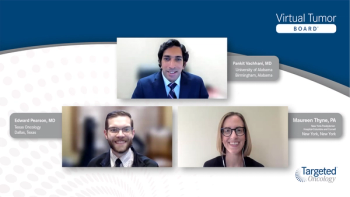
Panelists discuss how new treatments like rusfertide (a hepcidin mimetic) offer promising options for polycythemia vera patients, demonstrating benefits in reducing phlebotomy requirements while addressing the paradoxical iron deficiency caused by current treatments, potentially improving quality of life while allowing patients to maintain their existing cytoreductive therapies, though questions remain about whether it will show the disease-modifying effects seen with ruxolitinib and interferons.
Panelists discuss how interferon therapy for polycythemia vera requires patient education about its unique characteristics, including the need for long-term treatment (with benefits most apparent at 36 months rather than 12 months), potential adverse effects (mild flu-like symptoms, depression, injection site reactions, and autoimmune issues), and evolving dosing strategies that may improve tolerability, while emphasizing that with FDA approval of ropeginterferon, insurance hurdles have decreased and molecular response monitoring may eventually guide treatment optimization.
Linda Duska, MD, FASCO, MPH, discusses the importance of the KEYNOTE-A18 study reinforcing the new standard of care of pembrolizumab plus concurrent chemoradiotherapy in locally advanced cervical cancer.

Meghan Mooradian, MD, discusses findings and implications of the phase 2 NEO-MEL-T study.
J. Randolph (Randy) Hecht, MD, discusses the phase 3 OrigAMI-3 trial for patients with recurrent, unresectable, or metastatic RAS/BRAF wild-type colorectal cancer.

A panelist discusses how advances in chronic graft-vs-host disease (cGVHD) prevention include posttransplant cyclophosphamide showing significant reduction in moderate to severe cGVHD and the promising Precision-T trial using split-dose infusions of regulatory T cells followed by conventional T cells, both demonstrating improved cGVHD-free survival compared with standard prophylaxis.
A panelist discusses how community-based care coordination can be implemented for patients with chronic graft-vs-host disease (cGVHD) on axatilimab, with initial cycles administered at specialized centers followed by local infusions under community oncologist supervision, with periodic assessment visits to evaluate treatment response.
Helena Yu, MD, discusses the importance of zipalertinib's oral administration route for patients with EGFRm non–small cell lung cancer.
Helena Yu, MD, discusses the efficacy of zipalertinib for EGFR-mutant non–small cell lung cancer and the importance of exploring therapies with CNS penetration in this space.
Shlomo Koyfman, MD, discusses the MK-3475-630/KEYNOTE-630 trial, which focused on patients with high-risk cutaneous squamous cell cancer.

Panelists discuss how a multidisciplinary team approach to patient education and medication management is crucial for ensuring adherence and optimal outcomes with oral medications like elacestrant.
Panelists discuss how real-world studies have shown improved outcomes with elacestrant compared with the original EMERALD trial data, demonstrating that proper patient selection leads to better treatment responses.
Panelists discuss balancing clinical trial data with real-world patient factors when choosing between treatment options, emphasizing the importance of quality of life alongside cancer control in the second-line setting.
Panelists discuss how the EMERALD trial demonstrated elacestrant's efficacy in ESR1-mutated tumors, particularly in patients who had received CDK4/6 inhibitors for at least 12 months. This led to its FDA approval for this specific population.
Panelists discuss how to communicate genomic testing results to patients and make shared treatment decisions, particularly when multiple targeted therapy options are available for patients with ESR1 and PIK3CA mutations.
Panelists discuss how to approach second-line therapy decisions for patients with metastatic breast cancer, emphasizing the importance of biomarker testing, including ESR1 mutations, and considering patient-specific factors.
Panelists discuss how testing for specific changes in cancer cells, like ESR1 mutations, can help guide treatment choices for patients with hormone receptor-positive metastatic breast cancer.
Panelists discuss how differentiating primary from secondary erythrocytosis is crucial in guiding treatment strategies, emphasizing the importance of addressing underlying causes such as chronic hypoxia, tumors, or anabolic steroid use while managing hematologic parameters as necessary.
Panelists discuss how belumosudil is particularly effective for patients with lung involvement due to its antifibrotic mechanism.
