
Fengting Yan, MD, PhD, discusses how her clinical practice is informed by data and guidelines available on testing in breast cancer.

Fengting Yan, MD, PhD, discusses how her clinical practice is informed by data and guidelines available on testing in breast cancer.

The Oncology Brothers provide a comprehensive recap of the key highlights presented at the European Lung Cancer Conference (ELCC 2025) along with their expert final thoughts and clinical interpretations.
Panelists discuss how response rates, progression-free survival, and overall survival data presented at the European Lung Cancer Conference (ELCC 2025) demonstrate meaningful clinical outcomes while highlighting important safety considerations for patients.
Panelists discuss how the MARIPOSA study design demonstrates an overall survival benefit while effectively preventing adverse events in patients.
Panelists discuss how the practice-changing LAURA study demonstrates the critical importance of next-generation sequencing in guiding therapeutic decisions for non–small cell lung cancer (NSCLC) patients.
Panelists discuss how KEYNOTE-799 provides updated data on safety, toxicity, positive response rates, and median survival rates for both squamous and nonsquamous non–small cell lung cancer treatments.
Enriqueta Felip, MD, PhD, discusses the design of the phase 3 3475A-D77 trial evaluating subcutaneous pembrolizumab in metastatic NSCLC.
A panelist discusses how identifying steroid-dependent or steroid-refractory (SR) graft-vs-host disease (GVHD) requires careful clinical monitoring, with the determination typically made when patients show disease progression during prednisone taper, inadequate response after 5 to 7 days of treatment, or persistent disease despite 2 weeks of appropriate steroid therapy.

Nicolas Ferreyros discusses the Community Oncology Alliance’s position statements on biomarker testing and physician autonomy.
Experts discuss how long-term data influence current and future approaches to first-line diffuse large B-cell lymphoma (DLBCL) treatment, exploring how these outcomes shape perspectives on DLBCL treatment evolution and highlighting the most compelling aspects of emerging data for advancing clinical practice.
Experts discuss the decision-making factors and real-world challenges that shape treatment selection in diffuse large B-cell lymphoma (DLBCL) patient care. They focus on how efficacy data, safety profiles, and patient factors influence treatment choices, and the implementation challenges encountered when introducing newer regimens into practice.
Experts discuss how disease progression impacts patients with diffuse large B-cell lymphoma (DLBCL) and strategies for managing progressive disease based on first-line therapy selection, incorporating insights from the POLARIX 5-year subsequent treatment data and highlighting quality-of-life considerations that influence treatment decisions.
Jennifer Chan, MD, MPH, discussed outcomes of treating neuroendocrine tumors (NETs) with cabozantinib depending on whether they were pancreatic NETs or extrapancreatic NETs.
Yago Nieto, MD, PhD, discusses AFM13, how it works, and its effect as a bispecific antibody that targets CD30 and CD16.
John L. Marshall, MD, discusses the sequencing of targeted therapy for refractory metastatic colorectal cancer.

David Spigel, MD, discusses the significant benefits of durvalumab as consolidation therapy following standard chemoradiotherapy for patients with limited-stage small cell lung cancer.

Julie Gralow, MD, FACP, FASCO, discusses the strategies and policy changes implemented by ASCO to address the oncology workforce shortage.

Seth Wander, MD, PhD, discusses the extended survival with elacestrant in a real-world, which was longer than the randomized phase 3 trial data.
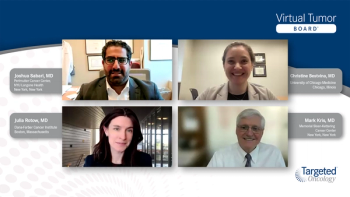
Panelists discuss the management of treatment-associated interstitial lung disease (ILD) and pneumonitis, emphasizing diagnostic strategies, therapeutic options, and patient monitoring.
Panelists discuss strategies for managing adverse events (AEs) related to antibody-drug conjugates (ADCs), focusing on prevention, early detection, and treatment of these effects.
Cedric Pobel, MD, discusses how the results of the PEACE-1 trial support the use of radiotherapy plus standard of care and abiraterone in low-volume metastatic castration-sensitive prostate cancer.

John Seymour, MBBS, FRACP, PhD, explains why BCL-2 was considered an undruggable target for so long and what led to the development of effective BCL-2 inhibitors.
A panelist discusses how steroid therapy remains the cornerstone of acute graft-vs-host disease (GVHD) treatment, with treatment protocols typically starting with prednisone at doses ranging from 1 to 2 mg/kg/day depending on disease severity, though optimal dosing strategies continue to be refined through clinical research.
Hedyeh Ebrahimi, MD, MPH, discusses updated data from a phase 1 study of CBM588, cabozantinib, and nivolumab in metastatic renal cell carcinoma.
Pat Gulhati, MD, PhD, discusses findings from a comprehensive analysis of genetic, immunological, and signaling pathway variations in pancreatic cancer.
Enriqueta Felip, MD, PhD, discusses the phase 3 3475A-D77 study of subcutaneous pembrolizumab plus chemotherapy in metastatic non–small cell lung cancer.

Deborah Wong, MD, PhD, discusses the toripalimab combination that is now considered standard of care in nasopharyngeal cancer.
Hamlet Gasoyan, MD, discusses some of the common challenges that oncologists face when getting patients started on more costly oral treatments for multiple myeloma.
Seth Wander, MD, PhD, discusses the tolerability of selective estrogen receptor degraders and next-generation anti-estrogen agents in breast cancer.
Experts discuss polatuzumab’s effectiveness across germinal center B-cell (GCB) and activated B-cell (ABC) diffuse large B-cell lymphoma (DLBCL) subgroups, including updates to published data. They also explore how different molecular classification methods compare in clinical practice to guide treatment selection, with insights on differential responses across specific molecular or clinical subgroups.