
Daniel P. Petrylak, MD, discusses the impact of the approval of apalutamide in the metastatic castration-sensitive prostate cancer setting.

Daniel P. Petrylak, MD, discusses the impact of the approval of apalutamide in the metastatic castration-sensitive prostate cancer setting.

Elisabetta Abruzzese, MD of S. Eugenio Hospital, discusses the management of pregnancy in patient with chronic myeloid leukemia.

Anthony El-Khoueiry, MD, provides a brief review of sequencing therapy for patients with cholangiocarcinoma in the modern treatment landscape.
Focused discussion on the adverse events that may occur when managing cholangiocarcinoma with targeted therapies.
A comprehensive review of chemotherapy and targeted agents available to treat cholangiocarcinoma throughout various lines of therapy.
Expert insight on the current role of biomarker testing and targeted therapy in cholangiocarcinoma management.
Anthony El-Khoueiry, MD, reviews cholangiocarcinoma subtypes and outlines strategies in identification and diagnosis.
An overview of the LOTIS-1 clinical trial and the rationale for the accelerated approval of loncastuximab for relapsed/refractory diffuse large B-cell lymphoma.
Recommendations for managing patients with diffuse large B-cell lymphoma on tafasitamab.

John C. Byrd, MD, discusses the early results and adverse events observed in the ELEVATE-RR trial in patients with chronic lymphocytic leukemia.

Mark A. Socinski, MD, discusses the patient population of the trials targeting MET exon 14 skipping mutations in non–small cell lung cancer.

Thomas Powles, MD, MBBS, MRCP, discusses the safety profile of enfortumab vedotin in urothelial cancers as observed in the phase 3 urothelial cancerstrial.
Next steps investigating novel-based therapies for newly diagnosed metastatic renal cell carcinoma.

Advice to oncology nurses who manage patients with metastatic renal cell carcinoma receiving novel-based therapies, including lenvatinib and pembrolizumab.
An overview of data demonstrated by other investigational studies of lenvatinib plus pembrolizumab as frontline therapy for metastatic renal cell carcinoma.
Implications for treating patients with metastatic renal cell carcinoma with frontline lenvatinib plus pembrolizumab, based on the regimen’s performance in the CLEAR study compared with other options.
Reactions to efficacy and safety data demonstrated by the CLEAR study of lenvatinib plus pembrolizumab as first-line treatment for metastatic renal cell carcinoma.
The rationale for investigating the combinations of lenvatinib plus pembrolizumab and lenvatinib plus everolimus as frontline therapy for metastatic renal cell carcinoma.
An overview of current novel-based approaches for metastatic renal cell carcinoma and current treatment gaps.

Dana Chase, MD, discusses frontline therapy options for patients with advanced ovarian cancer.
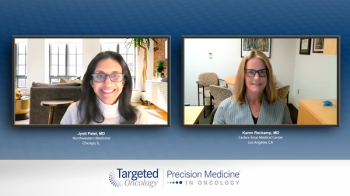
Karen Reckamp, MD, and Jyoti Patel, MD, review currently available frontline treatment options for ALK+ advanced NSCLC and discuss updated efficacy and safety data from key clinical trials of these agents in advanced NSCLC.
Jyoti Patel, MD, elucidates the mechanism of action of various ALK targeting agents in NSCLC and the optimal formulations and dosing strategies in patients with advanced NSCLC.
Treatment advice for community oncologists and hematologists who treat follicular lymphoma based on therapeutic advances occurring rapidly in the field.
Treatment options and variables that need to be considered when managing patients with follicular lymphoma who relapse early after first-line chemoimmunotherapy.
Factors that affect the use of maintenance therapy, including anti-CD20 maintenance therapy, for newly diagnosed follicular lymphoma, and recommendations for assessing response to therapy.
The rationale for treating newly diagnosed follicular lymphoma with the anti-CD20 monoclonal antibody, obinutuzumab, in the first-line setting.
Goals of therapy and variables that affect how patients with newly diagnosed follicular lymphoma are managed with chemoimmunotherapy in the frontline setting, including during COVID-19.
Recommendations for assessing and risk stratifying patients with newly diagnosed follicular lymphoma, with special considerations regarding the current role of molecular testing.
Similarities between the management of a hypothetical case of newly diagnosed follicular lymphoma compared with what is done in real-world practice.

Marshall Posner, MD, discusses a study exploring the use of HB-201 and HB-202 vaccines in patients with HPV16-positive cancers.