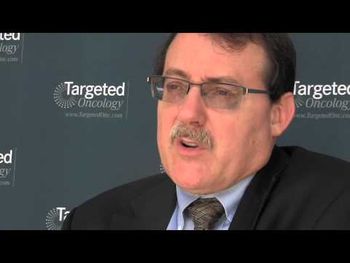
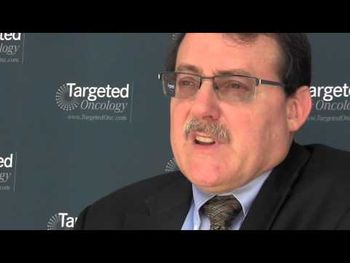
Martin Reck, MD, PhD, Head of Thoracic Oncology, Hospital Grosshansdorf, discusses the phase III SQUIRE trial in patients with non-small cell lung cancer (NSCLC) treated with necitumumab.

Martin Reck, MD, PhD, Head of Thoracic Oncology, Hospital Grosshansdorf, discusses the phase III SQUIRE trial in patients with non-small cell lung cancer (NSCLC) treated with necitumumab.

Kyle A. Richards, MD, assistant professor, University of Wisconsin, discusses bladder cancer outcomes in men vs. women.
Ryan Werntz, MD, urologist, Oregon Health and Science University, discusses the significance of prostate-specific antigen (PSA) screening by primary care physicians.

Alexander Kutikov, MD, FACS, attending surgeon, Urologic Oncology, associate professor, Urologic Oncology, Fox Chase Cancer Center, discusses neoadjuvant chemotherapy for the treatment of patients with bladder cancer.
Dirk Arnold, MD, director of the Department of Medical Oncology at Klinik für Tumorbiologie, Freiburg, Germany, discusses the advantages of using yttrium-90 (Y-90) as the first line treatment for patients with liver metastases from metastatic colorectal cancer (mCRC).
S. Yousuf Zafar, MD, Associate Professor of Medicine at Duke Cancer Institute, discusses the association of obesity with metastatic colorectal cancer.
Anna C. Pavlick, DO, co-director, Melanoma Program, assistant director, Clinical Research Education, associate professor, Departments of Medicine and Dermatology, Langone Medical Center, New York University, discusses the study of vemurafenib combined with a MEK inhibitor.
James J. Lee, MD, PhD, assistant professor of medicine, Division of Hematology-Oncology, Department of Medicine, University of Pittsburgh, discusses the importance of mismatched repair testing in colorectal cancer (CRC).
Hope S. Rugo, MD, clinical professor, Department of Medicine (Hematology/Oncology), director, Breast Oncology Clinical Trials Program, Helen Diller Family Comprehensive Cancer Center, University of California, San Francisco, discusses patient selection for premenopausal endocrine therapy.

Debra Patt, MD, MPH, MBA, medical oncologist, director of Public Policy, Texas Oncology, director of Health Care Informatics, McKesson Specialty Health and The US Oncology Network, discusses the challenges that medical oncologists will face due to health care reform.

Stephen Rosenberg, MD, Department of Human Oncology, University of Wisconsin School of Medicine and Public Health, discusses the possibility of writing information in a way that patients can understand.

Barbara A. Burtness, MD, professor of medicine, clinical research program leader, Head and Neck Cancers Program, co-director, Developmental Therapeutics Research Program, Yale Cancer Center, discusses the treatment of patients with HPV associated locally advanced oropharynx cancer.

Adam M. Brufsky, MD, PhD, ​professor of medicine, University of Pittsburgh School of Medicine, associate director of clinical investigation, University of Pittsburgh Cancer Institute, discusses the adverse effects, as well as future treatments, of anastrozole in patients with ductal carcinoma In situ (DCIS).
Mark A. Socinski, MD, professor, Medicine and Cardiothoracic Surgery, director, Lung Cancer Section, Division of Hematology/Oncology, clinical associate director, Lung SPORE, co-director, UPMC Lung Cancer Center of Excellence, co-leader, UPCI Lung Cancer Program, University of Pittsburgh, discusses the adverse events, as well as the overall significance, of nivolumab in patients with advanced non-squamous non-small cell lung cancer (NSCLC).

Ruben A. Mesa, MD, chair, Hematology, deputy director, Mayo Clinic, discusses pacritinib vs ruxolitinib.
Frank A. Sinicrope, MD, medical oncologist, Departments of Gastroenterology and Hepatology and Oncology, Cancer Center, Mayo Clinic discusses a study on two adjuvant trials in patients with stage III colon cancer.
Howard A. “Skip†Burris, III, MD, president, Clinical Operations, chief medical officer and executive director, Drug Development Program, Sarah Cannon, discusses the novel agents in breast cancer and monoclonal antibodies.

Howard M. Sandler, MD, MS, FASTRO, Chair, Radiation Oncology, Ronald H. Bloom Family Chair, Cancer Therapeutics, Cedars Sinai, discusses the significance of a phase III study on docetaxel with hormonal and radiation therapy in prostate cancer.

Trisha Wise-Draper, MD, PhD, assistant professor, University of Cincinnati, discusses the quality of life (QOL) as a predictor of clinical outcome in patients with head and neck cancer (HNC).

Alexander Zukiwski, MD, CEO, Arno Therapeutics, Inc., discusses the efficacy of onapristone (ONA) in progesterone receptor (PR)-expressing tumors.

Yung-Jue Bang, MD, PhD, professor of medical oncology, College of Medicine, Seoul National University, president, Biomedical Research Institute, Seoul National University Hospital, discusses the clinical results for the treatment of pembrolizumab in patients with advanced gastric cancer.
Michael Manns, MD, chairman for the Department of Gastroenterology, Hepatology, and Endocrinology, Center of Internal Medicine, Hanover Medical School, Hanover, Germany, Vice President, United European Gastroenterology (UEG), discusses testing and treatment for Hepatitis C in patients with, as well as without, Hepatocellular carcinoma (HCC) liver cancer.