
At ASCO 2025, Suneel Kamath, MD, presented an analysis of federal cancer research funding disparities and their ripple effects on care delivery and outcomes.

At ASCO 2025, Suneel Kamath, MD, presented an analysis of federal cancer research funding disparities and their ripple effects on care delivery and outcomes.
Erin Cobain, MD, discusses findings from a study exploring the differences in diagnosis and treatment of high-risk breast cancer in Black and White patients.
Naomi Haas, MD, discusses the 5-year follow-up of the KEYNOTE-564 study being presented at the 2025 ASCO Annual Meeting.
Sara M. Tolaney, MD, MPH, shares new data from the ASCENT-04 trial of sacituzumab govitecan and pembrolizumab in triple-negative breast cancer.
Ibrahim Aldoss, MD, discusses a post hoc analysis of ponatinib in patients with Philadelphia chromosome-positive acute lymphoblastic leukemia who did not achieve early MRD negativity.

Christopher Danes, PhD, discusses how patient and caregiver priorities and concerns vary during the course of treatment for non–small cell lung cancer.
Sara M. Tolaney, MD, MPH, highlights a transformative year for breast cancer research at this year’s ASCO Annual Meeting.
Christopher Danes, PhD, discusses a study exploring the differences in priorities for patients and their caregivers when undergoing treatment for non–small cell lung cancer.
Terence M. Williams, MD, PhD, discusses what inspired the new phase 1 DINOMITE trial at City of Hope.

Toon Van Gorp, MD, PhD, discusses the rationale behind and the findings from the phase 3 MIRASOL trial of mirvetuximab soravtansine in patients with folate receptor α–positive, platinum-resistant ovarian cancer.

Ayal Aizer, MD, MHS, discusses the unmet needs in treating patients with brain metastases.

Alexander Kenigsberg, MD, discusses a new option for treating prostate cancer: robotic high-intensity focused ultrasound.
Nini Wu, MD, MBA, highlights key tactics that community oncology practices can implement now to better support their clinicians and staff.
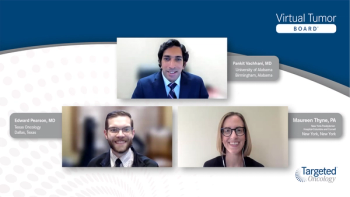
Panelists discuss how the MAJIC-PV trial provides critical evidence that ruxolitinib offers more than symptomatic relief in polycythemia vera, demonstrating approximately 40% reduction in thromboembolic events and improved event-free survival while correlating these clinical benefits with molecular responses through JAK2 V617F allele burden reduction, suggesting ruxolitinib may be truly disease-modifying rather than merely a bandage treatment when comprehensive control of all 3 blood cell lineages (red cells, white cells, and platelets) is achieved.
A panelist discusses how treatment sequencing for neuroendocrine tumors (NETs) is less important than ensuring patients receive all available treatments, highlighting cabozantinib as a reasonable second- or third-line option with manageable adverse effects like hypertension and liver function abnormalities.
A panelist discusses how NCCN guidelines now include cabozantinib as a category 1 recommendation for gastrointestinal (GI) neuroendocrine tumors (NETs) after prior treatment with everolimus or lutetium-177 dotatate, with slightly different recommendations for pancreatic, lung, and thymic NETs.
Panelists discuss how ruxolitinib provides comprehensive benefits for polycythemia vera patients beyond count control, highlighting its remarkable ability to rapidly alleviate severe pruritus (often within 48 hours) and other constitutional symptoms that remain resistant to conventional therapies like hydroxyurea and interferon while also effectively managing cytokine-driven and spleen-related symptoms that significantly impact quality of life.

A panelist discusses how chronic graft-versus-host disease affects 30-70% of allogeneic transplant patients across eight cardinal organs (most commonly skin), presents with varying symptoms from rashes and joint stiffness to dry eyes and lung complications, and requires graded treatment approaches ranging from topical therapies for mild cases to systemic corticosteroids for moderate-to-severe disease, though 50% of patients ultimately need alternative treatments due to steroid dependency or resistance.
Nini Wu, MD, MBA, discusses long-term investments aimed at stabilizing and strengthening the future of community oncology

A panelist discusses how axatilimab is particularly effective for patients with bronchiolitis obliterans syndrome, showing response rates of almost 50% with 20% complete responses, and offers the advantage of reliable intravenous delivery despite logistical challenges of infusion center visits.
A panelist discusses how axatilimab demonstrated efficacy in a heavily pretreated patient population with predominantly severe chronic graft-vs-host disease (cGVHD) in the AGAVE-201 trial, with manageable adverse effects including infusion reactions and enzyme elevations that rarely required discontinuation of treatment.
Dong Chen, MD, PhD, discusses how AI has changed the landscape for genomic testing and patient management.
Prof Martin Dreyling discusses the unmet needs in MCL and the potential next lines of research on the BTK inhibitor acalabrutinib.

Panelists discuss how most clinicians prefer ruxolitinib over ibrutinib as second-line therapy due to better tolerability
Panelists discuss how hepcidin mimetics like rusfertide offer a novel approach to managing polycythemia vera (PV) by regulating iron metabolism, reducing iron overload, and improving hematocrit control, particularly in patients with iron deficiency or refractory disease, while also potentially enhancing disease management and quality of life when used alone or in combination with standard therapies like hydroxyurea or ruxolitinib.
Panelists discuss how clinical trial data has shaped second-line therapy in polycythemia vera (PV), highlighting ruxolitinib and interferon as key options for patients resistant or intolerant to hydroxyurea due to their efficacy in symptom control, quality of life improvement, and disease-modifying benefits, especially for those with splenomegaly or inadequate response to first-line treatments.
Panelists discuss how FDA-approved therapies such as ibrutinib, ruxolitinib, belumosudil, and axatilimab provide treatment options for steroid-refractory chronic graft-vs-host disease (cGVHD).
Manmeet Ahluwalia, MD, MBA, FASCO, shares a message during Brain Cancer Awareness Month.

Anuradha Krishnamurthy, MBBS, discusses the exciting frontier of tumor-infiltrating lymphocyte therapy in melanoma and other disease states.
Prof Martin Dreyling discusses the safety profile of the BTK inhibitor acalabrutinib in patients with mantle cell lymphoma.