
Seven-year follow-up data on over 1400 patients show radium-223's long-term safety, with a low 2% secondary malignancy rate, reflecting real-world use.

Seven-year follow-up data on over 1400 patients show radium-223's long-term safety, with a low 2% secondary malignancy rate, reflecting real-world use.

Jill Feldman discusses the background of the phase 2 COCOON trial in advanced non–small cell lung cancer with EGFR mutations.
Panelists discuss how JAK inhibitor therapy can benefit patients with intermediate-1–risk myelofibrosis despite being studied primarily in higher-risk patients in the COMFORT and JUMP trials.
Panelists discuss how risk stratification, symptom burden, and splenomegaly guide treatment decisions for a 68-year-old woman with intermediate-risk myelofibrosis who isn’t interested in transplant.

A panelist discusses how to sequence the four approved cGVHD agents based on patient-specific factors, recommending axatilimab or belumosidil for lung involvement, any of the three oral agents for skin/joint disease, and ibrutinib for lymphoma patients, while considering individual toxicity profiles and disease manifestations.
Marwan G. Fakih, MD, discusses topics in metastatic colorectal cancer from the Case-Based Roundtable meeting he moderated.

Brian P. Mulherin, MD, shares his key takeaways from the 2025 ASCO Annual Meeting, highlighting significant advancements in SCLC and the challenge of information overload at large conferences.
Sara Char, MD, discusses how inflammatory diets impact colon cancer survival rates.

Zeynep Eroglu, MD, discusses the use of a triplet regimen vs standard doublet therapy for the treatment of brain metastases in patients with melanoma.
Discover the groundbreaking AMPLITUDE trial results, showcasing niraparib's effectiveness in treating metastatic prostate cancer with minimal safety concerns.
Yelena Y. Janjigian, MD, discusses how findings from the MATTERHORN trial presented at ASCO 2025 build upon previous research.

Jamie Jacobs, PhD, discusses a study assessing the BMT-CARE App, a self-guided digital intervention for caregivers of patients undergoing stem cell transplant.
A recent trial reveals that durvalumab enhances event-free survival in patients with resectable gastric and gastroesophageal junction adenocarcinoma.

Stephen V. Liu, MD, discusses the phase 3 IMforte study of lurbinectedin and atezolizumab in extended-stage small cell lung cancer.

An expert discusses how combining androgen receptor pathway inhibitors (ARPIs) with PARP inhibitors, particularly enzalutamide with talazoparib, has significantly improved outcomes in metastatic castration-resistant prostate cancer (mCRPC)—especially for patients with homologous recombination repair (HRR) mutations—underscoring the importance of early genomic testing and personalized combination therapy.
An expert discusses how treatment decisions in metastatic castration-resistant prostate cancer (mCRPC) increasingly depend on prior androgen receptor pathway inhibitor (ARPI) exposure, highlighting the need for individualized therapy sequencing based on evolving practice patterns and patient history.
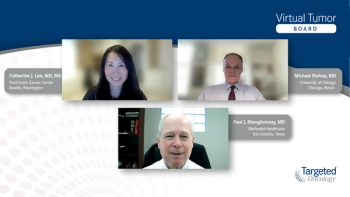
Panelists discuss how future directions in chronic graft-vs-host disease (cGVHD) management may include preemptive use of targeted therapies, first-line treatment with newer agents, and cell-based approaches.
Panelists discuss how axatilimab demonstrates particularly good responses for gastrointestinal graft-vs-host disease (GVHD) and may improve sclerotic skin changes despite lower rates of overall skin response.
Panelists discuss how axatilimab showed promising response rates in the AGAVE-201 trial, even in patients with graft-vs-host disease (cGVHD) who had failed other approved therapies.

Massimo Cristofanilli, MD, discusses the role of cell-free DNA in breast cancer.


Theresa Medina, MD, discusses treatment with lifileucel in patients with advanced melanoma and the background of the C-144-01 study.
Manojkumar Bupathi, MD, MS, discussed his takeaways on physician decision-making for frontline metastatic renal cell carcinoma (RCC) treatment from a Case-Based Roundtable event.
An expert shares clinical pearls with the community, offering insights and tips for managing patients effectively.
An expert discusses the safety profiles of combination regimens, effective strategies for managing side effects, and how to weigh the potential for toxicity versus efficacy/benefits when discussing treatment options with patients.
An expert discusses a treatment approach for the patient case above, how factors like brain metastases influence first-line treatment choices, reviews high-risk/CNS outcomes data from MARIPOSA and FLAURA2, and shares their impression of icPFS and DoR from MARIPOSA, along with how to determine which patients are best suited for either combination treatment option.
An expert discusses treatment goals for patients with EGFR-mutated advanced/metastatic NSCLC, how to approach combination therapy with high-risk patients, and how recent data has influenced their practice.