
Opinion|Videos|November 4, 2024
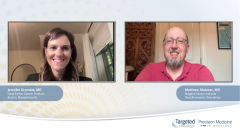
Academic Perspectives for Evaluating, Identifying, and Managing CRS
Panelists discuss the recommendations for evaluating, identifying, and managing cytokine release syndrome (CRS), covering the pretreatment phase, patient education, treatment location, premedications, CRS management, dose modifications, and the community oncology perspective.
Advertisement
Video content above is prompted by the following:
- What are the recommendations for evaluating, identifying, and managing cytokine release syndrome (CRS)?
- Pretreatment phase
- Patient education and monitoring
- Treatment location
- Premedications
- Management of CRS
- Dose modifications and retreatment
- Community oncology perspective
Newsletter
Stay up to date on practice-changing data in community practice.
SubscribeAdvertisement
Related to this article
During a live event, Seth M. Pollack, MD, and participants discussed 2 investigational agents for recurrent diffuse tenosynovial giant cell tumor and how dosing format, treatment duration, and reimbursement could shape the choice among targeted therapies.
A phase 2 trial is planned for an allogeneic CAR T-cell product in patients with lung or breast cancer with brain metastases.
RYZ101, a targeted alpha radiopharmaceutical, boosts progression-free survival in SSTR+ GEP-NETs after progression, offering a promising post-¹⁷⁷Lu option.
Natera’s blood test analyzes cell-free DNA to screen for several cancer types from a single sample.
A Japanese study found favorable sensitivity and specificity for recurrence of melanoma based on presence of melanoma-specific markers in circulating tumor DNA.

Theodore Wagener, PhD, of The Ohio State University discusses the design of the phase 2 DREAM LUNG study of psilocybin-assisted therapy for depression in non–small cell lung cancer.

"AI will not replace oncologists; it will help interpret complex data and design more precise, adaptive, personalized cancer treatment," the authors write.
The phase 2 NRG-BR002 failed to improve outcomes with targeted radiotherapy to oligometastases; the phase 3 portion will not proceed.
Advertisement
Advertisement
Trending on Targeted Oncology - Immunotherapy, Biomarkers, and Cancer Pathways
1
FDA Grants Breakthrough Status to Multi-Cancer Early Detection Blood Test
2
Epigenomic ctDNA Assay Predicts Recurrence in Resected Melanoma
3
FDA Clears Phase 2 Trial of B7-H3 CAR T MT027 for Brain Metastases
4
Alpha-Emitting RYZ101 Meets Phase 3 PFS End Point in Advanced GEP-NETs
5