
Opinion|Videos|May 28, 2026
Subcutaneous Amivantamab and Q4W Dosing for First-Line EGFR-Mutant NSCLC
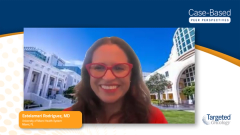
Author(s)Estelamari Rodriguez, MD, MPH
Dr. Rodriguez turns to treatment burden, a central concern for Mr. Smith, who cannot drive because of seizure precautions, lives 45 minutes from clinic, and has a wife who works part-time. She describes the subcutaneous (SC) formulation of amivantamab and how it changes the administration schedule: dosing is approximately 5 minutes versus up to 4 to 5 hours for intravenous (IV) chemotherapy, and the maintenance interval moves from every 2 weeks to every 4 weeks (Q4W). Patients still come weekly during cycle 1, with maintenance visits less frequent thereafter.
Advertisement
Episodes in this series
Dr. Rodriguez turns to treatment burden, a central concern for Mr. Smith, who cannot drive because of seizure precautions, lives 45 minutes from clinic, and has a wife who works part-time. She describes the subcutaneous (SC) formulation of amivantamab and how it changes the administration schedule: dosing is approximately 5 minutes versus up to 4 to 5 hours for intravenous (IV) chemotherapy, and the maintenance interval moves from every 2 weeks to every 4 weeks (Q4W). Patients still come weekly during cycle 1, with maintenance visits less frequent thereafter.
By contrast, osimertinib plus chemotherapy under FLAURA2 requires infusion-center visits every 3 weeks, with approximately 4 hours in the chair for the first 4 cycles and continued pemetrexed maintenance every 3 weeks thereafter as long as the patient can tolerate it. For Mr. Smith’s logistics, this is a heavier long-term schedule than SC amivantamab plus lazertinib.
PALOMA-3 demonstrated noninferior pharmacokinetics for SC versus IV amivantamab, including comparable activity in the brain, and an approximately 80% reduction in administration-related reactions (13% with SC versus 66% with IV). Dr. Rodriguez notes that her cancer center has fully transitioned to the SC formulation and that this is currently the only subcutaneous combination regimen available for first-line treatment in EGFR-positive metastatic NSCLC. For Mr. Smith specifically, fewer clinic visits, shorter time on-site, and the side-effect profile she has described aligned with the priorities he and his wife stated.
In the next episode, “Evolving Treatment Landscape and Future Directions n First-Line EGFR-Mutant NSCLC,” Dr. Rodriguez closes the case by considering how the first-line decision shapes later-line options and what is on the horizon.
Advertisement
Related to this article

J. Thaddeus Beck, MD, discusses how the shift from intravenous to subcutaneous formulations is changing oncology practice, from clinic logistics to patient preferences.

Experts debate second-line tivozanib for advanced renal cell carcinoma, weighing PFS gains, tolerability, and whether continuing immunotherapy adds real benefit.
The designation expands the investigational immunotherapy’s development across tumor types for patients whose disease progresses after prior treatment, including immune checkpoint inhibition.

Phase 2b data show iopofosine I-131 drives deep, durable responses in relapsed Waldenström macroglobulinemia after BTK inhibitors, with manageable cytopenias.

The RELIGHT study found that adding retlirafusp alfa to chemotherapy extended overall and progression-free survival in previously untreated gastric and GEJ cancers.

Gary Simmons, DO, MSHA, discusses outpatient CAR T-cell therapy in the community, the operational and payer bottlenecks his practice has faced, and advice for colleagues.

During a virtual event, Neil M. Iyengar, MD, and participants discussed how approvals for trastuzumab deruxtecan before and after surgery complicate sequencing for patients with HER2-positive early breast cancer.
The oral KRAS G12D inhibitor VS-7375 elicited clinical responses across patients with KRAS G12D–mutant pancreatic, lung, and colorectal cancer.
Advertisement
Advertisement