



Bladder Cancer
Latest News
Advertisement
Latest Videos
















































Advertisement
More News

In an interview with Targeted Oncology, Scott T. Tagawa, MD, discussed the findings from the TROPHY-U-O1 trial presented at the 2019 ESMO Congress and shared his thoughts on the next steps for sacituzumab govitecan.
Christopher J. Hoimes, DO, discusses an unmet medical need in the population of patients with urothelial carcinoma.


Non-Hodgkin Lymphoma
In an interview with <em>Targeted Oncology</em>, Arlene Siefker-Radtke, MD, examined the treatment landscape for bladder cancer and how factors like BCG shortages and prognoses in the elderly population are causing a shift toward novel immunotherapy agents.
Several novel therapeutics have gained approval from the European Medicines Agency for the treatment of patients with bladder cancer in recent years, prompting the European Society for Medical Oncology to issue an eUpdate to these guidelines in August of 2019.
Atezolizumab as monotherapy or in combination with platinum-based chemotherapy may improve progression-free survival in patients with locally advanced or metastatic urothelial carcinoma, based on the <a href="https://www.targetedonc.com/conference/esmo-2019/firstline-atezolizumabchemotherapy-improves-outcomes-in-metastatic-urothelial-cancer">results from the phase III IMvigor130 trial</a>.

The FDA has approved a supplemental New Drug Application for a single dose of aprepitant injectable emulsion for intravenous use in patients receiving moderately emetogenic chemotherapy. The approval expands the dose for aprepitant to include a 130 mg single-dose regimen for the prevention of acute and delayed chemotherapy-induced nausea and vomiting.<br />

Enrique Grande, MD, discusses the characteristics of metastatic urothelial cancer, which rationalizes the use of atezolizumab in combination with platinum-based chemotherapy in the IMvigor130 trial, in patients with locally advanced or metastatic urothelial carcinoma.<br />
Marcelo C. Pasquini, MD, discusses the rationale for analyzing real-world data for the use of tisagenlecleucel, a chimeric antigen receptor T-cell therapy, as a treatment for patients with acute lymphoblastic leukemia and diffuse large B-cell lymphoma. This CD19 CAR T cell was approved 2 years ago for use in both ALL and DLBCL.
The addition of direct oral oral anticoagulants for the management of venous thromboembolism in patients with cancer is the latest change to previous guidelines issued by the American Society of Clinical Oncology.

Using a measure known as the growth modulation index, patients with TRK fusion–positive cancers who were treated with larotrectinib had a clinically meaningful improvement in progression-free survival compared with the time to progression on their prior treatment, an analysis of patients enrolled in 1 of 3 clinical trials has found.
In an interview with <em>Targeted Oncology</em>, Nicholas J. Vogelzang, MD, FACP, FASCO, explained the need for updates to clinical trial criteria to make checkpoint inhibition more widely available to patients with metastatic bladder cancer.
In patients with locally advanced or metastatic urothelial carcinoma, atezolizumab and chemotherapy improved median progression-free survival by 1.9 months compared with placebo and chemotherapy. However, no overall survival benefit was seen, according to results of the phase III IMvigor130 trial presented at the 2019 ESMO Congress.
Three clinical trials presented at the 2019 ESMO Congress show that the tropomyosin receptor kinase inhibitor larotrectinib continues to show anti-tumor activity, including long-lasting objective responses and low toxicity, according to results from an integrated analysis.
The investigational agent UGN-101 induced a complete response in 59% of patients with low-grade upper tract urothelial cancer in the phase III OLYMPUS trial, according to findings from a final analysis of the pivotal trial.
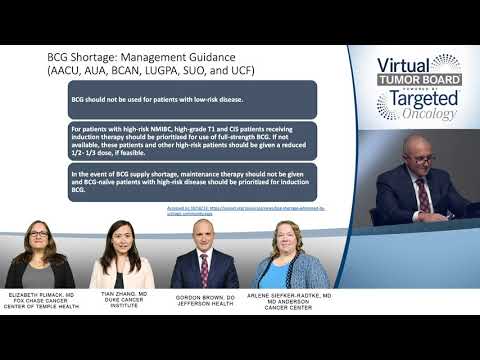
Even as supplies of bacillus Calmette-Guérin, a standard of care for many patients with non–muscle invasive bladder cancer, continue to dwindle, oncologists have undertaken some desperate measures to continue the care they have been providing to their patients.

Now in it 24th year, the annual International Congress on Hematologic Malignancies: Focus on Leukemias, Lymphomas, and Myeloma, hosted by Physicians’ Education Resource, LLC, continues to bring significant advances in hematology to the forefront.
Robert Dreicer, MD, discusses the role of biomarkers to predict response to immunotherapy in patients with urothelial carcinoma. He highlights the current status of using PD-L1 expression as a predictive biomarker to immunotherapy.
In an interview with <em>Targeted Oncology</em>, Jonathan Rosenberg, MD, discussed the ongoing study of durvalumab plus olaparib in patients with metastatic urothelial cancer and other studies that have lain the groundwork for this combination.
Advertisement
Advertisement
Trending on Targeted Oncology - Immunotherapy, Biomarkers, and Cancer Pathways
1
Plinabulin Receives FDA Fast Track Designation in Post-ICI NSCLC
2
Denosumab Biosimilar Approved For Existing Oncology Indications
3
FDA Oncology Recap: Approvals, Designations, and Decisions in September 2026
4
Tile-Based Radiation Improves Local Control in Resected Brain Metastases
5