

Bladder Cancer
Latest News
Advertisement
Latest Videos















































Advertisement
More News

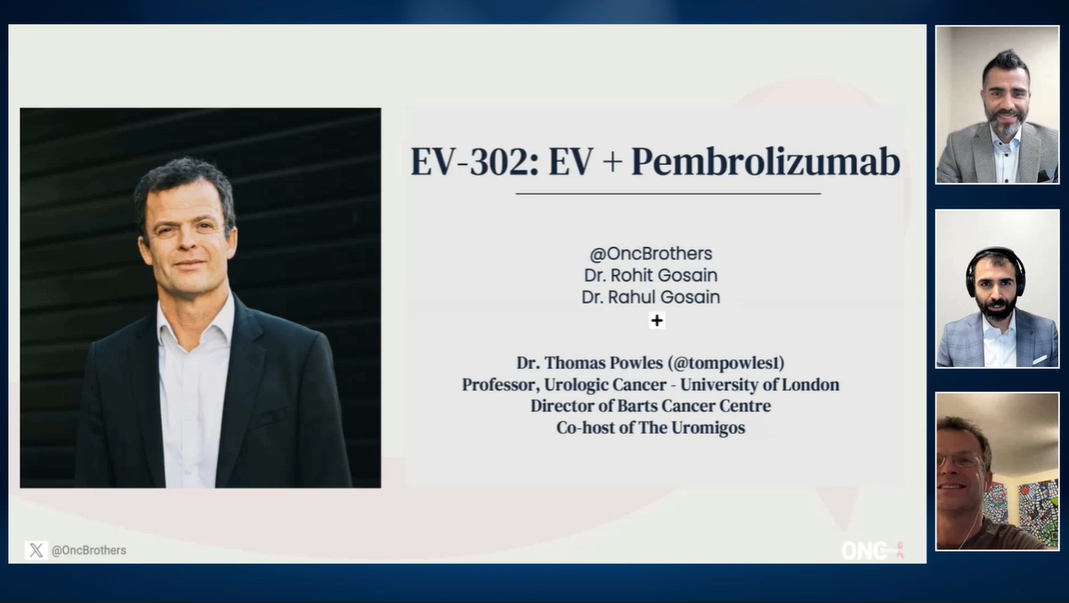
Thomas Powles, MBBS, MRCP, MD, joins the Oncology Brothers to discuss the study design and results of the EV-302 trial investigating enfortumab vedotin plus pembrolizumab in untreated advanced urothelial carcinoma.

Arlene O. Siefker-Radtke, MD, dives into the background and the cohorts included in the phase 3 THOR study.

Stephen Williams, MD, MBA, MS, FACS, FACHE, discusses new and exciting developments in the bladder cancer treatment landscape.
At a live virtual event, Arlene O. Siefker-Radtke, MD, looked at the newer treatment strategies available for patients with advanced bladder cancer including sacituzumab govitecan.

Nivolumab given with cisplatin-based chemotherapy has received approval from the FDA for patients with treatment-naive unresectable or mUC.
Enfortumab vedotin with pembrolizumab significantly improved survival outcomes compared with chemotherapy in patients with previously untreated advanced urothelial cancer.
Alex Chehrazi-Raffle, MD, discussed a real-world analysis of clinical characteristics of patients with bladder cancer receiving adjuvant nivolumab or chemotherapy.

Michiel S. Van der Heijden, MD, PhD, discusses the methods, design, and findings of the phase 3 CheckMate 901 trial of concurrent frontline nivolumab and chemotherapy followed by nivolumab maintenance therapy in urothelial carcinoma.
Available data on patient-reported outcomes and positive interim results from QUILT 3.032 support N-803 for patients with Bacillus Calmette-Guérin-unresponsive non-muscle-invasive bladder cancer.
In an interview with Targeted Oncology, Stephen Williams, MD, discussed a retrospective cohort study presented at ASCO GU analyzing intravesical gemcitabine usage vs Bacillus Calmette-Guérin for the treatment of high-risk non-muscle invasive bladder cancer.
Michiel S. Van der Heijden, MD, PhD, discusses background of the phase 3 CheckMate 901 study which evaluated concurrent frontline nivolumab and gemcitabine/cisplatin followed by nivolumab maintenance therapy among patients with urothelial carcinoma.
In an interview with Targeted Oncology, Thomas Powles, MD, MBBS, MRCP, discussed the impressive performance of enfortumab vedotin plus pembrolizumab for the treatment of locally advanced or metastatic urothelial carcinoma, as seen in the EV-302 trial.
Research across kidney, bladder, and prostate cancers was showcased January 25-27 in San Francisco, California.
The phase 3 AMBASSADOR Alliance A031501 trial of adjuvant pembrolizumab in muscle-invasive and locally advanced urothelial carcinoma successfully achieved its primary end point. However, the interim analysis did not meet the overall survival end point.
The phase 3 EV-302/KEYNOTE-A39 trial, which includes prespecified subgroup analyses, revealed favorable outcomes compared with chemotherapy. The findings pertain to patients with previously untreated locally advanced or metastatic urothelial carcinoma.
Pembrolizumab and cabozantinib showed promising results as first-line treatment for advanced urothelial carcinoma, including those who were ineligible for cisplatin.
In patients with non-muscle-invasive bladder cancer unresponsive to BCG who underwent nadofaragene firadenovec (Adstiladrin) treatment, those who achieved urinary minimal residual disease (uMRD)-negative status showed no recurrences.

Joseph M. Jacob, MD, discusses the key takeaways from the SunRISe-1 study and data presented at the 2024 Genitourinary Cancers Symposium.

The FDA has approved erdafitinib for the treatment of locally advanced or metastatic urothelial carcinoma with FGFR3 alterations.
Three-year data showed durable clinical activity with nadofaragene firadenovec-vncg in patients with high-risk, BCG-unresponsive non–muscle-invasive bladder cancer with carcinoma in situ with or without papillary tumors.
The gene therapy, nadofaragene firadenovec-vncg, is now fully available across the United States for patients with this aggressive bladder cancer.
In the phase 3 BOND-003 trial, cretostimogene grenadenorepvec led to complete responses in over three-fourths of patients with high-risk BCG-unresponsive non–muscle-invasive bladder cancer.
According to John M. Burke, MD, it is hard to imagine that results presented at ESMO in the urothelial cancer space will not lead to the complete replacement of conventional chemotherapy as the standard first-line treatment.

BCG-unresponsive NMIBC requires vigilant surveillance during new treatments to avoid missing signs of progression and avoid delaying cystectomy, which remains the best chance for cure if intravesical therapies are failing.

Guru P. Sonpavde, MD, provides insights on the phase 3 CheckMate 901 trial and explains what a community oncologist should know about the use of concurrent frontline nivolumab plus chemotherapy in metastatic or unresectable urothelial carcinoma based on this study.
Advertisement
Advertisement
Trending on Targeted Oncology - Immunotherapy, Biomarkers, and Cancer Pathways
1
FDA Oncology Recap: Approvals, Designations, and Decisions in September 2026
2
Plinabulin Receives FDA Fast Track Designation in Post-ICI NSCLC
3
Denosumab Biosimilar Approved For Existing Oncology Indications
4
CEPHEUS and Frontline Treatment in Newly Diagnosed Multiple Myeloma
5