





Colorectal Cancer
Latest News
Advertisement
Latest Videos














































Advertisement
More News

Novel immunomodulatory agent pixatimod combined with nivolumab, a PD-1 inhibitor, may benefit patients with advanced bowel cancers, including a small subset of those with colorectal cancer considered to be microsatellite stable.
Real-world dosing data for regorafenib in patients with metastatic colorectal cancer was presented at the 2018 ESMO Congress from the prospective, observational CORRELATE study.
Over the past 15 years, cancer therapy has been revolutionized through the development and use of antibodies that block T-cell inhibition via immune checkpoint, such as CTLA-4 and PD-1.
Wasif Saif, MD, MBBS, recently talked about the treatment considerations and decisions he makes when treating patients with colorectal cancer. Saif explained his treatment decisions based on a case scenario during a <em>Targeted Oncology</em> live case-based peer perspectives presentation.
During a <em>Targeted Oncology </em>live case-based peer perspectives presentation, L. Wayne Keiser, MD, talked about the treatment considerations and decisions he makes when treating patients with colorectal cancer. Keiser, a medical oncologist at St. Joseph Health Medical Group, Santa Rosa, California, explained his treatment decisions for the based on a case scenario of a patient with <em>KRAS</em>-mutated metastatic CRC.

Tanios Bekaii-Saab, MD, discusses how community oncologists can play an important role in the advancement of gastrointestinal (GI) cancers despite not having access to major trials.
Cathy Eng, MD, discusses the current paradigm of GI cancers, specifically sharing insight on colorectal cancer and hepatocellular carcinoma.<br />

Complex drug trials that use a single protocol to test either 1 agent against multiple cancers or multiple agents against 1 cancer can make drug testing faster, cheaper, and more informative, particularly when those trials use the data to constantly improve protocols.
The National Colorectal Cancer Roundtable may have come up short in its goal to get 80% of American adults ≥50 years screened for colorectal cancer by 2018, but David A. Greenwald, MD, told his audience at the 2018 American College of Gastroenterology Annual Meeting that the group can point to smaller victories that deserve recognition.
According to findings from the first neoadjuvant study to test ipilimumab (Yervoy) plus nivolumab (Opdivo) in early-stage mismatch repair deficient tumors and MMR proficient colon cancers, the combination induced major pathologic responses from all 7 patients with dMMR tumors.
In a presentation at the 33<sup>rd</sup> Annual Meeting & Pre-Conference Programs of the Society for Immunotherapy of Cance, Dr. Galon discussed the definition of the immune contexture of Immunoscore, its international validation for the risk-classification of stage I-III colon cancer, and the potential value of Immunoscore in stage IV metastatic disease.

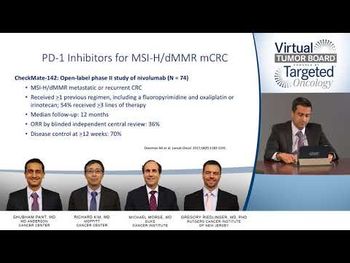
Michael J. Overman, MD, discusses recent data reported at the 2018 ESMO Congress for the frontline combination of nivolumab plus ipilimumab in microsatellite instability-high metastatic colorectal cancer.
An analysis of immunologic biomarkers in a phase II trial of patients with advanced colorectal cancer treated with chemotherapy and PD-1 checkpoint inhibition identified several factors associated with a patient’s beneficial response to the chemo-immunotherapy regimen, according to findings presented during the 33rd Annual Meeting of the Society for Immunotherapy of Cancer.

Matthew Farren, PhD, post-doctoral fellow, Winship Cancer Institute, Emory University, discusses immunologic biomarker findings in a study of mFOLFOX6 plus pembrolizumab (Keytruda) in colorectal cancer.









Advertisement
Advertisement
Trending on Targeted Oncology - Immunotherapy, Biomarkers, and Cancer Pathways
1
Plinabulin Receives FDA Fast Track Designation in Post-ICI NSCLC
2
Denosumab Biosimilar Approved For Existing Oncology Indications
3
FDA Oncology Recap: Approvals, Designations, and Decisions in September 2026
4
Tile-Based Radiation Improves Local Control in Resected Brain Metastases
5