



GYNECOLOGIC CANCERS
Latest News
Advertisement
Latest Videos















































Advertisement
More News

BRCA mutation testing in patients with ovarian cancer could mean a world of difference in treatment, says Robert Coleman, MD.
Early identification of BRCA mutations can significantly help inform future treatment choices for patients with ovarian cancer, says Leslie Randall, MD.

The anti-CD22 antibody-drug conjugate inotuzumab ozogamicin demonstrated significantly improved progression-free survival (PFS) and complete remission (CR) rates compared with chemotherapy for patients with relapsed or refractory acute lymphoblastic leukemia (ALL).
A novel dual-pathway inhibitor of tumor angiogenesis passed a preliminary clinical test, demonstrating manageable toxicity and biomarker evidence of engagement with the drug's targets, as reported at the 2016 ASCO Annual Meeting in Chicago.
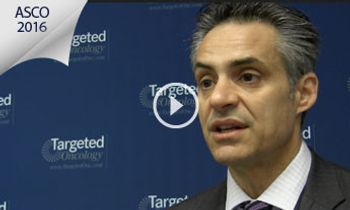
Robert L. Coleman, MD, discusses the importance of early BRCA testing for patients with ovarian cancer.
Infusion with 19-28z chimeric antigen receptor (CAR) modified T-cells led to complete response (CR) rates of 77% to 90% and minimal residual disease (MRD)-CR rates of 68% to 70% in adult patients with relapsed or refractory B-cell acute lymphocytic leukemia (B-ALL).
The largest-ever genetic analysis of ovarian cancer patients yielded a short list of 11 suspect germline genetic mutations that may be associated with an increased risk for developing ovarian cancer, according to an oral presentation at the 2016 ASCO Annual Meeting in Chicago.
Loss of genomic heterozygosity is a marker for the efficacy of rucaparib even in patients without BRCA 1 and 2 mutations, according to a poster presented Monday at the 2016 ASCO Annual Meeting.
It is feasible to administer the PARP inhibitor niraparib in combination with bevacizumab to patients with platinum-sensitive relapsed ovarian cancer with manageable toxicities. The results of a phase I study (NCT02354131) in 12 patients were presented during a poster session at the 2016 ASCO Annual Meeting.
Napabucasin (BBI-608, BB608) is a first-in-class cancer "stemness" inhibitor that targets the STAT3 pathway, has acceptable toxicity, and shows some antitumor activity in combination with paclitaxel in platinum-resistant ovarian cancer. Results of an early phase trial were presented at a poster session at the 2016 ASCO Annual Meeting.
Avelumab (MSB0010718C), a fully human anti-PD-L1 (programmed death-1 receptor ligand) IgG1 antibody, showed activity in patients with heavily pretreated recurrent or refractory ovarian cancer with acceptable toxicity in the phase Ib JAVELIN Solid Tumor trial.
The PARP inhibitor olaparib (Lynparza) significantly increased overall survival (OS) in women with platinum-sensitive relapsed serous ovarian cancer when given as maintenance monotherapy. These interim results, a third updated survival analysis, come from an extension of the Study 19 phase II trial and were presented at the 2016 ASCO Annual Meeting.
Durvalumab, an investigational PD-L1 targeting drug, is the subject of a unique ongoing basket trial being conducted by the National Institutes of Health, and was part of a single arm phase I combination therapy study of the drug in 19 patients with cervical cancer, triple negative breast cancer (TNBC), ovarian cancer, or uterine leiomyosarcoma.
Findings from a population-based study reported at the 2016 ASCO Annual Meeting revealed that young black women with breast cancer are much less likely to undergo testing for the BRCA gene or to get risk reducing prophylactic mastectomy or salpingo-oophorectomy than other women.
Neratinib, an experimental TKI being developed for breast cancer, achieved a 36% clinical benefit rate in a phase II trial, according to a poster presented June 5, 2016 at the ASCO Annual Meeting in Chicago.
Intraperitoneal chemotherapy (IP) was well tolerated by patients with advanced epithelial ovarian cancer (EOC) and reduced the risk of progressive disease.

Todd Murphree, PharmD, pharmacist, Clearview Cancer Institute, discusses measuring the quality and value of having oncology pharmacy accreditation.

Sue Naeyaert, senior director of Biosimilars Policy, EMD Serono, discusses the long-term impact that biosimilars could potentially have on the field of oncology.

The FDA has granted a priority review to a supplemental biologics license application that would extend the indication for blinatumomab to include the treatment of pediatric and adolescent patients with Philadelphia chromosome-negative relapsed or refractory B-cell precursor acute lymphoblastic leukemia.

Precision oncology should play a vital role in the shift toward value-based medicine by helping to deliver more effective therapies with more manageable pricing profiles.

Intraperitoneal (IP) therapy was not superior to intravenous (IV) treatment when used in combination with bevacizumab (Avastin) as a regimen for patients with advanced ovarian cancer, according to phase III findings from the GOG-252 study.

Tuya Pal, MD, discusses the importance of genetic risk assessment shaping management guidelines in ovarian cancer.
A new drug application (NDA) has been submitted to the FDA for telotristat etiprate as a treatment for carcinoid syndrome in patients with metastatic neuroendocrine tumors (NETs), according to a statement from the drug's developer, Lexicon Pharmaceuticals.

The FDA has approved defibrotide sodium (Defitelio) as a treatment for severe hepatic veno-occlusive disease (VOD) with associated kidney or lung abnormalities following hematopoietic stem cell transplantation (HSCT), based on data from the collection of 3 studies.

Second-line treatment of metastatic pancreatic cancer, after first-line treatment with nab-paclitaxel plus gemcitabine or gemcitabine alone, is feasible and may improve outcomes, according to a post-hoc analysis of the phase 3 MPACT trial presented at the 2016 Gastrointestinal Cancers Symposium.
Advertisement
Advertisement
Trending on Targeted Oncology - Immunotherapy, Biomarkers, and Cancer Pathways
1
Plinabulin Receives FDA Fast Track Designation in Post-ICI NSCLC
2
FDA Oncology Recap: Approvals, Designations, and Decisions in September 2026
3
Denosumab Biosimilar Approved For Existing Oncology Indications
4
CEPHEUS and Frontline Treatment in Newly Diagnosed Multiple Myeloma
5