



HCC
Latest News
Advertisement
Latest Videos































Advertisement
More News

Eleni Gkika, MD, a radiation oncologist at the University Medical Center Freiburg, discusses the future of treatment for patients with advanced hepatocellular carcinoma.
A phase 2 trial of tislelizumab and another trial of Tumor Treating Fields accompanied by sorafenib are filling unmet needs in advanced hepatocellular carcinoma, although more data are still needed in this space.
Patients with unresectable hepatocellular carcinoma with Child-Pugh class B liver function experienced a similar tumor size reduction as their Child-Pugh class A counterparts, all treated with lenvatinib, according to a post-hoc analysis of the phase 3 REFLECT study.

As June is Cancer Immunotherapy Month, Mehmet Akce, MD, discusses the future of immunotherapy in HCC in an interview with Targeted Oncology.

The combination of cabozantinib and atezolizumab demonstrated improvement in both progression-free and overall survival compared with sorafenib, in patients with untreated advanced hepatocellular carcinoma.

New published data from a phase 2/3 trial shows the increased survival benefit of PD-1 inhibitor sintililmab and bevacizumab biosimilar IBI305 in the frontline setting for patients with metastatic HCC.
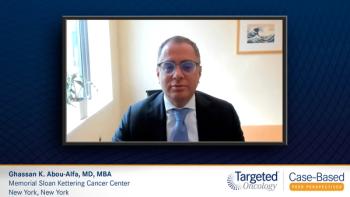
Ghassan K. Abou-Alfa, MD, MBA, shares clinical pearls and advice for the management of patients with unresectable HCC.
Gastrointestinal oncology expert, Dr Ghassan K. Abou-Alfa, discusses future directions and promising novel approaches under investigation for the treatment of unresectable HCC.

The combination of camrelizumab and apatinib has shown long-term survival benefit in patients with advanced hepatocellular carcinoma, according to updated results from the RESCUE trial.

An FDA Oncologic Drugs Advisory Committee meeting resulted in continued approval for 4 of 6 indications that were discussed, although all 6 indications did not demonstrate clinical benefit in confirmatory studies. The meeting, held April 27-29, evaluated anti–PD-1/PD-L1 drugs that received accelerated approvals through the FDA’s accelerated approval program, a nearly 30-year-old initiative to expedite the approval process.

An updated analysis, presented at the 2021 ASCO Annual Meeting, showed encouraging signs for the combination of regorafenib plus pembrolizumab in patients with advanced hepatocellular carcinoma.
Results from the phase 2 LTHAIC study showed that adding toripalimab and hepatic arterial infusion chemotherapy to lenvatinib achieved robust and durable responses in patients with advanced hepatocellular carcinoma.

In an interview with Targeted Oncology, Thomas Marron, MD, PhD, discussed neoadjuvant cemiplimab for the treatment of hepatocellular carcinoma.
The FDA’s Oncologic Drug Advisory Committee voted 5 to 4 against the continued accelerated approval of nivolumab for the treatment of patients with hepatocellular carcinoma who were previously treated with sorafenib.
In an 8 to 0 vote, the FDA’s Oncologic Drug Advisory Committee opted to continue to accelerated approval of pembrolizumab for the treatment of patients with hepatocellular carcinoma who have been previously treated with sorafenib.

In the past 3 years, the FDA has approved 7 novel drugs, either given alone or in combination, to help treat patients with hepatocellular carcinoma.

Half of all patients with hepatocellular carcinoma treated with the combination of regorafenib and nivolumab following progression on 2 lines of chemotherapy achieved disease control, according to initial results from a phase 2 proof-of-concept trial.
In a single-arm study, 100% of patients treated with sintilimab plus stereotactic body radiotherapy who had oligometastases of hepatocellular carcinoma achieved disease control and were alive and progression free at 6 months.
The FDA has approved TheraSphere yttrium-90 glass microspheres for the treatment of patients with unresectable hepatocellular carcinoma.
In an interview with Targeted Oncology, Laura Goff, MD, discussed the treatment of hepatocellular carcinoma in the frontline and beyond.

As part of the virtual 17th Annual Meeting of the International School of Gastrointestinal Oncology, a debate ensued around whether liver-directed or systemic therapy is best for the treatment of patients with HCC.
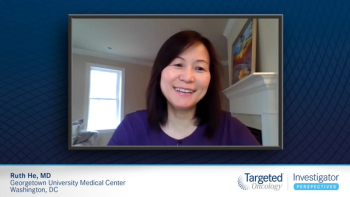
Ruth He, MD, acknowledges the current struggles experts face in combatting unresectable hepatocellular carcinoma.
Ruth He, MD, discusses the approval of frontline atezolizumab-bevacizumab and its relation to subsequent treatment of patients with unresectable hepatocellular carcinoma.
Ruth He, MD, discusses major takeaways from the phase 3 IMbrave150 trial of atezolizumab and bevacizumab in unresectable hepatocellular carcinoma.
Ruth He, MD, highlights factors that influence her use of frontline systemic therapy in patients with unresectable hepatocellular carcinoma.
Advertisement
Advertisement
Trending on Targeted Oncology - Immunotherapy, Biomarkers, and Cancer Pathways
1
FDA Accepts NDA for Daraxonrasib in Metastatic Pancreatic Cancer
2
Advanced Renal Cell Carcinoma: Tailoring Second-Line Therapy After Prior Immunotherapy
3
Teclistamab/Talquetamab Reduces Risk of Progression by 89% in R/R Multiple Myeloma
4
IMNN-001 Plus Chemo Cuts MRD Rate in Frontline Ovarian Cancer
5