



HEMATOLOGY
Latest News
Advertisement
Latest Videos

CME Content






































Advertisement
More News

A hematologist/oncologist discusses a phase 1b/2 study investigating canakinumab in patients with myelodysplastic syndrome.
In the fifth article of this series, Yazan Madanat, MD, reviews recent updates presented at the 2023 ASH Annual Meeting and discusses the evolving treatment landscape.
Drs Safah and Koprivinikar discuss emerging therapies, such as imetelstat and canakinumab, and where they might fit in the treatment paradigm for lower-risk MDS.
An expert on MDS reviews the biomarker analysis and patient-reported outcomes from the COMMANDS study as well as long-term outcomes from the MEDALIST study.
Dr Schiller reviews data updates from the IMerge phase 3 trial looking at patient-reported outcomes and cytopenias in patients with MDS following imetelstat treatment.
Gary J. Schiller, MD, reviews recent data on durable transfusion independence for patients with lower-risk MDS in the IMerge phase 3 study and discusses how transfusion frequency affects patient outcomes.
An expert on myelodysplastic syndrome discusses the impact of mutational status on response in the IMerge phase 3 study.

Findings from 2 Chinese clinical trials of olverembatinib support its addition to The National Comprehensive Cancer Network guidelines for the treatment of patients with chronic myeloid leukemia.
Clinicians review the MEDALIST trial, which evaluated luspatercept in the second-line setting and comment on updated data from MEDALIST that was recently presented at the annual ASH 2023 meeting.
Dr Hana Safah discusses the role of stem cell transplant and reviews the eligibility criteria.

The phase 3 ASCERTAIN study found that orally administered decitabine and cedazuridine had similar pharmacologic effects compared with intravenously administered decitabine.

An investigational new drug for BSI-082 has been cleared by the FDA for the treatment of hematologic and solid tumors.

Tamoxifen, a selective estrogen receptor modulator, shows potential as a line of treatment in some patients with myeloproliferative neoplasms.

Dr Shadman provides insightful discussion on optimizing outcomes with BTK inhibition in CLL through adverse event mitigation and sustaining treatment in later lines.
Expert perspective on evolving data and strategies for managing relapsed/refractory CLL.
In an interview with Targeted Oncology, Guenther Koehne, MD, provides a comprehensive overview of the dynamic landscape and evolving strategies in immunotherapy for hematologic malignancies.
In the first article of a 2-part series, Lori Muffly, MD, MS, discusses with a panel of physicians what their approach is to identifying patients with severe chronic graft-versus-host-disease and how they treat them in conjunction with the transplant team.
Dipti Patel-Donnelly, MD, highlights challenges for physicians and patients when managing treatment of hematologic malignancies in the community setting.
Experts comment on factors that influence their decision-making when treating patients with lower-risk MDS.
Insights into treatment goals and review of the current treatment landscape for lower-risk MDS.
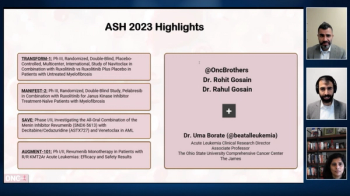
Following their review of updates from clinical trials presented at ASH 2023, the Oncology Brothers provide their key takeaways on recent data in myelofibrosis and acute myeloid leukemia.
Medical oncologists discuss the results from the SAVE and AUGMENT-101 clinical trials investigating revumenib in patients with acute myeloid leukemia.
Uma Borate, MBBS, and the Oncology Brothers provide insights gleaned from the MANIFEST-2 study, a phase 3, randomized, double-blind study on pelabresib plus ruxolitinib for JAK inhibitor treatment–naïve patients with myelofibrosis.
Following ASH 2023, Uma Borate, MBBS, joins the Oncology Brothers, Rahul Gosain, MD, and Rohit Gosain, MD, to discuss results from the TRANSFORM-1 trial investigating navitoclax plus ruxolitinib in patients with untreated myelofibrosis.
Dr Shadman provides an overview of zanubrutinib efficacy and safety data for relapsed/refractory CLL from the Phase 2 ALPINE trial.
Advertisement
Advertisement
Trending on Targeted Oncology - Immunotherapy, Biomarkers, and Cancer Pathways
1
Subcostal Robotic Surgery Cuts Thoracic Pain
2
FDA Grants Final Approval to Cabozantinib Capsule Formulation
3
David DiBardino, MD, on the Rationale for Intratumoral Therapy in Lung Cancer
4
Risk-Adapted Quadruplet Therapy Sustains 5-Year Survival Benefit in High-Risk Myeloma
5