
HEMATOLOGY
Latest News
Advertisement
Latest Videos








CME Content






































Advertisement
More News


Two poster presentations at the 2018 BMT Tandem Meetings of the Center for International Blood & Marrow Transplant Research and the American Society for Blood and Marrow Transplantation, provided a compelling extension of the recent phase III clinical trial that demonstrated the efficacy of prophylactic therapy with letermovir (Prevymis) for the prevention of cytomeg alovirus (CMV) infection in patients receiving allogeneic hematopoietic stem cell transplantation (HSCT).
While relapsed/refractory mantle cell lymphoma (MCL) is considered an aggressive disease, new findings show patients may benefit from adding chimeric antigen receptor T-cell therapy to their treatment regimen. ZUMA-2, a currently ongoing trial, aims to understand the potential benefits with axicabtagene ciloleucel, an anti-CD19 CAR T-cell product, for patients with relapsed/refractory MCL.
Voxtalisib (XL765) monotherapy induced objective responses in 41.3% of patients with follicular lymphoma, but displayed minimal efficacy in patients with other lymphomas, according to results from a phase II trial of patients with relapsed or refractory lymphoma or chronic lymphocytic leukemia that were recently published in the Lancet Haematology.

Enrollment has been halted by the FDA on clinical trials of tazemetostat in patients with various solid tumors and hematologic malignancies, according to Epizyme, the manufacturer of the EZH2 inhibitor.

Selina Chen-Kiang, PhD, a professor of pathology and immunology at Weill Cornell Medical College, discusses the rationale of her phase I trial investigating the use of CDK4/6 inhibitors for the treatment of patients with mantle cell lymphoma.
The B-Cell Lymphoma Moon Shot Program at The University of Texas MD Anderson Cancer Center wants to increase the cure rate of the disease from 30% to 60% within 5 years. In a presentation at the <em>22nd Annual</em> International Congress on Hematologic Malignancies, Michael Wang, MD, detailed results from 3 clinical trials that may help make that 5-year goal into a reality for patients with mantle cell lymphoma.

<em>Targeted Oncology</em>™, a print and digital resource that offers content and expert opinions on precision medicine in oncology, will launch the first Expert Perspective: Virtual Tumor Board on April 30. The Virtual Tumor Board is a video-editorial board discussion that features key opinion leaders from a specific oncological field.
A novel bromodomain and extra terminal protein inhibitor demonstrated promising early activity and a manageable safety profile in the treatment of patients with relapsed or refractory lymphoma in the results of a first-in-human phase I trial.
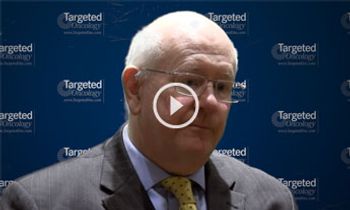
Owen O’Connor, MD, PhD, director of the Center for Lymphoid Malignancies at New York-Presbyterian Hospital, discusses the possibility of using chimeric antigen receptor (CAR) T-cell therapies for the treatment of patients with mantle cell lymphoma (MCL). This can be tricky for a number of reasons, but O’Connor is hopeful that there are treatment regimens for this patient population that can work.
Joshua R. Richter, MD, a hematologist/oncologist at John Theurer Cancer Center, discusses results from the Living with Cancer patient-reported outcomes (PROs) tool, which is a survey to record self-reported symptoms from patients. Richter used this tool to survey 239 patients with multiple myeloma on their symptoms and psychological distress.
The field of mantle cell lymphoma underwent a significant change with the FDA approval of ibrutinib in 2013. Now, the recent approval of acalabrutinib has similarly impacted the treatment landscape, as experts say it could be associated with slightly fewer adverse events than ibrutinib, according to Andre Goy, MD.
Alan Skarbnik, MD, director of the Chronic Lymphocytic Leukemia Program at John Theurer Cancer Center, discusses the possibility of triplet combinations for the treatment of hematologic malignances. The biggest challenge with this type of treatment regimen is the increased risk of adverse events.
Venetoclax induced a response in two-thirds of patients with relapsed/refractory chronic lymphocytic leukemia who had progressed after receiving prior therapy with idelalisib, according to findings of a phase II study recently published in <em>Blood</em>.
After findings from 2 randomized trials and an open-label extenstion study were released, fostamatinib (Tavalisse), anSYK inhibitor, was approved by the FDA as a second-line treatment following insufficient response to a previous therapy for patients with chronic immune thrombocytopenia.
Ruben A. Mesa, MD, recently discussed the treatment considerations and decisions he makes when treating patients with polycythemia vera. Mesa, director of the University of Texas Health Cancer Center, explained his treatment decisions based on 2 case scenarios during a <em>Targeted Oncology </em>live case-based peer perspectives presentation.
Advertisement
Advertisement
Trending on Targeted Oncology - Immunotherapy, Biomarkers, and Cancer Pathways
1
FDA Grants Final Approval to Cabozantinib Capsule Formulation
2
David DiBardino, MD, on the Rationale for Intratumoral Therapy in Lung Cancer
3
Subcostal Robotic Surgery Cuts Thoracic Pain
4
Four Approvals Reflect Growth in Hormone-Sensitive Prostate Cancer Treatment
5