
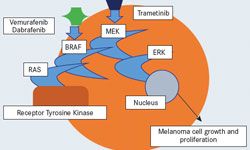




























Several novel approaches to the delivery of therapeutics for advanced melanoma may improve treatment efficacy and patient survival.

Several novel approaches to the delivery of therapeutics for advanced melanoma may improve treatment efficacy and patient survival.

A plenary session held November 15 at the Society of Neuro-Oncology’s (SNO) 2014 Annual Meeting in Miami Beach focused on immunotherapy’s promise as well as its challenges as a treatment for patients with brain cancer.

According to data from a phase I study, the oncolytic virus Delta-24-RGD can infect, replicate, and kill glioma cells in patients.
David Reardon, MD, clinical director, Center for Neuro-Oncology, Dana-Farber Cancer Institute, president, Society for Neuro-Oncology, describes the mechanism of action of rindopepimut for recurrent glioblastoma.
The vaccine rindopepimut appears to benefit patients with epidermal growth factor receptor variant III mutation (EGFRvIII) in glioblastoma with regard to progression-free survival (PFS) and overall survival (OS).
The vaccine rindopepimut (CDX110) in combination with bevacizumab induced tumor regression in a subset of patients with recurrent glioblastoma.

Recent news stories profiling a cancer patient whose last hope rests on treatment by injections of the virus that causes AIDS may have created some misconceptions regarding a new cancer immunotherapy.

Combination therapies with agents such as indoleamine 2,3-dioxygenase (IDO) inhibitors may have the potential to synergize with immunotherapeutic approaches to improve immune function against tumor cells.

Peter Hammerman, MD, PhD, assistant professor of medicine, Harvard Medical School, Dana-Farber Cancer Institute, discusses the future treatment of squamous cell lung cancer.

Abraham Chachoua, MD, discusses some challenges of treating patients with lung cancer.

Dendreon has filed for chapter 11 bankruptcy, the company announced Nov. 10. Dendreon is the maker of the first FDA-approved immunotherapy for advanced prostate cancer, sipuleucel-T (Provenge).

Adding the GM-CSF agent sargramostim to the CTLA-4 inhibitor ipilimumab (Yervoy) prolonged overall survival (OS) and lowered toxicity for patients with unresectable stage III or IV melanoma.

Joshua Brody, MD, assistant professor, Icahn School of Medicine, director, Lymphoma Immunotherapy Program, Mount Sinai Hospital, discusses vaccine strategies in follicular lymphoma.

The FDA has granted a breakthrough therapy designation to pembrolizumab for the treatment of patients with NSCLC who are EGFR mutation- or ALK rearrangement-negative and whose disease has progressed on or following platinum-based chemotherapy.
The investigational chimeric antigen receptor (CAR) therapy CTL019 elicited complete remissions in 27 of 30 pediatric and adult patients (90%) with relapsed/refractory acute lymphoblastic leukemia (ALL) in 2 pilot trials.
Tanios Bekaii-Saab, MD, discusses the future of immunotherapy and viral therapy for the treatment of pancreatic cancer.
Robert J. Motzer, MD, attending physician, Memorial Sloan Kettering Cancer Center, discusses nivolumab for the treatment of metastatic renal cell carcinoma.
Roy S. Herbst, MD, PhD, from Yale-New Haven in Connecticut, discusses the benefit of treating lung cancer with immunotherapy.

Immunotherapies have shown great promise in the treatment of advanced cancers, including metastatic melanoma and non-small cell lung cancers (NSCLC)

Several clinical trials combining nivolumab (Opdivo) with targeted therapies against ALK, c-MET, and T790M for patients with non-small cell lung cancer (NSCLC) have been established as part of a collaboration between Novartis and Bristol-Myers Squibb (BMS).
Harriet Kluger, MD, associate professor of medicine, Yale Cancer Center, discusses the toxicity profile of concurrent nivolumab and ipilimumab as seen in a phase I trial.
Elizabeth Plimack, MD, MS, director, Genitourinary Clinical Research, Fox Chase Cancer Center, discusses a phase Ib study of pembrolizumab for the treatment of patients with bladder cancer.

Almost 60% of patients with advanced non–small cell lung cancer had tumor shrinkage when treated with the PD-L1 inhibitor pembrolizumab.

Treatment with nivolumab (Opdivo) demonstrated superior objective response rates (ORR) and longer durations of response compared with chemotherapy in a phase III trial of patients with previously treated advanced metastatic melanoma
Barbara Burtness, MD, discusses immune checkpoint inhibitors for head and neck cancers.