



LUNG CANCER
Latest News
Advertisement
Latest Videos







































Advertisement
More News
Treatment with lurbinectedin and doxorubicin missed the prespecified end point of overall survival in patients with small cell lung cancer who progressed after 1 prior platinum therapy.

The FDA has granted a Fast Track designation to the irinotecan liposome injection as a potential treatment option for patients with small cell lung cancer who progressed following a first-line platinum-based regimen, Ipsen announced, in a press release.
The results from the phase 3 CASPIAN trial were reviewed and compared with the phase 3 IMpower133 by Jyoti D. Patel, MD, during a Targeted Oncology Case Based Peer Perspectives event.

Alexander Spira, MD, PhD, shares an important message with community oncologists regarding the treatment of patients with lung cancer.
During a Targeted Oncology Case Based Peer Perspectives event, John Heymach, MD, PhD, professor and Chair, David Bruton Jr Chair in Cancer Research. Department of Thoracic/Head and Neck Medical Oncology, The University of Texas MD Anderson Cancer Center, discussed the guidelines and therapeutic option for stage III non–small cell lung cancer, based on a case of a 66-year-old patient.
The FDA has approved an additional dosing option for the approved indications of durvalumab at a 1500-mg fixed dose administered every 4 weeks.
During Lung Cancer Awareness Month, David Spigel, MD, shared his insights on the evolving treatment paradigm in lung cancer and how the latest advances have impacted his treatment decisions for patients with lung cancer.
Patients of color who were diagnosed with lung cancer were associated with worse outcomes compared with Caucasian patients, according to findings from the 3rd Annual “State of Lung Cancer” Report by the American Lung Association.
The primary end point of overall survival with tislelizumab compared with docetaxel as the second- or third-line treatment of patients with locally advanced or metastatic non–small cell lung cancer who progressed on previous platinum-based chemotherapy.
Dramatic improvements in efficacy outcomes for patients with non–small cell lung cancer have been a reason for celebration over the last decade, as FDA approvals of immunotherapy-plus-chemotherapy combinations as well as oncogenic-targeting drugs have transformed the treatment landscape.
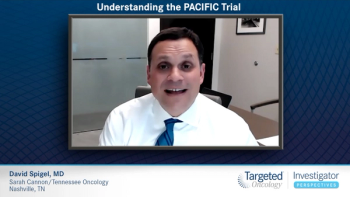
Dr David Spigel provides information on the PACIFIC trial, including the 4-year update.
The phase 3 KEYNOTE-598 study of pembrolizumab plus ipilimumab in a population of patients with metastatic non–small cell lung cancer has been discontinued for futility.
Alexander Drilon, MD, chief of Early Drug Development Service at Memorial Sloan Kettering Cancer Center in New York, discussed each of the recently approved agents used for the treatment of these tumors and presented a review of the data at the 15th Annual New York Lung Cancer Symposium.
As the field of lung cancers continues to lean further into the precision medicine era, KRAS G12C has become an emerging actionable target for which multiple therapies are under development, said Bob T. Li, MD.
Many challenges have arisen as a result of the coronavirus 2019 pandemic, which is still impacting nations across the world. In the United States, oncologists have initiated research to provide wider understanding of the virus and the threat it poses to patients with lung cancer.

Brett Simon, MD, PhD, discusses an ongoing program at his institution that aims to improve symptoms and outcomes for patients with lung cancer who have undergone surgery.
In an interview with Targeted Oncology, David M. Waterhouse, MD, MPH, discussed the evolving role of genomic testing and related challenges in the lung cancer treatment paradigm as immunotherapies and targeted therapies continue to expand the field.
In an interview with Targeted Oncology, Tony S. K. Mok, MD, BMSc, FRCPC, FASCO, discussed the actionable mutations that have been identified in the lung cancer space, the agents that have been developed to target them, and the importance of genetic testing to provide personalized care.
Tumor mutational burden has been correlated with response to immunotherapy use in patients treated with immune checkpoint blockade. However, use of this biomarker has been challenged along the way with various criticisms of validity and routine use.

Mark G. Kris, MD, discusses 1 of the major topics of discussion from the 15th Annual New York Lung Cancers Symposium, among other areas of focus at the meeting.
Advertisement
Advertisement
Trending on Targeted Oncology - Immunotherapy, Biomarkers, and Cancer Pathways
1
SOT106 Receives New FDA FTD and ODD in Sarcoma
2
IMS 2026 Day 4 Recap: MRD-Guided Regimens Highlight Final Sessions
3
Iberdomide Doubles MRD-Negative CR Rate in Phase 3 EXCALIBER-RRMM Trial
4
IMS 2026 Day 3 Recap: Etentamig Outperforms Standard Therapy in RRMM Trial
5