

Mantle Cell Lymphoma
Latest News

Advertisement
Latest Videos


































Advertisement
More News

In an interview with Targeted Oncology, Kellie Ryan, MPH, discussed the data on how physicians are currently using acalabrutinib as treatment of patients with mantle cell lymphoma in the real-world setting. She highlighted where she sees this research evolving in time.
Evaluation of an expansion cohort of the pivotal phase I/II ZUMA-1 trial in patients with refractory large B-cell lymphoma revealed that early steroid intervention may have a positive impact on the toxicity profile of chimeric antigen receptor T-cell therapy with axicabtagene ciloleucel, according to findings presented during a poster session at the 2020 Transplantation & Cellular Therapy Meetings in Orlando, Florida.

David Miklos, MD, PhD, explains the rationale behind the ZUMA-2 trial of KTE-X19 as well as the efficacy of the drug.

A Biologics License Application for the investigational chimeric antigen receptor T-cell therapy agent, KTE-X19, was accepted by the FDA and granted Priority Review for the treatment of adult patients with relapsed or refractory mantle cell lymphoma, according to a press release from Kite, developer of KTE-X19.<sup> </sup>
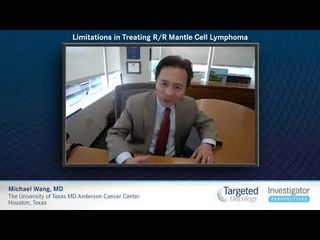
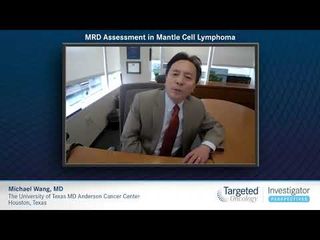
Michael Wang, MD, discusses the approaches physicians can use when treating their patients with mantle cell lymphoma who have become resistant to cellular therapies, such as CAR T-cell therapy.
Salvage therapy with high‐dose cyclophosphamide showed meaningful clinical activity in a cohort of 6 patients with mantle cell lymphoma who were previously treated with ≥2 prior lines of therapy and had no other available options. These patients made up 14% of the 42 participants in a phase II study showing similar efficacy in adult patients with other relapsed or refractory B‐cell non‐Hodgkin lymphomas.
In an interview with Targeted Oncology, Simon Rule, MD, discussed the findings from a pooled analysis evaluating the efficacy and safety of using ibrutinib in patients with relapsed/refractory mantle cell lymphoma. He also highlighted other abstracts of interest that were presented during the 2019 American Society of Hematology Annual Meeting that were of interest in the field of mantle cell lymphoma.
In an interview with Targeted Oncology, Ian W. Flinn, MD, PhD, discussed the results from the ZUMA-2 trial which evaluated the efficacy and safety of KTE-X19, a CAR T-cell therapy, in patients with relapsed/refractory mantle cell lymphoma. He highlighted how unique this product is compared to other CAR T-cell therapies and where he believes it will fit into the treatment landscape for patients with mantle cell lymphoma.
Older patients with mantle cell lymphoma were more likely to have a maintained response with induction rituximab, cyclophosphamide, doxorubicin, vincristine, and prednisone followed by rituximab maintenance when compared against R-CHOP and interferon-alpha maintenance.
Andre Goy, MD, discusses the results from a small clinical trial, which was presented at the 2019 American Society of Hematology Annual Meeting that he found particularly significant for the treatment of patients with relapsed/refractory mantle cell lymphoma.
Following the 2019 ASH Annual Meeting, Targeted Oncology spoke with experts from various specialties in hematology. The experts highlighted some of the top abstracts from the meeting that will impact the way multiple myeloma, leukemias, MPNs, and lymphomas are treated.
A Biologics License Application for the investigational chimeric antigen receptor T-cell therapy agent, KTE-X19 has been submitted to the FDA for the treatment of adult patients with relapsed/refractory mantle cell lymphoma, according to a press release from Kite.<br />
Patients with relapsed/refractory mantle cell lymphoma experienced a 67% complete remission rate and an objective response rate of 93% after treatment with the anti-CD19 CAR T-cell therapy KTE-X19, according to findings from the phase II ZUMA-2 study presented at the 2019 American Society of Hematology ASH Annual Meeting.
A prospective trial showed that treatment with ibrutinib might prompt a decrease in progression-free survival in patients with relapsed or refractory mantle cell lymphoma, according to long-term follow-up data presented at the 2019 American Society for Hematology Annual Meeting and Exposition.
<br /> Diego Villa, MD, MPH, clinical associate professor, Division of Medical Oncology, The University of British Columbia, discusses a retrospective analysis evaluating bendamustine and rituximab as induction therapy in both transplant eligible and ineligible patients with mantle cell lymphoma. <br />
In November 2019, the FDA approved a number of treatments, including acalabrutinib for the treatment of chronic lymphocytic leukemia and small lymphocytic leukemia, as well as zanubrutinib for the treatment of mantle cell lymphoma. A biosimilar for pegfilgrastim was also approved under indications.
Andre H. Goy, MD, predicts the future use of novel combinations for treatment of mantle cell lymphoma.
In an interview with <em>Targeted Oncology</em>, Lalit Sehgal, PhD, discussed the rationale for investigating how the tumor microenvironment impacts survival in patients with mantle cell lymphoma through various signaling pathways.
Five-year outcomes data from the S1106 phase II trial in patients with newly diagnosed mantle cell lymphoma found that the RB regimen was equally effective but less toxic than the RH regimen. <br />
The FDA has granted an accelerated approval to zanubrutinib for the treatment of adult patients with mantle cell lymphoma who have received at least 1 prior therapy.
In an interview with Targeted Oncology, Jia Ruan, MD, PhD, examined the evolving treatment landscape for mantle cell lymphoma. She also discussed modern strategies like precision medicine and ctDNA liquid biopsy that are aiding the evolution.

Simon Rule, MD, PhD, shares his thoughts on the FDA’s decision to grant zanubrutinib, a BTK inhibitor, priority review for the treatment of patients with mantle cell lymphoma. Should the drug be approved, it will be available for patients with MCL who have received at least 1 prior line of therapy.
Target resequencing and DNA profiling of purified tumor samples collected from younger patients with mantle cell lymphoma found that mutations of <em>KMT2D</em> and disruption of <em>TP53</em> by deletion or mutation were associated with an increased risk of progression and death, both in univariate and multivariate analysis, from standard treatments, according to a study published recently in <em>Haematologica</em>.<br />
The phase I/II CIRLL trial has opened an expansion cohort to include patients with mantle cell lymphoma in the study of the monoclonal antibody, cirmtuzumab, plus ibrutinib. The study was previously open to patients with chronic lymphocytic leukemia and small lymphocytic leukemia only.<sup>1 </sup>

Emerging from the recent 2019 World Conference on Lung Cancer are several notable developments, Robert L. Ferris, MD, PhD, wrote in this issue of <em>Targeted Therapies in Oncology. </em>
Advertisement
Advertisement
Trending on Targeted Onc
1
Survey Highlights NMIBC Care Challenges Among US Military Service, Veterans
2
FDA Approves Durvalumab-EV Combo, Expanding MIBC Treatment Options
3
New ACS Guidelines Push for Earlier Prostate Cancer Screening
4
Expanding the Evidence on Lung Cancer Prevention
5