

MULTIPLE MYELOMA
Latest News

Belantamb Mafodotin Shows PFS Benefit and Tolerable Safety in R/R Multiple Myeloma
Advertisement
Latest Videos


































Advertisement
More News

Positive results were reported on the phase 2 MagnetisMM-3 study at the ASH Annual Meeting 2022.
Results from the phase 1b MajesTEC-2 trial showed that teclistamab plus daratumumab and lenalidomide demonstrated potential for deep and durable responses in relapsed or refractory multiple myeloma.
The use of 2 separate recommended phase 2 doses of Talquetamab was associated with high response rates in patients with heavily pre-treated relapsed/refractory multiple myeloma.

Based on the outcome of the confirmatory phase 3 OCEAN study, the FDA has requested melphalan flufenamide be withdrawn for patients with relapsed or refractory multiple myeloma.

Patients with multiple myeloma administered daratumumab in combination with bortezomib and dexamethasone demonstrated improvements in overall survival compared with those given bortezomib and dexamethasone alone.

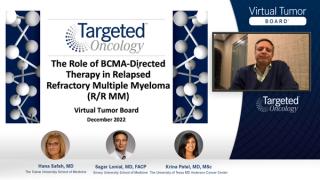
Sagar Lonial, MD, FACP, provides a look at an upcoming Virtual Tumor Board program on BCMA-directed therapies in relapsed/refractory multiple myeloma treatment.

In an interview with Targeted Oncology, Christopher R. D’Angelo, MD discussed recent approvals in the multiple myeloma space and how to treat patients using immunotherapy.
At a live virtual event, Sumit Madan, MD, broke down the use of quadruplet therapies in the frontline setting for patients with multiple myeloma and how to care for patients when they relapse on treatment.

Thomas G. Martin, MD, discusses the goals and efficacy outcomes of the phase 1/2 MajesTEC-1 trial of teclistamab-cqyv for patients with relapsed/refractory multiple myeloma.
During a Targeted Oncology case-based roundtable event, Yvonne A. Efebara, MD, MPH, discussed the role of triplet and quadruplet systemic therapies for newly diagnosed multiple myeloma and the use of autologous stem cell transplant.
After an update from the phase 3 DREAMM-3 study the use of belantamab monotherapy for previously treated patients with relapsed or refractory multiple myeloma was pulled from US market authorization by request of the FDA.
During a Targeted Oncology case-based roundtable event, Peter Forsberg, MD, discussed data from several trials of selinexor in patients with relapsed/refractory multiple myeloma.
During a Targeted Oncology case-based roundtable event, Adam Binder, MD, discussed trials supporting triplet and quadruplet regimens along with autologous stem cell transplant.

Retrospective real-world evidence shows that patients who relapse after B-cell maturation antigen chimeric antigen receptor T-cell therapy may have multiple treatment options, including salvage therapy and T-cell engagers.

A breakthrough therapy designation has been granted by the FDA to elranatamab for relapsed/refractory multiple myeloma.
Joseph Mikhael, MD, discusses the ongoing impact of daratumumab in the treatment landscape of patients with multiple myeloma.

In an interview with Targeted Oncology, Alfred L. Garfall, MD, discussed the FDA approval of teclistamab, the MajesTEC-1 trial, and how this information should be used in the future.
Despite the small number of patients enrolled, the confirmatory phase 3 LIGHTHOUSE study of melphalan flufenamide in patients with relapsed/refractory multiple myeloma demonstrates promising safety and efficacy.
Based on positive responses from the phase 1/2 MajesTEC-1 trial, the FDA has granted approval for the use of teclistamab-cqyv in relapsed or refractory multiple myeloma.
During a Targeted Oncology case-based roundtable event, Jeffrey Zonder, MD, discussed with participants the later-line therapy options for patients who have relapsed following several lines of treatment for multiple myeloma.
Adam Cohen, MD, discusses when patients should receive chimeric antigen receptor T-cell therapies for relapsed/refractory multiple myeloma.
At a 2022 NCCN meeting, a panel discussed the use of immunotherapy for the treatment of patients with multiple myeloma, specifically how to choose the best course of action and how to manage toxicities.

Peter Voorhees, MD, discussed managing adverse events related to belantamab mafadotin in patients with relapsed/refractory multiple myeloma during a live event.

Paul G. Richardson, MD, discusses what is expected and exciting for the future of multiple myeloma research.

During a live virtual event, Brea C. Lipe, MD, discussed with participants their experiences with maintenance treatment in patients with transplant-eligible multiple myeloma. This is the second of 2 articles based on this event.
Advertisement
Advertisement
Trending on Targeted Oncology - Immunotherapy, Biomarkers, and Cancer Pathways
1
Anito-Cel Delivers Durable Responses With Low Neurotoxicity in RRMM
2
Risk, Histology, and Metastatic Site Guide First-Line RCC Treatment Choices
3
FDA Application Withdrawn for I-DXd in Small Cell Lung Cancer
4
Elinzanetant Gets Priority Review for VMS From Breast Cancer Endocrine Therapy
5