

MULTIPLE MYELOMA
Latest News
Advertisement
Latest Videos




































Advertisement
More News

Thomas G. Martin, MD, discusses the mechanism of action of bispecific T-cell engagers including teclistamab-cqyv in patients with relapsed/refractory multiple myeloma.

Hana Safah, MD, presents the case of a 63-year-old woman with relapsed/refractory multiple myeloma receiving treatment with a BCMA-directed CAR T-cell therapy.

Sagar Lonial, MD, FACP, reviews the design and outcomes of the DREAMM-2 and ALGONQUIN studies investigating belantamab mafodotin in the treatment of relapsed/refractory multiple myeloma.

In an interview with Targeted Oncology, Shaji K. Kumar, MD, discussed the presentations from ASH 2022 that stood out as most important to the multiple myeloma landscape.
The panel describes the factors they consider when selecting an appropriate BCMA-directed bispecific antibody for a patient with relapsed/refractory multiple myeloma.
Hana Safah, MD, details the prevention and management of cytokine release syndrome (CRS) and immune effector cell-associated neurotoxicity syndrome (ICANS) in patients receiving BCMA-directed bispecific antibodies for relapsed/refractory multiple myeloma.

Results from cohort A of the MagnetisMM–3 trial of erlanatamab for patients with relapsed/refractory multiple myeloma have led the FDA to grant priority review to a biologics license application for the agent in this patient population.

A second interim analysis of the phase 3 Karmma-3 trial demonstrated significantly improved progression-free survival and overall response rates, compared with standard regimens, in patients with triple-class-exposed relapsed/refractory multiple myeloma.
A single-center, retrospective study demonstrated high rates of chronic opioid use after autologous stem cell transplantation in patients with multiple myeloma, also leading to inferior overall survival at 6 months of follow-up.
Treatment with the chimeric antigen receptor (CAR) T-cell therapy idecabtagene vicleucel is safe and effective for patients with relapsed/refractory multiple myeloma.

Krina Patel, MD, MSc, explains which patients with relapsed/refractory multiple myeloma she would not treat with CAR T-cell therapy, and the options after disease progression on CAR-T.
A look at BCMA targeting in relapsed/refractory multiple myeloma treatment and the BCMA-directed bispecific antibody teclistamab.

Ben Derman, MD, discussed results from a trial investigating minimal residual disease–guided discontinuation of maintenance therapy in patients with multiple myeloma.
Dr Sagar Lonial presents the case of a 58-year-old man with relapsed/refractory multiple myeloma to the panel for discussion.
Sagar Lonial, MD, FACP, provides an overview of the potential treatment options for patients with relapsed/refractory multiple myeloma.
In separate live, virtual events, David Dingli, MD, PhD, and Douglas W. Sborov, MD, MS, discussed with participants how they would treat a patient with multiple myeloma in accordance with the available therapeutic regimens.

After the results of the phase 2 KarMMa trial showed that idecabtagene vicleucel is a new standard of care in relapsed/refractory multiple myeloma, a real-world analysis continues to show the CAR T-cell therapy could have a wider reach.

During a Targeted Oncology case-based roundtable event, Amandeep Godara, MD, discussed the use of maintenance therapy for patients with multiple myeloma. This is the second of 2 articles based on this event.
The phase 1 POLARIS trial showed a 100% overall response rate for OriCAR-017, a novel CAR T-cell therapy with a new target in relapsed/refractory multiple myeloma.
Ben Derman, MD, discussed the rationale for an ongoing clinical trial evaluating minimal residual disease–guided discontinuation of maintenance therapy in patients with multiple myeloma.
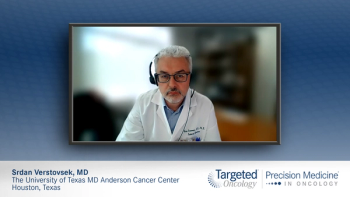
Dr Srdan Verstovsek discusses how ruxolitinib might fit into the myelofibrosis treatment landscape in the future, and highlights remaining unmet needs.
Srdan Verstovsek, MD, reviews data presented at ASH 2022 on combination ruxolitinib and selinexor for the frontline treatment of myelofibrosis.
Dr Srdan Verstovsek, MD, details how the JAK-STAT pathway is utilized in the treatment of myelofibrosis.
Srdan Verstovsek, MD, provides an overview of myelofibrosis and the clinical signs and symptoms to look for.
Dr Joshua Richter explains which patients with multiple myeloma are most suitable for triplet combination therapies.
Advertisement
Advertisement
Trending on Targeted Oncology - Immunotherapy, Biomarkers, and Cancer Pathways
1
Anito-Cel Delivers Durable Responses With Low Neurotoxicity in RRMM
2
Risk, Histology, and Metastatic Site Guide First-Line RCC Treatment Choices
3
FDA Application Withdrawn for I-DXd in Small Cell Lung Cancer
4
Elinzanetant Gets Priority Review for VMS From Breast Cancer Endocrine Therapy
5