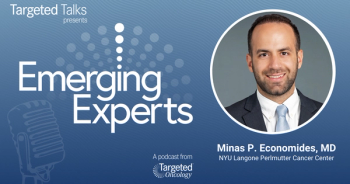
In our 4th episode of Emerging Experts, Minas P. Economides, MD, unveils the challenges and opportunities for renal cell carcinoma treatment, focusing on the lack of therapies available in the second-line setting.


Your AI-Trained Oncology Knowledge Connection!
In our 4th episode of Emerging Experts, Minas P. Economides, MD, unveils the challenges and opportunities for renal cell carcinoma treatment, focusing on the lack of therapies available in the second-line setting.
Paul Richardson, MD, further discusses the data from the CC-92480-MM-002 trial, and future directions for research of mezigdomide combinations for patients with relapsed/refractory multiple myeloma.
Here is a look back at the FDA happenings from the month of January 2024.

In the second article of a 2-part series, Yara Abdou, MD, provided a deep dive into the evolving landscape of HER2-targeted therapy and its potential to revolutionize cancer treatment.
Douglas Tremblay, MD, discusses the factors which influence the decision to recommend cytoreduction for patients with essential thrombocytopenia and polycythemia vera.

In an interview with Targeted Oncology, Geoffrey D. Moorer, MD, discussed recent trending topics in the field of oncology among hospital tumor boards and committees.
Paul Richardson, MD, discusses the safety and efficacy findings from the CC-92480-MM-002 trial of mezigdomide with dexamethasone and daratumumab or elotuzumab in patients with relapsed/refractory multiple myeloma.
The FDA has decided to re-evaluate the ProSense System as a minimally invasive treatment option for patients with early-stage, low-risk breast cancer.
The application is based on promising findings from the phase 3 PERSEUS trial which were presented at the American Society of Hematology Annual Meeting in December 2023.
Paul Richardson, MD, discusses the baseline characteristics of the patients with relapsed/refractory multiple myeloma enrolled in the CC-92480-MM-002 trial.

Michiel S. Van der Heijden, MD, PhD, discusses background of the phase 3 CheckMate 901 study which evaluated concurrent frontline nivolumab and gemcitabine/cisplatin followed by nivolumab maintenance therapy among patients with urothelial carcinoma.

Robotic peritoneal mesometrial resection with targeted or systemic lymphadenectomy demonstrated feasibility with acceptable complication rates in intermediate/high-risk endometrial cancer requiring second surgery after prior hysterectomy.

In an interview with Targeted Oncology, Naval G. Daver, MD, discussed the first-in-human, phase 1/2 study of DSP-5336 in patients with relapsed or refractory acute myeloid leukemia.
Paul Richardson, MD, discusses the background and design of the CC-92480-MM-002 trial in multiple myeloma.
The axicabtagene ciloleucel manufacturing process has received FDA approval for a change to reduce the median turnaround time.
The FDA and Japan’s Ministry of Health, Labor, and Welfare advanced lisocabtagene maraleucel for relapsed/refractory follicular and mantle cell lymphomas.
In an interview with Targeted Oncology, Thomas Powles, MD, MBBS, MRCP, discussed the impressive performance of enfortumab vedotin plus pembrolizumab for the treatment of locally advanced or metastatic urothelial carcinoma, as seen in the EV-302 trial.
Binod Dhakal, MD, MS, discusses the safety data from the phase 2 IMPEDE study of isatuximab, pomalidomide, elotuzumab, and dexamethasone for the treatment of patients with relapsed/refractory multiple myeloma.
By expediting referral processes, enhancing information quality, and boosting patient satisfaction, these systems are reshaping healthcare experiences for both providers and patients.
The investigational new drug application for OriCAR-017 has been cleared by the FDA for the treatment of patients with relapsed/refractory multiple myeloma.
If approved, trastuzumab deruxtecan would be the first HER2-directed antibody-drug conjugate for a tumor-agnostic indication.

Matthew Matasar, MD, discussed the rationale and findings of the doublet consisting of ibrutinib and venetoclax for the treatment of mantle cell lymphoma.

Bruno R. Bastos, MD, discusses findings from a study which assessed the pharmacodynamic and radiographic changes among patients with renal cell carcinoma who were treated with the combination of nivolumab and TPST-1120.
In an interview with Targeted Oncology, Mark Dybul, MD, discussed a breakthrough method of immunotherapy in solid tumors.
Subcutaneous nivolumab coformulated with rHuPH20 showed noninferiority of PK exposures compared with intravenous nivolumab in metastatic ccRCC.
Adjuvant pembrolizumab treatment significantly improved overall survival vs placebo in patients with clear cell renal cell carcinoma.
In the phase 3 CheckMate 914 trial, the use of nivolumab did not meet the primary endpoint of disease-free survival when compared to a placebo in patients with localized renal cell carcinoma at a heightened risk of relapse following nephrectomy.
Real-world, retrospective data showed that morphologic renal cell carcinoma types and tumor-stages helps to inform recurrence and prognosis.
Pembrolizumab with lenvatinib continued to demonstrate antitumor activity and led to longer survival rates vs historical controls in patients with advanced non–clear cell renal cell carcinoma.