

2024 saw the establishment of docetaxel, oxaliplatin, leucovorin, and 5-fluorouracil as the preferred regimen for patients with localized adenocarcinoma.

2024 saw the establishment of docetaxel, oxaliplatin, leucovorin, and 5-fluorouracil as the preferred regimen for patients with localized adenocarcinoma.

A phase 1 trial evaluating FSHR-targeting CAR T cells for patients with ovarian cancer has dosed the first patient in its third cohort.
Aman Chauhan, MD, highlights an ongoing phase 2 trial exploring the combination of triapine, a radiation sensitizer, with lutetium 177 dotatate for treating well-differentiated somatostatin receptor–-positive neuroendocrine tumors.

Martin Dreyling, MD, discusses the final follow-up results of the TRIANGLE study in mantle cell lymphoma.
Jacob E. Berchuck, MD, discusses how a new epigenomic platform may influence the accessibility of PSMA-based therapies, especially for patients who may not have easy access to PSMA PET scans.

An AI-driven tool enhances stereotactic radiosurgery for small brain metastases by predicting local failure risks, optimizing radiation dosing, and personalizing MRI follow-ups.

A recap of key breakthroughs this year in the field of genitourinary cancer.
The FDA has approved tislelizumab plus chemotherapy for the treatment of patients with newly diagnosed, locally advanced or metastatic gastric and gastroesophageal junction adenocarcinoma.
This approval marks the first and only approved subcutaneously administered PD-1 inhibitor.

Saro H. Armenian, DO, MPH, discussed the unique challenges facing children diagnosed with cancer and their families and what lies on the horizon.
Joseph Greer, PhD, discussed a study evaluating in-person vs telehealth modalities of early integrated palliative care for patients with advanced lung cancer.
Ryan Motte, PharmD, CSP, reviewed the global cancer burden among men and its projected trajectory to 2050, highlighting the role specialty pharmacies can play in combating this issue.
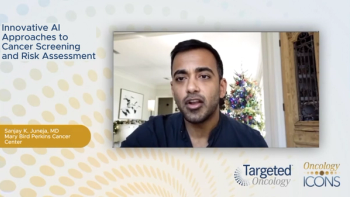
Sanjay K. Juneja, MD, discusses how artificial intelligence is transforming early cancer screening.

Neoadjuvant chemotherapy's effect on local disease management of breast cancer has a number of clinical implications, including tumor downsizing, potentially improved overall survival, and more.

The advent of cellular therapies, such as chimeric antigen receptor T-cell therapy, has revolutionized the field of hematologic malignancies.

A phase 2 trial found that dual immune checkpoint inhibition with nivolumab and ipilimumab shows promise in anaplastic thyroid cancer, but limited effectiveness in radioiodine refractory differentiated thyroid carcinoma.
The FDA granted priority review to taletrectinib in ROS1-positive advanced NSCLC, with a target decision date of June 2025.

Here are the top 10 developments from the year.
The combination of encorafenib, cetuximab, and mFOLFOX6 has gained accelerated approval from the FDA for the treatment of patients with metastatic colorectal cancer with a BRAF V600E mutation.

Sanjay K. Juneja, MD, discusses how artificial intelligence has evolved in 2024 to help improve early detection of cancer.

Key 2024 SABCS and ASH findings: palbociclib improves PFS in HR+, HER2+ breast cancer, cilta-cel achieves 100% CR in smoldering MM, and selinexor with ruxolitinib aids myelofibrosis.
Eunice S. Wang, MD, discusses the role of transplant eligibility in shaping treatment strategies for secondary acute myeloid leukemia.

Chunhui Han, PhD, discusses the use of of Gallium 68 PSMA-11 in biology-guided radiotherapy and whether or not the radiotracer can improve the targeting and treatment of bony metastases in patients with prostate cancer.

MT-303, a novel GPC3-targeting mRNA/lipid nanoparticle chimeric antigen receptor therapy, enhances cytokine-driven immune response and tumor cytotoxicity.
Solly Chedid, MD, discussed luspatercept and its role in boosting quality of life for patients with myelodysplastic syndrome.
The FDA granted fast track designation to NX-5948 for treating relapsed/refractory Waldenström macroglobulinemia after 2 or more lines of therapy, including a BTK inhibitor.
In an interview with Targeted Oncology, Adrienne Waks, MD, provided insights into the significance of the findings from the DAPHNe trial and their clinical implications for patients with HER2-positive breast cancer.

One new frontier of cancer detection is emerging: metabolomics.
The FDA has granted ensartinib approval for adult patients with ALK-positive non–small cell lung cancer.
The FDA issued a complete response letter for the BLA submission of subcutaneous amivantamab for EGFR-mutated NSCLC, citing manufacturing inspection issues, but confirming no need for additional clinical trials.