Denise Yardley, MD, discusses the takeaways and next steps of an analysis of the NATALEE trial investigating ribociclib in node-negative breast cancer.

Denise Yardley, MD, discusses the takeaways and next steps of an analysis of the NATALEE trial investigating ribociclib in node-negative breast cancer.

Maya Dimitrova, MD, discusses areas of further research and unmet needs for patients with melanoma.
Scott T. Tagawa, MD, MS, FACP, FASCO, discusses the potential benefits of antibody-drug conjugates in urothelial cancer while acknowledging the need for more education and experience among physicians to optimize their use.

Experts on graft-vs-host disease discuss the potential role for axatilimab within current treatment algorithms.
A hematologist provides an overview of the AGAVE-201 trial investigating axatilimab in patients with chronic graft-vs-host disease.
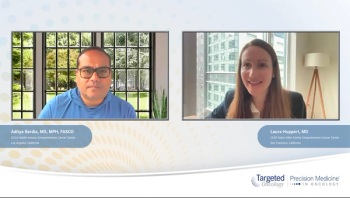
Medical oncologists share clinical practices for selecting and sequencing TROP2-directed antibody-drug conjugates, highlighting ideal candidates for sacituzumab govitecan or datopotamab deruxtecan.
Experts on breast cancer offer comprehensive insights on findings from the TROPiCS-02 study investigating sacituzumab govitecan in patients with HR+/HER2- metastatic or locally recurrent inoperable breast cancer.
Nazli Dizman, MD, discusses the importance of the 3 main clauses of the language of respect guidelines in renal cell carcinoma.
Dr. Campbell evaluates the efficacy and safety results from the 55-month analysis of the CheckMate-9ER trial, and explores the considerations for discontinuing or continuing immunotherapy (IO) in IO/IO versus IO/TKI combination regimens.
The key opinion leaders examine the data from the KEYNOTE-426 trial, focusing on safety and efficacy outcomes along with other pertinent updates.
Xiaolin Zhang, PhD, discusses findings from the phase 2 study exploring a novel oral agent for the treatment of EGFR-mutated non–small cell lung cancer.

Hannah Choe, MD, provides insights on potential areas for improvement in developing more targeted and effective treatments for chronic GVHD.
Corey Cutler, MD, MPH, discusses how axatilimab’s mechanism of action differs from currently available therapies for patients with chronic GVHD.
A genitourinary oncologist discusses the role of multidisciplinary care in the treatment of patients with advanced renal cell carcinoma.
Martin H. Voss, MD, outlines adverse events encountered with different IO-TKI and IO-IO combination regimens in RCC and discusses the importance of open communication with patients.
Breast cancer specialists review the study design, efficacy data, and safety profile findings from the TROPION-Breast01 study investigating datopotamab deruxtecan (Dato-DXd) in patients with HR+/HER2- metastatic breast cancer.
Medical oncologists provide insights on emerging pathways and TROP2-directed antibody-drug conjugates in HR+/HER2- metastatic breast cancer, highlighting ongoing research.
Aristotelis Tsirigos, PhD, discusses a self-taught artificial intelligence tool being developed to accurately diagnose cases of adenocarcinoma.
John Mascarenhas, MD, discusses the methods, design, and inclusion criteria of the phase 3 SENTRY trial for patients with JAK inhibitor treatment-naive myelofibrosis.
Mina Lobbous, MD, MPH, discusses findings and implications fro a study investigating a new regimen for the treatment of brain metastases in patients with HER2-positive breast cancer.
Salma Jabbour, MD, discusses the implications of a 4-year follow-up of the KEYNOTE-799 study of pembrolizumab and chemoradiotherapy in stage III non–small cell lung cancer.

David Spigel, MD, explains some of the unmet needs for patients with limited-stage small cell lung cancer and how they led to the initiation of the ADRIATIC trial.
Matthew Campbell, MD, MS, analyzes the crucial efficacy and safety results from the CLEAR trial's 4-year final analysis, incorporating insights on how these findings influence clinical decision-making for treatment-naïve patients with advanced renal cell carcinoma.
Rana McKay, MD, examines the pivotal efficacy and safety outcomes from the 8-year follow-up of the CheckMate-214 trial in treatment-naïve patients, presented at ASCO GU 2024, and discusses how these findings impact clinical practice.
Hope S. Rugo, MD, discusses the ELEVATE trial of elacestrant combined with various targeted therapies for patients with endocrine receptor-positive/HER2-negative metastatic breast cancer who have already received endocrine therapy and CDK4/6 inhibitors.
Binod Dhakal, MD, MS, discusses selecting patients for chimeric antigen receptor T-cell therapy by considering each patient’s condition and logistics.

Tanya Gupta, MD, discusses the current landscape of antibody-drug conjugates for breast cancer subtypes beyond HER2-positive disease.
An expert on non–clear cell renal cell carcinoma provides clinical insights on TKI dosing strategies and duration of therapy implications for IO-TKI combinations.
Following the 2024 ASCO Annual Meeting, Martin H. Voss, MD, discusses long-term follow-up data from the phase 2 KEYNOTE-B61 trial investigating pembrolizumab plus lenvatinib in the first-line treatment of advanced non–clear cell RCC.
Paolo Ghia, MD, PhD, discusses the key takeaways from 5-year data follow-up data from the phase 2 CAPTIVATE trial of ibrutinib plus venetoclax for the treatment of patients with chronic lymphocytic leukemia and/or small lymphocytic lymphoma.