Articles by Paul L. Swiecicki, MD
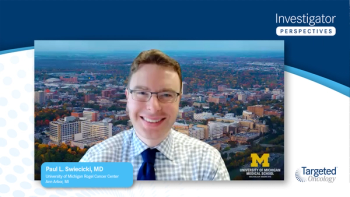
Paul L. Swiecicki, MD, of the University of Michigan Rogel Cancer Center, explains the significance of OrigAMI-5's all-comer design, which enrolls patients with recurrent or metastatic head and neck squamous cell carcinoma (HNSCC) regardless of PD-L1 combined positive score (CPS), using local CPS testing only for stratification rather than eligibility.
Paul L. Swiecicki, MD, of the University of Michigan Rogel Cancer Center, discusses the rationale for the phase 3 OrigAMI-5 study, which evaluates amivantamab earlier, in the first-line setting, in combination with pembrolizumab and carboplatin.
Paul L. Swiecicki, MD, of the University of Michigan Rogel Cancer Center, shares his perspective on where subcutaneous amivantamab may fit in the treatment paradigm for previously treated, recurrent or metastatic head and neck squamous cell carcinoma (HNSCC), based on cohort 1 data from OrigAMI-4 and the agent's Breakthrough Therapy Designation.
Paul L. Swiecicki, MD, of the University of Michigan Rogel Cancer Center, discusses how Breakthrough Therapy Designation and the convenience of subcutaneous dosing could influence adoption of amivantamab in community oncology practice for head and neck squamous cell carcinoma (HNSCC).
Paul L. Swiecicki, MD, of the University of Michigan Rogel Cancer Center, walks through the dosing schedule and administration of subcutaneous amivantamab in cohort 1 of the OrigAMI-4 study.
Paul L. Swiecicki, MD, of the University of Michigan Rogel Cancer Center, addresses whether biomarker testing is needed to select patients for subcutaneous amivantamab in head and neck squamous cell carcinoma (HNSCC).
Paul L. Swiecicki, MD, of the University of Michigan Rogel Cancer Center, discusses how community oncologists should counsel and manage adverse events (AEs) with subcutaneous amivantamab in head and neck squamous cell carcinoma.
Paul L. Swiecicki, MD, of the University of Michigan Rogel Cancer Center, characterizes the safety and tolerability of subcutaneous amivantamab monotherapy in cohort 1 of the OrigAMI-4 study.
Paul L. Swiecicki, MD, of the University of Michigan Rogel Cancer Center, compares subcutaneous amivantamab with 2 other EGFR-directed bispecific antibodies advancing toward phase 3 readouts in head and neck squamous cell carcinoma (HNSCC): petosemtamab and ficerafusp alfa.
Paul L. Swiecicki, MD, of the University of Michigan Rogel Cancer Center, discusses what the durability data from OrigAMI-4 cohort 1 suggest about subcutaneous amivantamab's benefit in recurrent or metastatic head and neck squamous cell carcinoma.
Paul L. Swiecicki, MD, of the University of Michigan Rogel Cancer Center, reviews efficacy results from the fully enrolled cohort 1 of the phase 1b/2 OrigAMI-4 study, published in the Journal of Clinical Oncology in 2026.
Paul L. Swiecicki, MD, of the University of Michigan Rogel Cancer Center, outlines the design of the phase 1b/2 OrigAMI-4 study, an umbrella trial evaluating subcutaneous amivantamab across multiple settings in recurrent or metastatic head and neck squamous cell carcinoma (HNSCC), including first-line disease, platinum-refractory disease, and platinum-and-immune-checkpoint-inhibitor (ICI)-refractory disease.
Paul L. Swiecicki, MD, of the University of Michigan Rogel Cancer Center, discusses the biological rationale for targeting epidermal growth factor receptor (EGFR) and MET in head and neck squamous cell carcinoma (HNSCC).
Paul L. Swiecicki, MD, of the University of Michigan Rogel Cancer Center, describes historical outcomes for patients with relapsed or recurrent metastatic head and neck squamous cell carcinoma (HNSCC) who progress after anti-PD-(L)1 therapy and platinum-based chemotherapy.
