


GENITOURINARY CANCERS
Latest News
Advertisement
Latest Videos








































Advertisement
More News

In the KEYNOTE-564 trial, patients with renal cell carcinoma who had a nephrectomy achieved improved overall survival rates vs placebo when treated with adjuvant pembrolizumab.

In a phase 2 trial, BXCL701 and pembrolizumab showed a significant increase in median overall survival time for patients with small cell neuroendocrine prostate cancer.

Arlene Siefker-Radtke, MD, highlights the ongoing quest for improved treatment options in metastatic urothelial cancer, emphasizing the role of clinical trials and novel agents in addressing unmet needs.
Expert perspective on the impact of neuropathy on treatment choices in urothelial cancer, providing insight into identifying and managing peripheral neuropathy and exploring suitable treatment options.
Arlene Siefker-Radtke, MD, delves into the complexities of managing progressive disease in metastatic urothelial cancer, outlining considerations for immune checkpoint inhibitors, antibody drug conjugates, and other targeted therapies.
Diverse approaches to frontline treatment for metastatic urothelial cancer, including eligibility for cisplatin-based chemotherapy, alternative regimens, and the impact of drug shortages on treatment decisions.
Arlene Siefker-Radtke, MD, emphasizes the importance of early mutation profiling in metastatic urothelial cancer and highlights the potential for targeted agents and clinical trials to improve treatment outcomes.
The evolving role of biomarker testing, including PD-L1 expression and mutations like FGFR3, in guiding treatment decisions for urothelial cancer patients, shedding light on their clinical significance and potential impact on therapeutic choices.
Expert insight into the complexities of managing metastatic urothelial cancer in geriatric patients with comorbidities, highlighting the importance of aggressive therapy in improving survival outcomes.
Arlene Siefker-Radtke, MD, discusses the nuanced treatment journey of a 73-year-old man with metastatic bladder cancer, highlighting the challenges and evolving strategies in his case.

Roby Thomas, MD discusses chemotherapy shortages and the impact these shortages have had on oncology research.
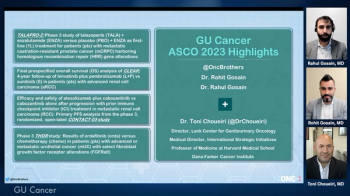
Rohit Gosain, MD, and Rahul Gosain, MD, summarize recent key data updates for genitourinary cancers following the 2023 ASCO Annual Meeting.
During a Targeted Oncology™ Case-Based Roundtable™ event, Pedro C. Barata, MD, MSc, and participants discussed when in sequence they would use sacituzumab govitecan for patients with metastatic urothelial cancer. This is the second of 2 articles based on this event.

During a Targeted Oncology™ Case-Based Roundtable™ event, Pedro C. Barata, MD, MSc, discussed data supporting the use of sacituzumab govitecan in advanced urothelial carcinoma.
In the KEYNOTE-045 and KEYNOTE-052 trials, pembrolizumab continued to led to durable responses with no new safety signals after 5 years.

In an interview with Targeted Oncology™, Rohan Garje, MD, discussed available therapies, how to assess risks, and manage toxicities for patients with renal cell carcinoma.

The phase 1 study of ADXS-504 for the treatment of early prostate cancer is ongoing and new patients with be enrolled to test a higher dose level.
Results from a phase 3 study show that the continuous maintenance therapy of enzalutamide reduces the risk of disease progression in certain patients with metastatic castration resistant prostate cancer.

In a first-in-human trial, a peptide-drug conjugate showed tolerability and antitumor activity in patients with advanced solid tumors.

Patients with metastatic castration-resistant prostate cancer treated with darolutamide for more than 4 years tolerated well the adverse effects of the drug.

The FDA has granted approval to the agent formerly known as 177Lu-PSMA-617 for the treatment of patients with metastatic castration-resistant prostate cancer in the post androgen receptor pathway inhibition, post-taxane-based chemotherapy setting.
In an interview with Targeted Oncology™, Sumtha K. Pal, discussed the most interesting research presented during ASCO Genitourinary Cancers Symposium.

Following the important information provided by the phase 3 VESPER trial, Jean Hoffman-Censits, Md said there are several noteworthy ongoing phase 3 neoadjuvant immunotherapy studies in bladder cancer.
Overall survival was prolonged with the addition of darolutamide to androgen-deprivation therapy and docetaxel in patient with metastatic, hormone-sensitive prostate cancer.
The phase 2 PERICLES trial of atezolizumab with or without radiotherapy in patients with stage IV cancer did not meet its primary end point of 1-year progression-free survival.
Advertisement
Advertisement
Trending on Targeted Oncology - Immunotherapy, Biomarkers, and Cancer Pathways
1
Denosumab Biosimilar Approved For Existing Oncology Indications
2
Plinabulin Receives FDA Fast Track Designation in Post-ICI NSCLC
3
FDA Oncology Recap: Approvals, Designations, and Decisions in September 2026
4
Giredestrant Plus Everolimus Improves PFS in ER+ Advanced Breast Cancer
5