





HEMATOLOGY
Latest News
Advertisement
Latest Videos




CME Content



































Advertisement
More News

Based on case details, Yi-Bin Chen, MD, and a group of peers discussed the probability of a patient developing acute graft-versus-host-disease and how to treat the disease.

The FDA has granted fast track designation to SNDX-5613 for the treatment of adult and pediatric patients with relapsed or refractory acute leukemias who harbor a mixed lineage leukemia rearranged or nucleophosmin mutation.
The defining feature of the 5th Annual Live Medical Crossfire®: Hematologic Malignancies program is the extensive interactivity between faculty and audience.
Responses After ASCT Were Extended With Daratumumab Maintenance and Standard Consolidation/Induction
The use of daratumumab as maintenance therapy for patients with newly diagnosed multiple myeloma who received autologous stem cell transplant plus induction and consolidation therapy with bortezomib, thalidomide, and dexamethasone was beneficial.
Without requiring red blood cell transfusions, luspatercept-aamt led to a mean increase in hemoglobin from baseline levels in 77.1% of patients compared with in 0% treated with placebo in patients with non-transfusion–dependent β-thalassemia in the phase 2 BEYOND trial, according to a presentation during the European Hematology Association 2021 Virtual Congress.

A combination of zandelisib and zanubrutinib induced significant responses, including several complete responses in patients with relapsed or refractory chronic lymphocytic leukemia and other B-cell lymphomas in a phase 1b study, the results of which were presented during the 2021 European Hematology Association Annual Congress.
Naratuximab emtansine in combination with rituximab showed deep responses and a duration of response that was not reached in patients with relapsed or refractory diffuse large B-cell lymphoma, according to findings from a phase 2 trial presented during the EHA 2021 Virtual Congress.
The FDA has granted the expanded use of ravulizumab-cwvz to include the treatment of children aged 1 month and older and adolescents with paroxysmal nocturnal hemoglobinuria.
Based on clinical trial research, ruxolitinib is a viable option for the treatment of acute graft-versus-host-disease. The agent has been shown to induce durable responses.
AB-205 demonstrated robust effects and an encouraging safety profile in patients with systemic lymphoma undergoing high-dose therapy and autologous hematopoietic stem cell transplantation.
Findings from the phase 3 REACH2 trial demonstrated a lower risk of relapse and longer median duration of response with ruxolitinib versus best available therapy in patients with steroid-refractory acute graft-versus-host disease.
Administered narsoplimab in patients with high-risk hematopoietic stem cell transplant– associated thrombotic microangiopathy resulted in a response rate of 61% among all patients treated with the monoclonal antibody
Pashna N. Munshi, MD, discussed the case of a 48-year-old male patient with acute graft-versus-host-disease.
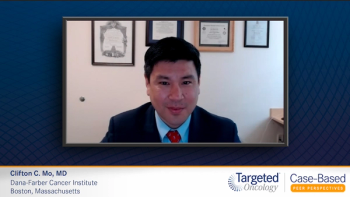
Multiple myeloma expert, Dr Clifton Mo, shares his insights on future directions for the treatment of multiple myeloma.
An expert hematologist-oncologist provides his perspective on the importance of managing toxicities in patients with relapsed/refractory multiple myeloma.
Clifton C. Mo, MD, reviews the ongoing multicenter phase 1 STOMP trial in relapsed/refractory multiple myeloma.
An expert hematologist-oncologist reviews the randomized, phase 3 BOSTON trial of a selinexor-based triplet regimen for the treatment of multiple myeloma.
Dr Clifton Mo describes second-line treatment options for the management of multiple myeloma, and treatment approaches for IMiD- and anti-CD38–refractory MM.
An expert hematologist-oncologist reviews the standard of care for transplant-eligible and transplant-ineligible patients with newly diagnosed MM and explores the role of quadruplet induction regimens.
Clifton C. Mo, MD, presents the case of a 79-year-old woman with R-ISS stage I multiple myeloma and shares his initial impressions.
Clifton C. Mo, MD, provides insight on the management of multiple myeloma and evaluates the role of current treatment regimens.
During a Targeted Oncology Case-Based Roundtable event, Joseph Mikhael, MD, discusses responses observed in transplant-eligible patients with multiple myeloma.
Citing clinical pearls from her own experience in working with patients with relapsed/refractory follicular lymphoma, Kami Maddocks, MD, gives advice to colleagues in their efforts to combat follicular lymphoma.
Kami Maddocks, MD, lists the future directions and unmet needs present in treating relapsed/refractory follicular lymphoma.
The challenges faced in treating patients beyond second-line treatment are addressed. Kami Maddocks, MD, reviews the frequency of patients who require third- and fourth-line treatment, in addition to the factors that affect treatment decisions in later lines of therapy.
Advertisement
Advertisement
Trending on Targeted Oncology - Immunotherapy, Biomarkers, and Cancer Pathways
1
David DiBardino, MD, on the Rationale for Intratumoral Therapy in Lung Cancer
2
FDA Grants Final Approval to Cabozantinib Capsule Formulation
3
Four Approvals Reflect Growth in Hormone-Sensitive Prostate Cancer Treatment
4
Subcostal Robotic Surgery Cuts Thoracic Pain
5