



MULTIPLE MYELOMA
Latest News
Advertisement
Latest Videos









































Advertisement
More News
Abdullah M. Khan, MBBS, discusses the recent updates to data on the use of idecabtagene vicleucel in patients with relapsed/refractory multiple myeloma.
In early lines of therapy for relapsed/refractory multiple myeloma, patients receiving cilta-cel demonstrated deep and enduring responses, with overall response rates of 95% and 100% in 2 cohorts.

Bispecific antibodies are a powerful class of therapy that offer an alternative or complement to CAR T-cell therapies, but there are similar challenges to implementing them in clinical practice. In live events, experts discussed their experience setting up standard operating procedures in their cancer centers.

Adam Binder, MD, discusses what he found to be notable from the results of the phase 3 BOSTON trial that looked at the efficacy of selinexor, bortezomib, and dexamethasone triplet therapy for patients with relapsed/refractory multiple myeloma.

Linvoseltamab shows promise for patients with heavily pretreated multiple myeloma, achieving a 71% overall response rate in a phase 1/2 trial.
The reduced dosing frequency of 1.5 mg/kg every 2 weeks for teclistamab in relapsed/refractory multiple myeloma who have sustained a complete response or better for at least 6 months provides flexibility in dosing schedules for patients.
In this episode of Targeted Talks, Ben Derman, MD, dissects the latest advancements in myeloma treatment, focusing on the role of ClonoSeq and minimal residual disease monitoring.

Paula Rodriguez-Otero, MD, PhD, provides an overview of the phase 3 KarMMa-3 trial of idecabtagene vicleucel for the treatment of adult patients with relapsed and refractory multiple myeloma.

At a live virtual event, Jack Khouri, MD, discussed how treatment options for patients with relapsed/refractory multiple myeloma have evolved with the use of bispecific antibodies giving physicians the opportunity to target BCMA and GPRC5D on the plasma cell.

According to an interim analysis of the DREAMM-7 trial, belantamab mafodotin, bortezomib, and dexamethasone achieved a statistically significant and clinically meaningful improvement in progression-free survival among patients with multiple myeloma.

In the second article of a 2-part series, Douglas Sborov, MD, discusses the toxicities seen with isatuximab and how this therapy can impact patients in rural areas relying on community center treatment.

The FDA’s Oncologic Drug Advisory Committee will be held on March 15, 2024, to review data pertaining to the supplemental biologics license application of ide-cel in relapsed or refractory multiple myeloma.
Paul Richardson, MD, further discusses the data from the CC-92480-MM-002 trial, and future directions for research of mezigdomide combinations for patients with relapsed/refractory multiple myeloma.
Paul Richardson, MD, discusses the safety and efficacy findings from the CC-92480-MM-002 trial of mezigdomide with dexamethasone and daratumumab or elotuzumab in patients with relapsed/refractory multiple myeloma.
The application is based on promising findings from the phase 3 PERSEUS trial which were presented at the American Society of Hematology Annual Meeting in December 2023.
Paul Richardson, MD, discusses the baseline characteristics of the patients with relapsed/refractory multiple myeloma enrolled in the CC-92480-MM-002 trial.
Paul Richardson, MD, discusses the background and design of the CC-92480-MM-002 trial in multiple myeloma.
Binod Dhakal, MD, MS, discusses the safety data from the phase 2 IMPEDE study of isatuximab, pomalidomide, elotuzumab, and dexamethasone for the treatment of patients with relapsed/refractory multiple myeloma.
The investigational new drug application for OriCAR-017 has been cleared by the FDA for the treatment of patients with relapsed/refractory multiple myeloma.
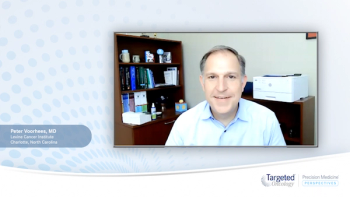
In this companion article, Dr Peter Voorhees provides insights into effective management of patients with newly diagnosed multiple myeloma (NDMM).

Practical insights for the management of patients with NDMM.
Summary of findings presented at the 2023 ASH meeting from this phase 2 trial using daratumumab, bortezomib, thalidomide and dexamethasone with tandem autologous stem cell transplant in high risk newly diagnosed multiple myeloma patients.
Review of the final analysis of data from the MASTER clinical trial assessing daratumumab plus carfilzomib, lenalidomide and dexamethasone.
Overview of findings from this phase 3 study evaluating isatuximab added to carfilzomib, lenalidomide and dexamethasone.
Review of the key primary outcome data from this trial of subcutaneous daratumumab with bortezomib, lenalidomide and dexamethasone for newly diagnosed transplant eligible multiple myeloma patients.
Advertisement
Advertisement
Trending on Targeted Oncology - Immunotherapy, Biomarkers, and Cancer Pathways
1
Anito-Cel Delivers Durable Responses With Low Neurotoxicity in RRMM
2
Risk, Histology, and Metastatic Site Guide First-Line RCC Treatment Choices
3
FDA Application Withdrawn for I-DXd in Small Cell Lung Cancer
4
Elinzanetant Gets Priority Review for VMS From Breast Cancer Endocrine Therapy
5