



MULTIPLE MYELOMA
Latest News
Advertisement
Latest Videos










































Advertisement
More News
Anitocabtagene autoleucel showcased early efficacy with acceptable toxicity in patients with relapsed and/or refractory multiple myeloma—even in those with high-risk features.
Induction therapy with subcutaneous daratumumab followed by autologous stem cell transplant and D-VRd consolidation and daratumumab/lenalidomide maintenance significantly prolonged progression-free survival.
Study findings support the use of a financial navigation program, in hopes to aid patients with multiple myeloma affected by financial toxicity.
Dose reductions of the GPRC5D/CD3 bispecific antibody talquetamab effectively improved on-target adverse events while sustaining high response rates for patients with relapsed/refractory multiple myeloma.

In the second article of a 2-part series, Joshua Richter, MD, discusses how the isatuximab, carfilzomib, and dexamethasone regimen fits into the landscape of treatment for patients with early relapsed multiple myeloma.
Investigators in the MCARTY study reported safety and high response rates in a small number of patients with relapsed/refractory multiple myeloma who received chimeric antigen receptor T-cell therapy designed with a new process to target the D8 binder, meant to improve efficacy in targeting BCMA.
Idecabtagene vicleucel improved health-related quality of life compared with standard regimens in patients with triple-class exposed, relapsed/refractory multiple myeloma.
The retrospective analysis demonstrated comparable outcomes with teclistamab from the phase 2 MajesTEC-1 trial, highlighting the need for close monitoring and supportive care in patients treated for their relapsed or refractory multiple myeloma.

During a Targeted Oncology™ Case-Based Roundtable™ event, Saulius K. Girnius, MD, and participants discussed use of combination therapies including daratumumab as frontline therapy for patients with transplant-eligible multiple myeloma.

During a Targeted Oncology™ Case-Based Roundtable™ event, Robert Mancini, PharmD, BCOP, FHOPA, discussed the various approved bispecific T-cell engagers and gave guidance for healthcare professionals, patients, and caregivers related to adverse event management. This is the second of 2 articles based on this event.
During a Targeted Oncology™ Clinical Case Forum event in partnership with the South Carolina Oncology Society, Hamza Hashmi, MD, discusses the significance of the MajesTEC-1 of the bispecific T-cell engager teclistamab for patients with relapsed/refractory multiple myeloma.

During a Targeted Oncology™ Case-Based Roundtable™ event, Jonathan L. Kaufman, MD, discussed results of the MonumenTAL-1 trial of talquetamab in patients with heavily pretreated relapsed/refractory multiple myeloma. This is the first of 2 articles based on this event.

A real-world analysis found that patients with acute coronary syndrome who were also diagnosed with a hematologic malignancy had worse survival outcomes, and patients with multiple myeloma were overrepresented in the population.

The phase 3 DREAMM-7 trial met its primary end point of progression-free survival, and overall survival data is trending positively.
Steady-state and chemotherapy-based mobilization both demonstrate feasibility in stem cell collection for patients with multiple myeloma undergoing autologous stem cell transplants, but challenges remain.
In the first article of a 2-part series, Sumit Madan, MD, discusses how the combination of selinexor, bortezomib, and dexamethasone shows superior survival outcomes for patients with relapsed/refractory multiple myeloma that are proteasome inhibitor naive or have high-risk cytogenetics.
During a Case-Based Roundtable event, Robert Mancini, PharmD, BCOP, FHOPA, discusses his experience setting up procedures for administering bispecific T-cell engagers for a large community oncology practice. This is the first of 2 articles based on this event.
In the first article of a 2-part series, Joshua Richter, MD, discussed how the triplet therapy of isatuximab, carfilzomib and dexamethasone, has impacted treatment considerations for patients with high-risk multiple myeloma.

Clark DuMontier, MD, discusses the main takeaways from his presentation on treatment intensity and frailty in newly diagnosed patients with multiple myeloma given at the 20th International Myeloma Society Annual Meeting.
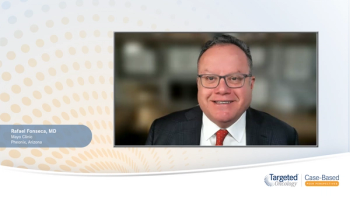
Rafael Fonseca, MD, envisions a future where bispecific antibodies and CAR T-cell therapy, currently used in advanced stages of multiple myeloma treatment, can offer potential cure for patients, and emphasizes the importance of advocating for their broader application in community settings.
An expert oncologist discusses novel treatments for relapsed/refractory multiple myeloma presented at recent meetings, highlighting a study on elranatamab, a new compound targeting BCMA, and trials including the LINKER-MM1 study on linvoseltamab.
Rafael Fonseca, MD, discusses the sequencing of CAR-T and bispecific antibodies in patients with relapsed/refractory multiple myeloma and tailoring treatment based on prior medical history for elderly and frail individuals.
Dr Fonseca shares findings from the MonumenTAL-1 trial presented at ASCO 2023, suggesting potentially reduced infection rates in patients with relapsed/refractory multiple myeloma receiving talquetamab relative to BCMA-targeted agents.

In the second article of this 2-part series, Sikander Ailawadhi, MD, discusses how understanding the safety profile of the bispecific antibody teclistamab allows for physicians to treat and monitor their patients in a better way for them.
The role of risk stratification in treatment decisions for patients with newly diagnosed, transplant eligible multiple myeloma vs newly diagnosed, transplant ineligible multiple myeloma was explored by Natalie S. Callander, MD.
Advertisement
Advertisement
Trending on Targeted Oncology - Immunotherapy, Biomarkers, and Cancer Pathways
1
Anito-Cel Delivers Durable Responses With Low Neurotoxicity in RRMM
2
Risk, Histology, and Metastatic Site Guide First-Line RCC Treatment Choices
3
FDA Application Withdrawn for I-DXd in Small Cell Lung Cancer
4
Elinzanetant Gets Priority Review for VMS From Breast Cancer Endocrine Therapy
5