



MULTIPLE MYELOMA
Latest News

Advertisement
Latest Videos










































Advertisement
More News





Results of the phase II DREAMM-2 trial recently published in The Lancet Oncology showed that the investigational agent belantamab mafodotin induced response rates above 30% and had a manageable safety profile in patients with heavily pretreated multiple myeloma.

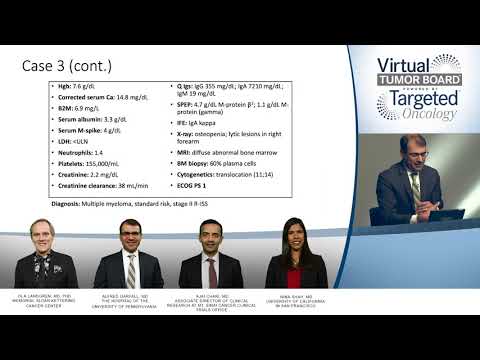
During a Targeted Oncology™ case-based peer perspectives live discussion, Ravi Vij, MD, MBA, professor, Department of Medicine, Oncology Division, Bone Marrow Tranplantation & Leukemia, Washington University School of Medicine in St. Louis spoke with a group of oncologists about best practices for treating patients with multiple myeloma. The ideas he presented were based on a real case of a male patient with multiple myeloma.




Transplant-Eligible Newly Diagnosed Multiple Myeloma
Outcomes in Newly Diagnosed Transplant-Ineligible Multiple Myeloma
The phase III BELLINI trial demonstrated translocation 11;14 and high BCL2 gene expression are predictive of response to treatment with the addition of venetoclax to bortezomib plus dexamethasone in patients with relapsed/refractory multiple myeloma, according to the findings presented at the 2019 ASH Annual Meeting.
A significant proportion of patients with transplant-ineligible newly diagnosed multiple myeloma alive and progression free after >3 years following treatment with daratumumab in addition to standard first-line therapy, according to updated safety and efficacy findings from the randomized ALCYONE study.
In the phase I CRB-402 study, patients with heavily pretreated relapsed/refractory multiple myeloma and minimal residual disease negativity had very good partial responses to the anti-BCMA CAR T cell therapy bb21217, according to updated results presented at the 2019 American Society of Hematology Annual Meeting.<br />
Advertisement
Advertisement
Trending on Targeted Oncology - Immunotherapy, Biomarkers, and Cancer Pathways
1
Anito-Cel Delivers Durable Responses With Low Neurotoxicity in RRMM
2
Risk, Histology, and Metastatic Site Guide First-Line RCC Treatment Choices
3
FDA Application Withdrawn for I-DXd in Small Cell Lung Cancer
4
Elinzanetant Gets Priority Review for VMS From Breast Cancer Endocrine Therapy
5