A panelist discusses how the unclear request format creates ambiguity about which case is being referenced, making it difficult to provide specific details that stand out without additional context.


Your AI-Trained Oncology Knowledge Connection!
A panelist discusses how the unclear request format creates ambiguity about which case is being referenced, making it difficult to provide specific details that stand out without additional context.

An expert discusses how adjuvant therapy options for high-risk muscle-invasive bladder cancer (MIBC); ypT2-ypT4a or N+) include cisplatin-based chemotherapy, which improves survival by targeting micrometastatic disease. Immune checkpoint inhibitors, such as atezolizumab and nivolumab, offer alternatives for cisplatin-ineligible patients.

Panelists discuss next-generation ROS1 inhibition, highlighting emerging therapies, their mechanisms of action, and potential benefits for patients with ROS1-positive metastatic non–small cell lung cancer.
Panelists discuss the presentation and management of a case involving metastatic non–-small cell lung cancer (NSCLC) with a ROS1 alteration, focusing on treatment approaches and clinical considerations
An expert discusses how patients with muscle-invasive urothelial carcinoma (MIUC) undergoing radical cystectomy face a significant recurrence risk. High-risk factors include advanced stage, lymph node involvement, and positive surgical margins. Neoadjuvant cisplatin-based chemotherapy can improve survival but does not eliminate recurrence risk. Other predictors include lymphovascular invasion, variant histology, and systemic inflammation markers.
Geoffrey Shouse, DO, PhD, discusses the growing interest in bispecific antibodies within the field of oncology.

Panelists discuss how combining systemic therapy with locoregional treatments like transarterial chemoembolization (TACE) aims to enhance therapeutic efficacy by addressing its limitations, such as incomplete tumor necrosis and hypoxia-induced progression. Tyrosine kinase inhibitors (TKIs) like lenvatinib and immune checkpoint inhibitors (ICIs) counteract TACE-induced resistance by inhibiting angiogenesis and boosting immune response, improving overall tumor control.

An expert discusses using sequence therapies based on disease progression, patient factors, and resistance mechanisms. After a first-line tyrosine kinase inhibitor plus immune checkpoint inhibitor (TKI + ICI) regimen, preferred subsequent-line options include alternative TKIs, chemotherapy, or combination strategies, tailored to patient response and tolerability.
Panelists discuss how systemic therapy plays a crucial role in embolization-eligible hepatocellular carcinoma (HCC), particularly for patients with progressive or extensive disease. In locally advanced cases, systemic therapies, including immunotherapy combinations and tyrosine kinase inhibitors (TKIs), are first-line options. Patients typically transition from transarterial chemoembolization (TACE) to systemic therapy upon progression, high tumor burden, or liver function decline.
An expert discusses how third line (3L) systemic therapy for metastatic renal cell carcinoma (mRCC) is guided by prior treatments, patient comorbidities, and drug-specific profiles. Options include tyrosine kinase inhibitors (TKIs; eg, tivozanib, cabozantinib), mTOR inhibitors (eg, everolimus), and immune-oncology– based approaches. Efficacy, tolerability (grade 3/4 adverse events [AEs]), and pharmacokinetic (PK) differences drive selection. Dose modifications, such as for tivozanib and lenvatinib/everolimus, balance efficacy and safety. Selection prioritizes sequencing strategy, with evidence (eg, Pal 2022) supporting reduced-dose efficacy.
Jennifer Marie Suga, MD, shares the lung cancer research she’s eager to explore as new data emerges.

The panelist discusses how for patients initially eligible for embolization, systemic therapy may be combined with transarterial chemoembolization (TACE) upfront for high-risk disease (ie, large tumor burden, elevated AFP) or reserved for progression after regional therapy in lower-risk cases. Treatment decisions should be individualized based on tumor characteristics, liver function, and patient preferences.
A panelist discusses how patient-reported outcomes have transformed their ability to deliver more personalized care approaches for patients with polycythemia vera (PV) by providing critical insights into symptom burden, quality-of-life impacts, and treatment effectiveness that might otherwise go unrecognized through standard clinical assessments alone.
The panelist discusses how the patient underwent transarterial chemoembolization (TACE) 3 times with an initial partial response. However, at the end of the 6-month treatment period, the patient had disease progression. The panelist advises that the best treatment option for the patient would be systemic therapy.
A panelist discusses how advances in JAK2 V617F and other molecular monitoring have enhanced their ability to assess polycythemia vera (PV) disease progression and guide initial treatment decisions by providing quantifiable markers for tracking mutation burden, treatment response, and risk stratification that complement traditional clinical parameters.
Marwan G. Fakih, MD, discusses the next steps for the clinical development of the balstilimab plus botensilimab in microsatellite stable metastatic colorectal cancer without liver metastases.

Paolo Ghia, MD, PhD, discusses the CAPTIVATE trial in chronic lymphocytic leukemia/small lymphocytic lymphoma, and what findings from the trial have been particularly noteworthy.
Hedy Lee Kindler, MD, explains the new treatment updates for patients with mesothelioma.
An expert discusses how blastic plasmacytoid dendritic cell neoplasm (BPDCN) is a rare hematologic malignancy derived from plasmacytoid dendritic cell precursors, presenting with skin lesions, lymphadenopathy, and bone marrow involvement. For a man aged 62 years, key concerns include rapid progression, immunophenotypic complexity, and potential misdiagnosis. Diagnostic challenges arise from its rarity and overlapping features with other hematologic disorders. Improved outcomes require multidisciplinary teams, standardized testing protocols, and specialized referral centers.
An expert discusses the patient case of a man aged 62 years who is newly diagnosed with blastic plasmacytoid dendritic cell neoplasm (BPDCN). The patient initially presented to the dermatologist with a progressive and persistent rash notable for bumps and nodules. The nodules presented a violet-like color, beginning on his forehead and spreading to the rest of his body.

An expert discusses what stands out most about this patient’s molecular profile and how these insights enhance the diagnostic approach in myeloproliferative neoplasms (MPNs).
An expert discusses the case of a 68-year-old woman diagnosed with primary myelofibrosis.

Panelists discuss how detailed analyses from KarMMa-3 reveal key insights about ide-cel’s performance across patient subgroups, timing of responses, durability of remissions, and management of adverse effects in relapsed/refractory multiple myeloma (RRMM).
Panelists discuss how the KarMMa-3 trial demonstrated superior efficacy of idecabtagene vicleucel (ide-cel) chimeric antigen receptor T-cell therapy compared to standard treatment regimens in patients with heavily pretreated, triple-class–exposed relapsed/refractory multiple myeloma (RRMM).

Joe Leach, MD, discusses some of the latest developments in incorporating immunotherapy into small cell lung cancer treatment regimens.
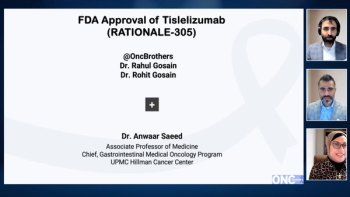
The panelists discuss how the RATIONALE-306 trial demonstrated efficacy outcomes through its design, measuring both progression-free survival and overall survival as key end points.

A panelist discusses how treatment sequencing decisions in RCC span multiple lines of therapy, incorporating various options like tivozanib, lenvatinib-everolimus combinations, and belzutifan, with careful consideration given to optimal dosing strategies, expected duration of therapy, anticipated response patterns, and the specific timing of each agent in the treatment journey, particularly in the post-ICI setting.

An expert discusses the safety findings from the PEACE-3 study, highlighting the adverse events associated with the combination of enzalutamide and radium-223 in ARPI-naïve metastatic castration-resistant prostate cancer.
An expert discusses the key efficacy findings from the PEACE-3 study, including results on radiographic progression-free survival (rPFS) and overall survival (OS), and offers insights on how to interpret and apply these results in clinical practice.
A panelist discusses how second-line therapy selection in metastatic RCC requires careful consideration of multiple factors including prior treatment response, individual patient characteristics, specific drug properties (such as mechanism of action and pharmacokinetics), strength of clinical evidence, and practical considerations like tolerability and quality of life, while acknowledging current evidence gaps and unmet needs in the post-ICI treatment landscape.