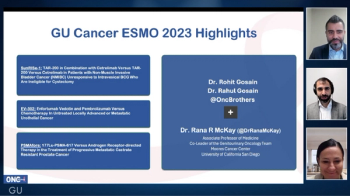
Key opinion leader Rana McKay, MD, joins the Oncology Brothers Rahul Gosain, MD, and Rohit Gosain, MD, to review updated data in GU cancer from ESMO 2023, starting with TAR-200 monotherapy in patients with NMIBC and the SunRISE-1 trial.

Key opinion leader Rana McKay, MD, joins the Oncology Brothers Rahul Gosain, MD, and Rohit Gosain, MD, to review updated data in GU cancer from ESMO 2023, starting with TAR-200 monotherapy in patients with NMIBC and the SunRISE-1 trial.
Bradley McGregor, MD, discusses the rationale behind the multi-institutional, prospective, single-arm phase 2 trial of cabozantinib, nivolumab, and ipilimumab for the treatment of patients with renal cell carcinoma with variant histologies.

Nirav Shah, MD, discusses long-term data from the phase 1/2 BRUIN study which evaluated pirtobrutinib in mantle cell lymphoma, and next steps for evaluating the agent.

Vijaya Raj Bhatt, MBBS, MS, discusses background and findings from a multicenter, phase 2 study of ruxolitinib for the treatment of patients with steroid refractory sclerotic chronic graft-versus-host disease.
Explores the intricate decision-making process for frontline treatment in BPDCN patients, with considerations for age, fitness, and various therapeutic approaches.
Expert insight into the diagnostic markers and challenges of BPDCN, including the importance of involving dermatologists and pathologists, to identify various disease presentations in both adult and pediatric patients.
Matthew Ulrickson, MD, discusses a patient case of BPDCN, emphasizing the importance of recognizing and treating this rare disease, exploring various treatment options, and highlighting the evolving prognosis.
Lucia Masarova, MD, PhD, discusses the rationale of the EXCEED-ET study of ropeginterferon alfa-2b-njf for patients with essential thrombocytopenia.
A discussion on streamlining patient care processes between urologists and medical oncologists while maintaining treatment continuity and minimizing disruptions for patients with prostate cancer.
Dr Rafael Fonesca reviews data from the TriMM-2 study presented at ASCO 2023 investigating combination talquetamab plus daratumumab for patients with relapsed/refractory multiple myeloma, highlighting a 78% response rate to talquetamab, but noting side effects like CRS and infections.
The RELATIVITY-047 trial evaluated relatlimab and nivolumab versus nivolumab alone in patients with metastatic melanoma, revealing improved progression-free survival, while PDL-1 status wasn't predictive of outcomes.
Experts share insights into collaborative relay strategies between urologists and medical oncologists that ensure smooth handoffs and continued care for patients with prostate cancer receiving combination therapies.
Hussein Tawbi, MD, PhD, explains that LAG-3 is a marker of T-cell exhaustion, and combining LAG-3 inhibitors with PD-1 inhibitors can reverse this exhaustion, enhancing T-cell effectiveness and showing therapeutic benefits in patients with metastatic melanoma.
Rafael Fonseca, MD, emphasizes the considerations of selecting therapies targeting specific markers like BCMA and GPRC5D in patients with relapsed/refractory multiple myeloma, such as prior exposures, efficacy, and potential side effects.
Explore the criteria for considering doublet or triplet therapies in advanced prostate cancer, examining their potential benefits and minimal added toxicity as discussed by key opinion leaders.

Hayder Saeed, MD, discusses how the mechanism of action of tafasitamab makes the therapy a potent cancer cell killer for patients with diffuse large B-cell lymphoma.
Tracy Proverbs-Singh, MD, and Steven Lee-Kong, MD, reflect on how to incorporate sequencing and personalized treatments effectively in oncology practice.
Key opinion leaders explore the evolving landscape of precision medicine in gastrointestinal cancers and how molecular profiling is transforming treatment decisions for patients.

Joan Culpepper-Morgan, MD, provides an overview on different treatment approaches for patients with hepatocellular carcinoma.

Joshua K. Sabari, MD, discusses where research on LY3537982 for patients with KRAS G12C-mutant advanced solid tumors is headed.

Matthew Powell, MD, discusses next steps and unmet needs following the phase 3 RUBY/ENGOT-EN6 study and the FDA approval of dostarlimab in combination with chemotherapy for the treatment of patients with mismatch repair deficient/microsatellite instability-high primary advanced or recurrent endometrial cancer.
Key opinion leaders review the evolving landscape of metastatic HSPC, exploring the benefits and considerations of triplet combination therapies, including chemotherapy and ARPI agents.
David Morris, MD, FACS, and Benjamin Garmezy, MD, discuss treatment options, including ARPIs like enzalutamide and darolutamide, in nmCRPC, emphasizing the importance of personalized approaches for patient quality of life and outcome improvement.
In a discussion with Targeted Oncology, David Dingli, MD, PhD, looks at how the use of step-up dosing with tecalistimab helped avoid many serious adverse events.

Adam J. Olszewski, MD, discusses findings from a phase 1b/2 study which evaluated treatment with mosunetuzumab for the treatment of elderly/unfit patients who were previously untreated for their diffuse large B-cell lymphoma.
Adam Brufsky, MD, PhD, FACP, discusses background and next steps of the phase 3 PALOMA-2 study which evaluated palbociclib plus letrozole in patients that identified as Black or Hispanic with advanced breast cancer.
Dr Fonseca discusses the prognosis of a patient with relapsed/refractory multiple myeloma, noting the patient's history with treatments like venetoclax and dexamethasone, and the ultimate decision to switch to talquetamab, a GPRC5D-directed bispecific antibody.
Rafael Fonseca, MD, presents the clinical case of a 66-year-old man with relapsed/refractory multiple myeloma for review.
Hussein Tawbi, MD, PhD, explains that for patients with melanoma without a BRAF mutation, first-line therapies primarily include immunotherapy-based (IO) checkpoint inhibitors, with PD-1 inhibitor combination therapies being the current standard of care.
Hussein Tawbi, MD, PhD, highlights the importance of BRAF mutations and LDH levels in diagnosing patients with metastatic melanoma and guiding treatment.