
Debu Tripathy, MD, discusses the TBCRC049 study which evaluated tucatinib, capecitabine, and trastuzumab in the cerebral spinal fluid of patients with HER2-positive breast cancer and leptomeningeal disease.

Debu Tripathy, MD, discusses the TBCRC049 study which evaluated tucatinib, capecitabine, and trastuzumab in the cerebral spinal fluid of patients with HER2-positive breast cancer and leptomeningeal disease.
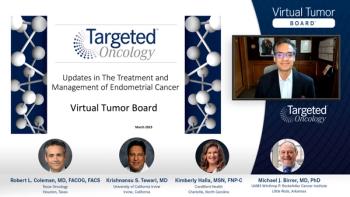
Opening its discussion on endometrial carcinoma, a panel of experts led by Robert L. Coleman, MD, reflects on a patient with mismatch repair proficient (MMRp) recurrent disease.
Focusing on the CROWN clinical trial in ALK+ NSCLC, expert panelists consider the role of frontline lorlatinib therapy in this setting.

Ken Kato, MD, PhD, discusses which patient characteristics to look out for when looking to put a patient on the combination of ipilimumab and nivolumab.
Neal Shore, MD, discusses the long-term exposure analysis of darolutamide in the phase 3 ARAMIS Rollover trial for patients with nonmetastatic castration-resistant prostate cancer.

Matthew P. Goetz, MD, discusses the next steps for evaluating treatment with lasofoxifene.
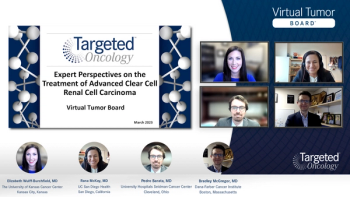
A panel of expert genitourinary oncologists give an overview of renal cell carcinoma and present the case of a 61-year-old man with metastatic clear cell RCC.
In this video, Edwin Choy, MD, discusses the NCCN Clinical Practice Guidelines for treating gastrointestinal stromal tumors.
Andrew Kuykendall, MD, discusses recent approvals seen for patients with myeloproliferative neoplasms.
A brief overview of study design, patient demographics, data from the phase 1 CHRYSALIS trial, which assessed the safety and efficacy of amivantamab in patients with EGFR exon 20-mutated, advanced or metastatic NSCLC.
Continuing the discussion of the presented case of EGFR exon 20-mutant mNSCLC, Dr Velázquez Mañana outlines how the patient experienced disease progression on first-line treatment, after which the panel shares clinical insights and best practices on how they might approach subsequent treatment selection in this scenario.
Pedro C. Barata, MD, MSc, explains how the favorable efficacy and tolerability of lenvatinib and pembrolizumab observed in the CLEAR trial helps provide a standard of care in this patient population.

Alexander Drilon, MD, discusses what to know when testing for NTRK gene fusions in patients with lung cancer.

Bruno Bockorny, MD, discusses the findings from a study of botensilimab plus bastilimab for the treatment of patients with recurrent platinum refractory/resistant ovarian cancer.
Edwin Choy, MD, discusses the evolution of treatment for gastrointestinal stromal tumors, including surgery and targeted therapy.
Sumanta “Monty” K. Pal, MD, FASCO, discuss exciting data in the renal cell carcinoma space.
Monty Pal, MD discusses the implications of updated NCCN guidelines on mRCC treatment selection and sequencing in 2023 as well as unmet needs in the mRCC treatment landscape.
A closer look at lenvatinib plus everolimus in patients with advanced renal cell carcinoma, touching on dose-related toxicities.
Thoughtful discussion of study data supporting the use of tivozanib in patients with metastatic renal cell carcinoma, in the relapsed/refractory setting.
Dr. Pal discusses clinical insights concerning treatment selection and sequencing in patients with metastatic renal cell carcinoma.
Monty Pal, MD, introduces a metastatic clear cell renal cell carcinoma (ccRCC) patient case and shares how he may approach treatment.
John Diaz, MD, discusses some of the challenges with using targeted therapies in the ovarian cancer space.

Michael Tees, MD, discusses the preliminary safety outcomes observed for an allogeneic chimeric antigen receptor T-cell therapy for large B-cell lymphoma.
Looking at the results of study assessing performing blood-based host immune classifier proteomic testing in patients with non–small cell lung cancer shows the potential for predicting the success of immunotherapy based on a patient’s biomarkers.

Pedro C. Barata, MD, MSc, discusses research topics to help bring more precision medicine options to the prostate cancer landscape.
Shared perspectives on the frontline use of brigatinib therapy in ALK+ NSCLC and results from the ALTA-1L clinical trial.
Centering discussion on clinical trial data in ALK+ NSCLC, panelists highlight the frontline use of alectinib in the ALEX study.
Gene G. Finley, MD, provides advice to community oncologists who are treating patients with small cell lung cancer.
Laura A. Dawson, MD, FRCPC, discusses the NRG/RTOG 1112 study for patients with hepatocellular carcinoma which evaluated stereotactic body radiation therapy followed by sorafenib compared with sorafenib alone.
Dr Bose engages with emergent trial data presented at the American Society of Hematology (ASH) 2022 Annual Meeting.