
Tycel Phillips, MD, discusses the agents available for the second-line treatment of diffuse large B-cell lymphoma, and the utility of chimeric antigen receptor T-cell therapy.

Tycel Phillips, MD, discusses the agents available for the second-line treatment of diffuse large B-cell lymphoma, and the utility of chimeric antigen receptor T-cell therapy.

Rana McKay, MD engages with critical gaps in mCRPC patient care, comments on promising clinical trials, and shares clinical pearls for community oncologists treating patients with mCRPC.
Subject matter expert reviews key trial data from recent years and explains how these data impact the prostate cancer treatment landscape.
Dr McKay shares her initial impressions of an mCRPC patient case before discussing typical patient treatment protocols, NCCN guidelines, and standard therapeutic options.
Rana McKay, MD introduces a metastatic castration-resistant prostate cancer (mCRPC) patient case featuring a 72-year-old man with a history of metastatic castration-resistant prostate cancer.
Carolyn Owen, MD, discusses minimal residual disease as an area of research in the chronic lymphocytic leukemia space.
Ariel Perez, MD, discusses polatuzumab vedotin in combination with bendamustine and rituximab since garnering approval from the FDA and studies that evaluated the combination.

Michael T. Tees, MD, discusses chimeric antigen receptor T-cell therapies, including ALLO-501A, and its use for patients with relapsed or refractory large B-cell lymphoma.

Abdulraheem Yacoub, MD, offers closing thoughts on the future myelofibrosis treatment landscape, with a focus on treatments under investigation.
A detailed overview on monitoring patients with myelofibrosis, and signs that a treatment isn’t effective.
An expert on myelofibrosis discusses recently updated data on momelotinib, which was recently submitted for FDA approval.
Abdulraheem Yacoub, MD, details the systemic therapy options for myelofibrosis and his approach to treatment sequencing.
A myelofibrosis expert discusses the indications for treatment initiation and transplantation for patients with myelofibrosis.
An expert on myeloproliferative neoplasms gives an overview of myelofibrosis and assessing patient risk.
Abdulraheem Yacoub, MD, presents the case of a 68-year-old woman with myelofibrosis and offers his initial impressions.

Dr Porter presents recent conference data on a matching-adjusted indirect comparison of amivantamab and mobocertinib for treatment of EGFR exon 20-mutated mNSCLC, and panelists weigh in on factors influencing selection between the two regimens.
Dr Jason Porter presents safety and efficacy data from a Phase 1/2 study on mobocertinib in patients with mNSCLC.

David S. Hong, MD, discusses updated findings from an analysis of 3 trials which ultimately led to the approval of larotrectinib for patients with solid tumors who harbor an NTRK fusion.

Nelson J. Chao, MD, offers closing thoughts on his treatment approach for a 35-year-old woman with chronic GVHD, and looks to the future of GVHD treatment.
A GVHD expert outlines the treatments available for patients with chronic GVHD and steroid-refractory chronic GVHD.
Nelson J. Chao, MD, gives an overview of acute and chronic GVHD, and details the classical presentation and staging process.
An expert on graft-vs-host disease discusses allogeneic stem cell transplantation, and reviews transplant conditioning and GVHD prophylaxis regimens.
Nelson J. Chao, MD, presents a patient profile of a 35-year-old woman diagnosed with chronic graft-vs-host disease, and provides his initial thoughts.

Lajos Pusztai, MD, DPhil, discusses the methods and design of the phase 3 KEYNOTE-522 trial.

Cary Gross, MD, discusses the findings from a retrospective study which revealed there to be an association between Medicaid insurance, rates of biomarker testing, and patient outcomes among patients with advanced non–small cell lung cancer.

Qian Wang, MD, MPH, discusses the changing incidence of small cell lung cancer among patients globally and in the United States.

John Allan, MD, presents the case of a 72-year-old woman with newly diagnosed chronic lymphocytic leukemia and shares his initial impressions.

Jason Luke, MD, discusses how the gated design of the REALITIVITY-047 led to results being delivered in phases for patients with advanced melanoma treated with the combination of relatlimab and nivolumab.
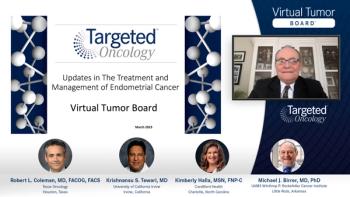
Experts Michael J. Birrer, MD, PhD, and Kimberly Halla, MSN, FNP-C, share insight to a typical patient presentation of MMRp recurrent endometrial carcinoma.
Following their review of clinical trial data behind frontline ALK TKIs in NSCLC, key opinion leaders share practical insight on selection and use of these agents.