A focused review of clinical trial data that inform the use of immune checkpoint inhibition in the setting of recurrent endometrial cancer.

A focused review of clinical trial data that inform the use of immune checkpoint inhibition in the setting of recurrent endometrial cancer.
An expert gynecologic oncologist shares her perspective on treatment options available to patients in the first- and second-line settings of endometrial cancer.
Opening her discussion on a patient case of recurrent endometrial cancer, Ritu Salani, MD, MBA, highlights the evolving role of molecular testing in this setting.
Bradley McGregor, MD, discusses the current landscape for advanced renal cell carcinoma therapies, emerging clinical evidence, and considerations for optimal treatment sequencing.

Matthew Anderson, MD, PhD, discusses how the results with niraparib for patients with advanced ovarian cancer impacts the use of somatic profiling in this patient population.
A panel of experts on renal cell carcinoma review updated data on IO-TKI regimens in advanced RCC, including the CheckMate 9ER, KEYNOTE-526, and CLEAR trials.
Expert oncologists give an overview of molecular testing, risk stratification, and treatment guidelines for renal cell carcinoma.

Bruno Bockorny, MD, explains the mechanism of action of botensilimab and its use in combination with balstilimab for ovarian cancer treatment.
Yuri E. Nikiforov, MD, PhD, discusses the approach to treating noninvasive follicular thyroid neoplasm with papillary-like nuclear features, which is now classified distinctly from thyroid cancers.

Emma Searle, discusses safety results of the MajestTEC-2 trial which combined teclistamab with daratumumab and lenalidomide in patients with multiple myeloma.

John T. Nauseef, MD, PhD, discusses an investigational prostate-specific membrane antigen targeted therapy for the treatment of metastatic castration-resistant prostate cancer.
Pierre Gholam, MD, discusses the phase 3 LEAP-002 study of lenvatinib and pembrolizumab for unresectable hepatocellular carcinoma.

Robert L. Coleman, MD, opens discussion on a second patient case and highlights critical aspects of mismatch repair deficient (dMMR) recurrent endometrial carcinoma.
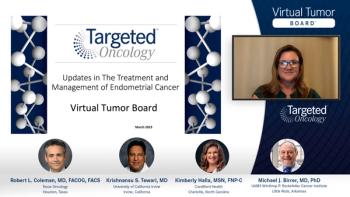
Before closing out their discussion on the first patient case, key opinion leaders on endometrial carcinoma reflect on the optimal selection and sequencing of therapy in pMMR recurrent disease.
Chad Tang, MD, discusses currently available treatment options and recent research in the prostate cancer space.
John Allan, MD, provides insights on novel agents and treatment strategies currently being studied in chronic lymphocytic leukemia.
An expert hematologist-oncologist offers advice for community oncologists who are treating patients with newly diagnosed chronic lymphocytic leukemia.
An overview of assessing risk of disease recurrence, steps taken to minimize recurrence, and when to consider second-line treatment for patients with CLL.
An expert on CLL reviews recent data updates from studies of BTK inhibitors in the frontline setting.
Mathew R. Smith, MD, PhD closes the discussion by sharing clinical pearls for community oncologists and highlights unmet needs in the CRPC landscape.
Dr. Smith presents key data concerning the use of darolutamide in patients with castration-resistant CRPC, with a focus on safety and patient quality of life.
John Allan, MD, an expert on chronic lymphocytic leukemia, details adverse events seen with venetoclax and obinutuzumab.
An expert on chronic lymphocytic leukemia reviews the CLL14 trial, evaluating venetoclax plus obinutuzumab in patients with previously untreated CLL.

Melanie Goldfarb, MD, MSc, FACS, FACE, discusses the current treatment landscape for patients with thyroid cancer.

John P. Diaz, MD, explains the importance of the topics to be discusses at the Miami Cancer Institute Women’s Cancer Symposium on April 21, 2023.
Neeta Somaiah, MD, discusses the expanding role of targeted therapies in patients with gastrointestinal stromal tumor and how these treatments are bolstering later lines of therapy.
John P. Diaz, MD, provides an overview of the topics to be discusses during the Miami Cancer Institute Women’s Cancer Symposium on April 21, 2023.
Closing out his review of HR+/HER2-low metastatic breast cancer management, Kevin Kalinsky, MD, considers unmet needs and ongoing investigation into novel treatment strategies.
Comprehensive insight to the treatment armamentarium for patients with HR+/HER2-low metastatic breast cancer and factors that help inform optimal sequencing.
Expert oncologist Kevin Kalinsky, MD, reviews the diagnosis and management of a 65-year old woman with HR+/HER2-low metastatic breast cancer.