
Jennifer R. Brown, MD, PhD, highlights the results from the phase 3 ALPINE study evaluating the treatment with zanubrutinib for the treatment of patients with relapsed/refractory chronic lymphocytic leukemia or small lymphocytic lymphoma.

Jennifer R. Brown, MD, PhD, highlights the results from the phase 3 ALPINE study evaluating the treatment with zanubrutinib for the treatment of patients with relapsed/refractory chronic lymphocytic leukemia or small lymphocytic lymphoma.

Samer A. Srour, MD, discusses the results of the phase 1 TRAVERSE trial of ALLO-316 in patients with advanced renal cell carcinoma.
Benjamin Besse, MD, PhD, discusses the biomarker analysis of the phase 1/1b CHRYSALIS-2 study of amivantamab and lazertinib in patients with EGFR-mutated non–small cell lung cancer.

Focused discussion on the first-line treatment armamentarium available to patients diagnosed with chronic lymphocytic leukemia.
Expert Andrew Lipsky, MD, reviews a patient case of relapsed/refractory chronic lymphocytic leukemia managed with BTK inhibition in the second-line setting.

Danielle M. Brander, MD, discusses updated results from the ELEVATE-TN trial of acalabrutinib in patients with chronic lymphocytic leukemia.

Eric Singer, MD, discusses the relevant data that led to the approval of sunitinib in the adjuvant treatment setting for renal cell carcinoma.

Elizabeth Davis, MD, explains the current treatment options available for patients with PEComa.
Andrew Folpe, MD, provides an overview of PEComas, including their incidence rate and malignant tumors.
Hatem Soliman, MD, discusses fam-trastuzumab deruxtecan-nxki and its importance for patients with HER2-positive breast cancer.

Karim Fizazi, MD, discusses the toxicities seen with the combination of talazoparib plus enzalutamide.

Warren Swegal, MD, explains how lenvatinib in currently used in the differentiated thyroid cancer landscape.
Karim Fizazi, MD, discusses findings from the phase 3 TALAPRO-2 trial which support the recent FDA approval of talazoparib plus enzalutamide in homologous recombination repair gene-mutated metastatic castration resistant prostate cancer.

Ruchi Garg, MD, discusses current treatment options and strategies being utilized for patients with endometrial cancer.
Benjamin Besse, MD, PhD, discusses the main findings and next steps of the phase 1/1b CHRYSALIS-2 study in EGFR-mutated non–small cell lung cancer.
Yazan Samhouri, MD, discusses the latest advancements in the diffuse large B-cell lymphoma treatment landscape.

Bradley J. Monk, MD, FACS, FACOG, explains the implications of the phase 3 KEYNOTE-826 clinical trial.
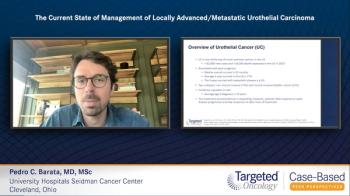
Expert perspectives on the current treatment paradigm for patients diagnosed with locally advanced or metastatic urothelial carcinoma.

Joshua K. Sabari, MD, discusses LY3537982 for patients with KRAS G12C-mutant advanced solid tumors.
Samer A. Srour, MD, discusses research on Orca-Q for patients undergoing haploidentical allogeneic hematopoietic stem cell transplantation.

Laura A. Dawson, MD, FRCPC, discusses key takeaways from the NRG/RTOG 1112 study of stereotactic body radiation therapy followed by sorafenib vs sorafenib alone in patients with hepatocellular carcinoma.

Expert oncologist Alicia Morgans, MD, MPH, shares her hope for future improvements in metastatic castration-resistant prostate cancer management as the landscape continues to evolve.
Comprehensive insight on the real-world use of lutetium Lu 177 vipivotide tetraxetan in metastatic castration-resistant prostate cancer management, given patient, disease, and logistical concerns.

Closing out her discussion on novel therapeutics in endometrial cancer, Ritu Salani, MD, MBA, shares excitement for ongoing evolutions within the treatment landscape.
Key opinion leader Alicia Morgans, MD, MPH, considers the role of lutetium Lu 177 vipivotide tetraxetan in metastatic castration-resistant prostate cancer management.
Expert perspectives on the VISION and TheraP trials, which utilized lutetium Lu 177 vipivotide tetraxetan, also known as lutetium-177–PSMA-617, in the setting of metastatic castration-resistant prostate cancer.
Expert Ritu Salani, MD, MBA, reviews data from TROPiCS-03 and considers the potential role for antibody drug conjugates in patients with advanced endometrial cancer.
A brief review of clinical trial data from RAINBO and GY020, which tested adjuvant immunotherapy following radiation in patients with endometrial cancer.
Focused discussion on the CARD trial, which utilized cabazitaxel therapy in patients with metastatic castration-resistant prostate cancer.
Focused discussion on single-agent immunotherapy in patients with advanced endometrial cancer following data from the PHAEDRA and DOMENICA clinical trials.