
A discussion on the toxicities associated with mTOR inhibitors and which patients with PEComa would be considered good candidates.

A discussion on the toxicities associated with mTOR inhibitors and which patients with PEComa would be considered good candidates.
Dr Andrew Wagner shares data from the AMPECT trial investigating the potential role of mTOR inhibitors in PEComa.
Jonathan C. Trent, MD, PhD, discusses the molecular analyses of the INTRIGUE study, which was supported by Caris Life Science’s Precision Oncology Alliance, investigating patients with GIST that were presented at ASCO 2023.

Ruchi Garg, MD, discusses the option of immunotherapy for the treatment of endometrial cancer.
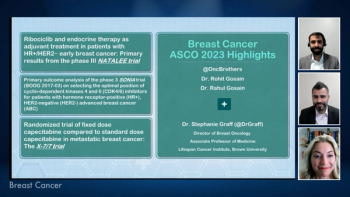
Following their interview with Stephanie Graff, MD, FACP, the Oncology Brothers share key takeaways from the NATALEE, SONIA, and X-7/7 trials and consider how they will impact the management of breast cancer.
The Oncology Brothers, joined by Stephanie Graff, MD, FACP, share their thoughts on data from the X-7/7 trial of fixed-dose capecitabine in patients with metastatic breast cancer.
Shared insight from the Oncology Brothers and Stephanie Graff, MD, FACP, on the role of CDK4/6 inhibition in combination with aromatase inhibitor therapy following data from the SONIA trial in HR+ metastatic breast cancer.
Expert oncologist Stephanie Graff, MD, FACP, joins the Oncology Brothers to review data from the NATALEE trial and consider the role of adjuvant ribociclib in patients with HR+ breast cancer.
Nicholas J. Roberts, discusses real-world research around the adoption of germline testing for breast cancer, and the testing gap in certain racial groups.

Colleen Danielson, NP shares the signs and symptoms she commonly sees in patients with graft versus host disease.

Yi-Bin Chen leads the panel in a review of various GVHD prophylaxis regimens.

David S. Hong, MD, discusses which disease subgroups may benefit from treatment with larotrectinib.

Cyrus M. Khan, discusses the current use of PI3K inhibitors to treat patients with chronic lymphocytic leukemia or small lymphocytic lymphoma and how recent ODAC decisions impacted their use.

Craig Horbinski, MD, PhD, discusses the classification of gliomas based on histology and molecular features.
Dennis J. Slamon, MD, discusses the rationale of the phase 3 NATALEE trial and ribociclib for the treatment of patients with HR+/HER2- early breast cancer.
Rohan Garje, MD, discusses the goals of his research in assessing the outcomes of sarcomatoid vs classic urothelial carcinoma of bladder.

Ashwin Kishtagari, MD, discusses the PERSIST-2 trial of pacritinib for patients with primary myelofibrosis and low platelet counts.
Dr Amy Dezern discusses the criteria for subtype classification and risk stratification in patients with MDS.
Amy Dezern, MD, MHS, shares the case of a 70-year-old man with MDS stratified as low-risk using the Revised International Prognostic Scoring System.

Lisa B. Ercolano, MD, discusses the treatment of sarcomas in an era of molecular medicine.
Dr Elizabeth Davis presents the case of a young woman with a TSC2-mutated uterine PEComa.
Andrew Wagner, MD, PhD, details his typical treatment approach for systemic therapy in patients with malignant PEComa.

Lori Muffly, MD, discusses findings a sub-analysis of a phase 1 study investigating briquilimab with low-dose total body radiation and fludarabine.

In the first installment of this series, Elias Jabbour, MD, provides an overview of myelodysplastic syndrome, discusses the current treatment landscape for lower-risk MDS, and offers insights on factors that influence treatment selection.
Dr Savona and Dr. Zeidan define lower- vs higher-risk MDS, describe their approach to risk stratification, and share how assessing risk is critical for developing treatment plans for patients.
Michael Savona, MD and Amer Zeidan, MBBS review the biology underlying myelodysplastic syndrome and explain the patient journey from symptom presentation to official diagnosis.

Catherine Lee explains risk factors that may contribute to the likelihood of a patient developing graft versus host disease.

A panel of experts discusses the types of graft versus host disease and the biologic pathways that are thought to be involved.
Dr Amer Zeidan explains the criteria he uses to assess risk in MDS, and why it is important to initiate treatment for lower-risk patients early.
Amer Zeidan, MBBS, discusses the signs and symptoms of lower-risk MDS and the tests typically used for diagnosis.