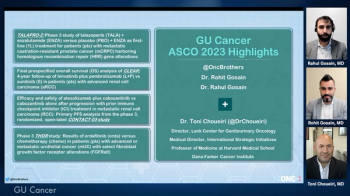
Rohit Gosain, MD, and Rahul Gosain, MD, summarize recent key data updates for genitourinary cancers following the 2023 ASCO Annual Meeting.

Rohit Gosain, MD, and Rahul Gosain, MD, summarize recent key data updates for genitourinary cancers following the 2023 ASCO Annual Meeting.
Expert oncologists offer insights on recent data from the THOR trial, which compared erdafitinib with chemotherapy in patients with metastatic bladder cancer.
Following ASCO 2023, experts in oncology review recent data from the CLEAR and CONTACT-03 clinical trials in the metastatic renal cell carcinoma space.
Toni Choueiri, MD, joins the Oncology Brothers, Rohit Gosain, MD, and Rahul Gosain, MD, to discuss recent updates from TALAPRO-2, which studied talazoparib plus enzalutamide in first-line metastatic castration-resistant prostate cancer.

Bradley J. Monk, MD, FACS, FACOG, discusses the rationale behind the KEYNOTE-826 study.

Discussion centered around available first-line combination options for patients with aRCC as well as factors influencing treatment choice.
An overview of advanced Renal Cell Carcinoma (aRCC), including its prevalence, patient presentation, classification, and treatment criteria.

Hans C. Lee, MD, discusses the toxicity seen with the BCMA/CD3 bispecific antibody linvoseltamab for patients with relapsed/refractory multiple myeloma.

Closing out his discussion on HR+/HER2- metastatic breast cancer, Kevin Kalinsky, MD, MS, highlights key takeaways and shares excitement for future evolutions in the treatment paradigm.

The panelists share their insights on the identification of patients at high risk for GVHD.
Key opinion leader Kevin Kalinsky, MD, MS, shares insight to recent and ongoing clinical trials with novel targeted therapies in the setting of HR+/HER2- metastatic breast cancer.
Dr Amy Dezern emphasizes how delayed frontline treatment of MDS can impact overall outcomes for patients with MDS.
Amy Dezern, MD, MHS, describes the currently available first-line treatment options for patients with MDS.

Dr Chen presents statistics on the incidence of chronic graft versus host disease.
Expert perspectives on the mechanisms of resistance to frontline therapy in HR+/HER2- metastatic breast cancer and results from key clinical trials analyzing the safety and efficacy of rechallenging with prior therapy.
Sagun Shrestha, MD, discusses how the addition of atezolizumab and durvalumab to treatment options for patients with extensive stage small cell lung cancer has impacted the field for the better.
Eric A. Singer, MD, discusses recent research evaluating adjuvant therapies for patients with high-risk renal cell carcinoma.
A key opinion leader on relapsed/refractory chronic lymphocytic leukemia provides practical advice on patient management and looks toward future evolutions in the treatment landscape.
Comprehensive insight to cardiovascular safety data with available therapies and how current understandings may impact the management of patients with relapsed/refractory chronic lymphocytic leukemia.
Centering conversation on patients with relapsed/refractory chronic lymphocytic leukemia, Andrew Lipsky, MD, reviews efficacy data and considers how it impacts treatment selection.
Shared insight on ELEVATE-RR, which utilized acalabrutinib in patients with relapsed/refractory chronic lymphocytic leukemia.
Expert perspectives on the ALPINE trial of zanubrutinib in patients with relapsed/refractory chronic lymphocytic leukemia.
Andrew Lipsky, MD, considers the role of BTK inhibitors as second-line therapy in patients with relapsed/refractory chronic lymphocytic leukemia.
Joseph M. Scandura, MD, PhD, discusses research regarding pelabresib for patients with myeloproliferative neoplasms.

Michael Wang, MD, discusses the background of the phase 3 BRUIN MCL-321 trial and how positive results may shape the future of the mantle cell lymphoma space.
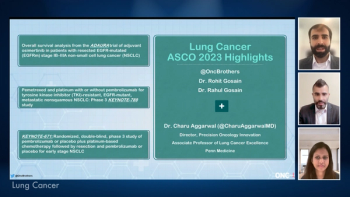
Rohit Gosain, MD, and Rahul Gosain, MD, provide a summary of the key NSCLC data updates discussed following the 2023 ASCO Annual Meeting.
A review of recently updated data from KEYNOTE-671, focused on perioperative use of pembrolizumab in early-stage non–small cell lung cancer.
Following ASCO 2023, experts in oncology review recent data updates from KEYNOTE-789 on chemotherapy with or without pembrolizumab for TKI-resistant nonsquamous NSCLC.
Charu Aggarwal, MD, MPH, joins the Oncology Brothers, Rohit Gosain, MD, and Rahul Gosain, MD, to discuss recent data updates from the ADAURA trial, an overall survival analysis of osimertinib in non–small cell lung cancer (NSCLC).

Jeffrey Dome, MD, PhD, discusses how the use of atezolizumab has impacted the treatment of pediatric patients with alveolar soft part sarcoma.