Joshua K. Sabari, MD

Joshua Sabari, MD, is an assistant professor of medicine, thoracic medical oncology, Perlmutter Cancer Center NYU Langone Health.

Articles by Joshua K. Sabari, MD

Joshua K. Sabari, MD, evaluates the potential of ifinatamab deruxtecan in combination with atezolizumab, with or without platinum-based chemotherapy, as first-line induction or maintenance therapy in ES-SCLC, emphasizing that statistically significant end points such as improved PFS and OS would be essential for clinical application in this patient population.
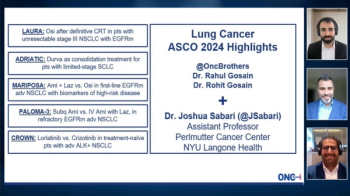
Joshua K. Sabari, MD, discusses the potential treatment synergies expected from combining MK-6070, a trispecific T-cell engager, with ifinatamab deruxtecan, noting that specific patient and disease factors (eg, tumor expression profiles and previous treatment responses) could influence the decision to pursue dual T-cell engager therapy in early clinical development.

Joshua K. Sabari, MD, discusses how the dosing schedule of ifinatamab deruxtecan offers advantages in terms of simplicity and treatment adherence vs topotecan and lurbinectedin, suggesting that it may enhance the overall quality of life for patients undergoing treatment for SCLC.

Joshua K. Sabari, MD, discusses the efficacy outcomes from the Ideate-Lung02 trial, noting the 52.4% ORR, 5.9-month median DOR, and 12.2-month OS and emphasizing that a 12-month OS is clinically meaningful for this patient population following a median of 2 prior lines of therapy.

Joshua K. Sabari, MD, discusses whether individual B7-H3 analysis is available at his institution, noting that, if it is, he obtains IHC for both PD-L1 and B7-H3 expression levels in all patients with SCLC. If B7-H3 testing becomes available, he would consider adding it to the biomarker assay, particularly at the time of diagnosis or recurrence.

Joshua K. Sabari, MD, discusses the unique mechanism of action of B7-H3, highlighting its role as an immune checkpoint regulator that is overexpressed in SCLC and associated with poor prognosis. He notes that B7-H3 blockade can enhance CD8-positive T-cell activity and may serve as a promising treatment option for SCLC that has progressed after platinum-based chemotherapy.

Joshua K. Sabari, MD, discusses the anticipated clinical benefits of adding tarlatamab to durvalumab as maintenance therapy for patients with ES-SCLC, highlighting that statistically significant trial end points, such as improved PFS and OS, could encourage community oncologists to adopt this dual maintenance approach.

Joshua K. Sabari, MD, discusses the future treatment potential of tarlatamab as a combination therapy with other anticancer agents for previously treated SCLC, suggesting that it could enhance efficacy and improve patient outcomes following 2 or more lines of prior therapy.

Joshua K. Sabari, MD, discusses how, despite the relatively small numbers of CRs and PRs in the DeLLphi-301 trial, the DOR to tarlatamab (exceeding 6 months in 59% of patients and more than 9 months in 29%) is promising, particularly considering that more than 50% of responders maintained their response at the data cutoff, indicating potential long-term benefits in this treatment setting.

Joshua K. Sabari, MD, discusses how the ORR of 32% to 40% observed in the DeLLphi-301 clinical trial among participants receiving tarlatamab is clinically meaningful, particularly given that these responses occurred between 5 and 7 weeks after initiation and emphasize the importance of ORR as a primary end point in evaluating the efficacy of treatment in this patient population.

Joshua K. Sabari, MD, discusses how tarlatamab, a BiTE, demonstrates a unique mechanism of action by targeting DLL3, which is aberrantly expressed in 85% to 94% of SCLC cells, thereby directing T cells to these cancer cells independently of MHC class I and promoting T-cell–mediated tumor lysis and regression.

Joshua K. Sabari, MD, discusses how, despite negative results from serial brain MRIs, the consideration of PCI in patients with ES-SCLC depends on individual risk factors, including the likelihood of brain metastases and the overall treatment strategy aimed at improving outcomes.

Dr. Sabari discusses how, for extensive stage small cell lung cancer (ES-SCLC) that progresses within six months after platinum-based chemoimmunotherapy and immunotherapy maintenance, options like lurbinectedin, topotecan, and irinotecan are considered viable subsequent treatments due to their proven effectiveness in similar clinical scenarios.

Panelists discuss how managing extensive stage small cell lung cancer involves balancing the survival benefits of subsequent therapies with the risks of treatment-related adverse events, emphasizing the importance of individualized treatment strategies.