



DLBCL
Latest News

Advertisement
Latest Videos














































Advertisement
More News

During a live virtual event with other physicians, Bijal Shah, MD, MS, discussed treatment options for patients with diffuse large B-cell lymphoma and the data that backs up the efficacy for these options.

75-year-old man presented with fever, a 7-lb unintentional weight loss, and occasional chest pain.

In an interview with Targeted Oncology, Jason Westin, MD, discussed the future of DLBCL treatment in both the frontline and later-line settings, along with current unmet clinical needs.
Eleven months after completion of therapy with the R-CHOP regimen, a 43-year-old woman with diffuse large B-cell lymphoma complained of fever, night sweats, and back pain.
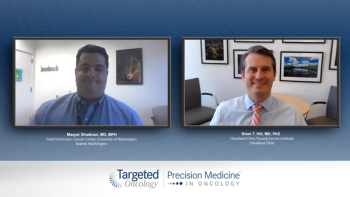
Mazyar Shadman, MD, MPH, and Brian T. Hill, MD, PhD, consider potential treatment options for relapsed/refractory diffuse large B-cell lymphoma in the future.
Two experts examine bispecific antibody treatment use for relapsed/refractory diffuse large B-cell lymphoma.

Jason Westin, MD, discusses the current standard of care in diffuse large B-cell lymphoma.
In an interview with Targeted Oncology, Brad S. Kahl, MD, provided an efficacy update from the LOTUS-2 study and discussed multiple agents showing promise for the treatment of relapsed/refractory diffuse large B-cell lymphoma.
The doctors switch their monoclonal antibody conversation’s focus to longcastuximab tesirine for the treatment of relapsed/refractory diffuse large B-cell lymphoma.
The discussion of tafasitamab as a monoclonal antibody therapy option for relapsed/refractory diffuse large B-cell lymphoma continues.
Encouraging results have been reported from the phase 2 Guidance-01 clinical trial.
Mehdi Hamadani, MD and Bertram Glass, MD recently debated on the role of allogeneic hematopoietic stem cell transplant for the treatment of aggressive B-cell lymphoma now that chimeric antigen receptor T cells have entered the landscape.
Dr Mazyar Shadman and Dr Brian T. Hill focus on CD19 being targeted in monoclonal antibody therapy options for relapsed/refractory diffuse large B-cell lymphoma, specifically tafasitamab.
Drs Shadman and Hill discuss using CD19 as a targeted therapy option in CAR T cell therapy for relapsed/refractory diffuse large B-cell lymphoma.
During a Targeted Oncology Case-Based Roundtable event, John M. Burke, MD, discussed the challenges with treating relapsed or refractory diffuse large B-cell lymphoma with a group of peers.
The experts delve further into treatment methods for relapsed/refractory diffuse large B-cell lymphoma, particular for transplant-eligible and -ineligible patients.
Mazyar Shadman, MD, MPH, and Brian T. Hill, MD, PhD, explain the intricacies of the diffuse large B-cell lymphoma treatment landscape.
Considering a patient’s relapse and potential response to therapy, Daniel O. Persky, MD, looks forward to the future use of novel therapies in diffuse large B-cell lymphoma.
Expert insight on the GO29365 trial, which informs selection of polatuzumab + bendamustine and rituximab in patients with relapsed/refractory DLBCL.
Daniel O. Persky, MD, reflects on a patient’s relapse with diffuse large B-cell lymphoma and the rationale behind treatment with polatuzumab + BR.
A review of frontline treatment options for DLBCL informed by comprehensive patient workup and the efficacy of available therapies.
Expert hematologist/oncologist Daniel O. Persky, MD, reviews the case of a 73-year-old woman who is diagnosed with and treated for DLBCL, later to relapse and require novel therapy.
Christopher R. Flowers, MD, discusses the current therapies used for patients with relapsed/refractory diffuse large B-cell lymphoma and goes into specifics of the L-MIND trial after the long-term follow-up.
Grzegorz S. Nowakowski, MD and Stephen D. Smith lead other participants of a Case Based Roundtable event in a discussion around treatment for patients with transplant-ineligible diffuse large B-cell lymphoma.
One year after being diagnosed with CD-10- positive and CD10-positive diffuse large B-cell lymphoma being treated with R-CHOP, and achieving complete remission, a PET/CT scan confirmed relapse in a 74-year-old male patient.
Advertisement
Advertisement
Trending on Targeted Oncology - Immunotherapy, Biomarkers, and Cancer Pathways
1
FDA Oncology Recap: Approvals, Designations, and Decisions in September 2026
2
Plinabulin Receives FDA Fast Track Designation in Post-ICI NSCLC
3
Denosumab Biosimilar Approved For Existing Oncology Indications
4
CEPHEUS and Frontline Treatment in Newly Diagnosed Multiple Myeloma
5