

LUNG CANCER
Latest News
Advertisement
Latest Videos



































Advertisement
More News

There was no overall survival improvement seen by expanding surveillance from chest x-ray to follow-up with PET-CT scan after surgery for patients with early-stage non–small cell lung cancer, according to data reported during the 2017 ESMO Congress.
According to findings presented at the 2017 ESMO Congress, nab-paclitaxel monotherapy demonstrated efficacy in patients with pretreated advanced nonsquamous non–small cell lung cancer that is not improved by the addition of CC-486.

In patients with previously treated advanced non-small cell lung cancer, <sup> </sup>superior progression-free survival was induced with continuous treatment with nivolumab until disease progression compared with a 1-year fixed duration treatment.
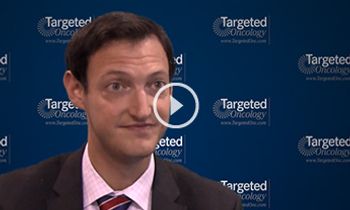
Joshua Bauml, MD, assistant professor, Perelman School of Medicine, University of Pennsylvania, discusses the randomized phase III FLAURA study of frontline osimertinib (Tagrisso) in patients with EGFR-mutant non-small cell lung cancer.
According to a retrospective analysis of a randomized study presented at the 2017 ESMO Congress, a liquid biopsy that measures tumor mutational burden showed promise for predicting benefit in patients with non–small cell lung cancer treated with a checkpoint inhibitor.
Treatment with the PD-L1 inhibitor durvalumab (Imfinzi) improved median PFS by 11.2 months compared with placebo for patients with locally advanced, unresectable stage III non–small cell lung cancer who had not progressed following chemoradiotherapy, according to phase III results from the PACIFIC trial presented at the 2017 ESMO Congress.
In results from the phase III FLAURA study of frontline osimertinib (Tagrisso) in patients with <em>EGFR</em>-mutant non–small cell lung cancer, osimertinib demonstrated a progression-free survival rate of 18.9 months (95% CI, 12.5-21.4), which was significantly improved over standard therapy.
According to findings from the phase III ALUR and ALEX studies announced ahead of the 2017 ESMO Congress,<sup> </sup>Alectinib demonstrated promising efficacy for patients with <em>ALK</em>-translocated non–small cell lung cancer with central nervous system metastases in both the first- and second-line setting.
The 2017 ESMO Annual Congress, taking place September 8 to 12 in Madrid, Spain, will feature several late-breaking abstracts that are poised to change the future of treatment for patients with lung cancer, pending their results, including the phase III PACIFIC and FLAURA studies.
Omid Hamid, MD, shares the top melanoma abstracts to look out for at the 2017 ESMO Annual Congress, which is taking place September 8 to 12 in Madrid, Spain, as well as some background on the promising phase I/II results he will be presenting for the combination of epacadostat plus pembrolizumab in patients with advanced melanoma.
Non-small cell lung cancer is the most common type of lung cancer, accounting for approximately 80% to 85% of lung cancer cases, whereas small cell lung cancer comprises approximately 10% to 15% of lung cancer cases.
Systemic anticancer therapy recommendations for patients with stage IV non–small cell lung cancer (NSCLC) depend on individual tumor histology, patient performance status, and driver oncogene biomarker status, which are most often anaplastic lymphoma kinase (ALK) translocation or epidermal growth factor receptor (EGFR) mutation.
Prospects for patients with non-small cell lung cancer have improved with the identification of actionable mutations and the development of targeted agents; however, patients without actionable mutations do not experience improved outcomes with these targeted therapies.
Lyudmila A. Bazhenova, MD, discusses the nondriver NSCLC population, the treatment strategies available for them, and challenges physicians continue to face with this subgroup of patients.
Lyudmila A. Bazhenova, MD, medical oncologist, professor of medicine, UC San Diego Health, discusses the prevalence of patients with non-driver non–small cell lung cancer.
Lyudmila A. Bazhenova, MD, medical oncologist, professor of medicine, UC San Diego Health, discusses the currently available treatment strategies for patients with non-driver non–small cell lung cancer.
Lyudmila A. Bazhenova, MD, medical oncologist, professor of medicine, UC San Diego Health, discusses the factors to take into consideration when treating a patient with non-driver non–small cell lung cancer with bevacizumab (Avastin).
Lyudmila A. Bazhenova, MD, medical oncologist, professor of medicine, UC San Diego Health, discusses what potential impact immunotherapy agents could have on outcomes for patients with non-driver non–small cell lung cancer.
Lyudmila A. Bazhenova, MD, medical oncologist, professor of medicine, UC San Diego Health, discusses ongoing and remaining challenges in the field of non-driver non–small cell lung cancer, as well as a look toward the future treatment landscape.
Lyudmila A. Bazhenova, MD, medical oncologist, professor of medicine, UC San Diego Health, discusses the prevalence of patients with non-driver non–small cell lung cancer.
Corey Langer, MD, provides details on the goals and implications of the KEYNOTE-021 trial. Moreover, he discusses the current arena in NSCLC treatment and the obstacles that remain in treating patients without driver mutations effectively.


Advertisement
Advertisement
Trending on Targeted Oncology - Immunotherapy, Biomarkers, and Cancer Pathways
1
SOT106 Receives New FDA FTD and ODD in Sarcoma
2
Iberdomide Doubles MRD-Negative CR Rate in Phase 3 EXCALIBER-RRMM Trial
3
IMS 2026 Day 4 Recap: MRD-Guided Regimens Highlight Final Sessions
4
Trispecifics: A New Strategy to Prevent Antigen Escape
5