



Renal Cell Carcinoma
Latest News
Advertisement
Latest Videos





































Advertisement
More News

Alan Tan, MD, discusses the 8-year follow-up data from the CheckMate 214 trial of patients with advanced renal cell carcinoma.

During a live event, Benjamin Garmezy, MD, discussed treatment options in renal cell carcinoma including IO/TKI combinations plus VEGF selectivity.

An expert discusses how medical professionals counsel patients on adverse event (AE) risks with tyrosine kinase inhibitors (TKIs) such as lenvatinib/everolimus by highlighting key safety distinctions, including hypertension (HTN), fatigue, and diarrhea. For third-line tivozanib, tolerability and common toxicities (eg, Palmar-Plantar Erythrodysesthesia (PPE), HTN) are considered. AE incidence, discontinuation rates, and drug interactions guide treatment choices. Managing toxicities involves prevention, monitoring, and mitigation strategies, with dose modifications tailored based on severity and combination regimens. Community oncologists are advised on proactive AE management to optimize outcomes.

During a Case-Based Roundtable® event, Elizabeth M. Wulff-Burchfield, MD, and other participants discussed their experiences with the frontline combination regimens for advanced renal cell carcinoma.
An expert discusses using sequence therapies based on disease progression, patient factors, and resistance mechanisms. After a first-line tyrosine kinase inhibitor plus immune checkpoint inhibitor (TKI + ICI) regimen, preferred subsequent-line options include alternative TKIs, chemotherapy, or combination strategies, tailored to patient response and tolerability.
An expert discusses how third line (3L) systemic therapy for metastatic renal cell carcinoma (mRCC) is guided by prior treatments, patient comorbidities, and drug-specific profiles. Options include tyrosine kinase inhibitors (TKIs; eg, tivozanib, cabozantinib), mTOR inhibitors (eg, everolimus), and immune-oncology– based approaches. Efficacy, tolerability (grade 3/4 adverse events [AEs]), and pharmacokinetic (PK) differences drive selection. Dose modifications, such as for tivozanib and lenvatinib/everolimus, balance efficacy and safety. Selection prioritizes sequencing strategy, with evidence (eg, Pal 2022) supporting reduced-dose efficacy.
Alan Tan, MD, discusses potential biomarkers that are being investigated to optimize treatment of patients with renal cell carcinoma.
An expert discusses how efficacy and safety data from trials such as METEOR, TIVO-3, TiNivo-2, and LITESPARK-005 guide third line (3L) renal cell carcinoma (RCC) treatment. Differences in trial populations, evolving long-term trends, and prior immune checkpoint inhibitor (ICI) use impact applicability. CONTACT-03 and TiNivo-2 provide key insights, and real-world data and patient-reported outcomes refine clinical decision-making. Community oncologists should critically assess study limitations and evolving evidence when selecting therapy.
A panelist discusses how, based on the NCCN guidelines for kidney cancer, third-line treatment options for this patient include cabozantinib, lenvatinib plus everolimus, tivozanib, and everolimus monotherapy. Clinical trials and best supportive care remain important considerations at this stage.
IB-T101, a CD70-targeted chimeric antigen receptor therapy, is being studied for relapsed clear cell renal cell carcinoma treatment in a dose-escalation trial.
An expert discusses how, in third line (3L) therapy, goals shift from optimal disease control to managing treatment-resistant disease while preserving quality of life. Unlike 2L therapy where significant disease control is still expected, 3L aims for modest clinical benefit, symptomatic relief, and stabilizing disease progression. Treatment choices now heavily prioritize tolerability, patient preferences, and palliative considerations.
An expert discusses the patient case of a 65-year-old woman who has presented to the emergency department with abdominal pain. The patient’s previous medical issues include a duodenal ulcer that she experienced 10 years ago. The patient is a smoker, and her current medication is lansoprazole (30 mg). After the patient begins to present worsening lower back pain, a CT scan shows lytic lesions in her thoracic spine and rounded lesion in both lungs. A biopsy of the lung lesion confirms clear cell renal cell carcinoma (RCC) with sarcomatoid differentiation.
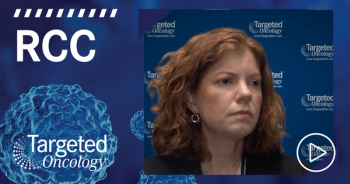
Kathryn Beckermann, MD, PhD, discusses the patient-reported outcomes for tivozanib plus nivolumab from the phase 3 TiNivo-2 study.
Casdatifan, a HIF-2α inhibitor, shows early clinical activity and good tolerance in patients with previously treated clear cell renal cell carcinoma.
Avelumab plus axitinib was effective and safe in real-world advanced kidney cancer, with outcomes matching clinical trials, according to AVION study findings.
Olanzapine may help manage adverse effects from tyrosine kinase inhibitors, though further randomized, placebo-controlled studies are needed to confirm these findings.
Avelumab maintenance with axitinib interruption was feasible in metastatic renal cell carcinoma responders, according to updated phase 2 TIDE-A study results.
Proactive onco-coaching did not improve quality of life but was linked to better overall survival in patients with metastatic renal cell carcinoma.
Tivozanib at 1.34 mg showed greater antitumor activity than 0.89 mg, with similar hypertension rates, in kidney cancer.
Lenvatinib plus pembrolizumab showed activity and a favorable safety profile in nonmetastatic clear cell renal cell carcinoma, per phase 2 study results.
Tivozanib plus nivolumab had similar patient-reported outcomes to tivozanib alone in advanced kidney cancer after prior treatment, according to the TiNivo-2 study.
Belzutifan plus cabozantinib maintained durable antitumor activity in advanced clear cell renal cell carcinoma, per phase 3 LITESPARK-003 data.
Cabozantinib plus nivolumab and ipilimumab maintained a progression-free survival benefit at 45 months vs placebo in advanced kidney cancer.
Nivolumab plus cabozantinib improved long-term efficacy and safety vs sunitinib in advanced renal cell carcinoma, per final CheckMate 9ER trial results.
Lenvatinib plus belzutifan showed durable activity and a consistent safety profile in advanced clear cell renal cell carcinoma after prior treatment.
Advertisement
Advertisement
Trending on Targeted Oncology - Immunotherapy, Biomarkers, and Cancer Pathways
1
Denosumab Biosimilar Approved For Existing Oncology Indications
2
Plinabulin Receives FDA Fast Track Designation in Post-ICI NSCLC
3
FDA Oncology Recap: Approvals, Designations, and Decisions in September 2026
4
Giredestrant Plus Everolimus Improves PFS in ER+ Advanced Breast Cancer
5