
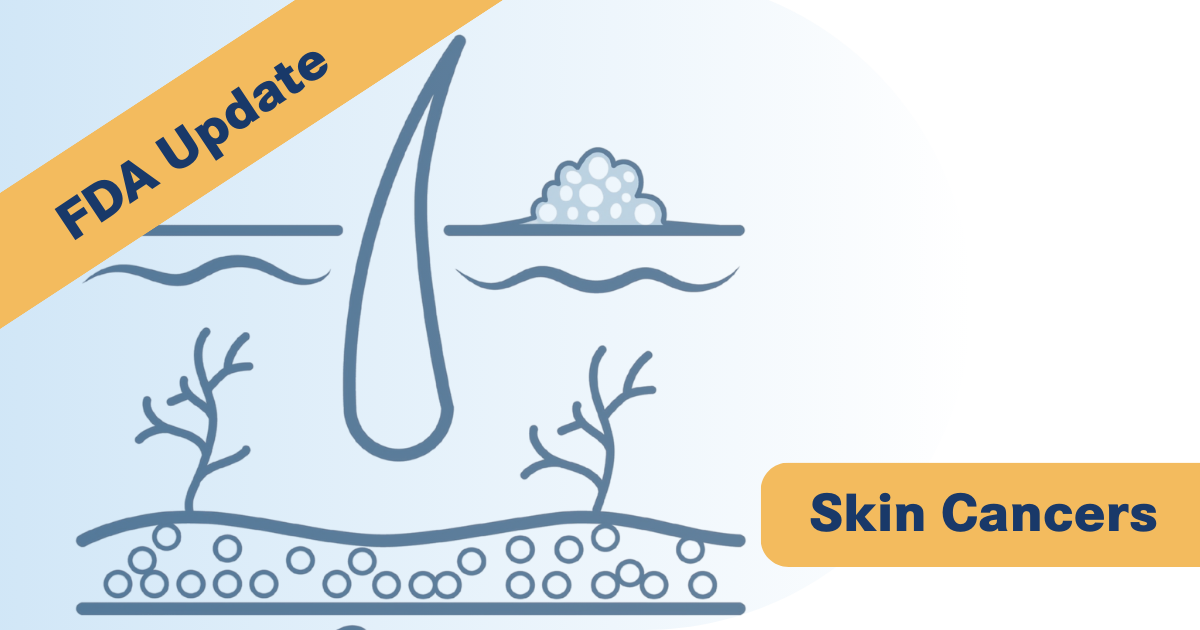





SKIN CANCERS
Latest News
Advertisement
Video Series





Latest Videos



Podcasts











































Advertisement
More News

Lifileucel shows sustained efficacy and safety in advanced melanoma, highlighting its potential as a key treatment for ICI-resistant cases.
Vishal A. Patel, MD, discusses the FDA approval of cemiplimab in cutaneous squamous cell carcinoma.

Cemiplimab shows comparable second primary tumor rates to placebo while improving disease-free survival in high-risk cutaneous squamous cell carcinoma patients.
New findings from the CheckMate 238 trial highlight nivolumab's superior long-term efficacy over ipilimumab in treating advanced melanoma.
The FDA has approved cemiplimab as an adjuvant treatment for high-risk cutaneous squamous cell carcinoma.
A new study reveals that multiple tattoos may lower melanoma risk, challenging previous beliefs about tattooing and skin cancer.
FDA advises against BLA submission for IO Biotech's melanoma vaccine after phase 3 trial results narrowly missed statistical significance.

During a Community Case Forum event, Adil Daud, MD, discussed immunotherapy options for cutaneous squamous cell carcinoma.

TuHURA Biosciences advances its phase 3 trial of IFx-2.0 for Merkel cell carcinoma, aiming to enhance immune response alongside pembrolizumab.

Michael E. Kasper, MD, FACRO, discussed unmet needs in skin cancer treatment and addressed misconceptions among patients and health care providers.
Findings from a phase 1 trial demonstrate that silmitasertib shows potential for the treatment of patients with advanced basal cell carcinoma.
Cosibelimab is now FDA approved for the treatment of patients with metastatic or locally advanced cutaneous squamous cell carcinoma that is not eligible for curative surgery or radiation.

During a Case-Based Roundtable® event, Jennifer L. Atlas, MD, discussed treatment for a patient with basal cell carcinoma who reported challenging adverse events with hedgehog pathway inhibitor.
Meredith McKean, MD, MPH, discussed findings from a longer-term follow-up study evaluating fianlimab plus cemiplimab for the treatment of metastatic melanoma.

During a Case-Based Roundtable® event, Ahmad Tarhini, MD, PhD, discussed the 2024 update to the RELATIVITY-047 trial in advanced melanoma in the first article of a 2-part series.

During a Case-Based Roundtable® event, Hussein A. Tawbi, MD, PhD, and participants look at benefits of nivolumab combinations for brain metastases and PD-L1 positivity in the metastatic melanoma population in the second article of a 2-part series.

The novel agent VMT01 is designed to target and deliver 212Pb to MC1R-expressing tumors like metastatic melanoma.
The phase 3 KEYNOTE-867 and KEYNOTE-630 studies will be stopped due to futility, following analysis from independent data monitoring committees.
During a Case-Based Roundtable® event, Hussein A. Tawbi, MD, PhD, and participants considered nivolumab/ipilimumab and nivolumab/relatlimab as options for a patient with metastatic melanoma in the first article of a 2-part series.
Andrew Brohl, MD, discussed findings from a study investigating a novel vaccine treatment for squamous cell and Merkel cell carcinomas.
The manufacturer has resubmitted an application to the FDA for approval of the drug cosibelimab, which is being investigated for the treatment of metastatic or locally advanced cutaneous squamous cell carcinoma.
Jose Lutzky, MD, discussed the promise of tumor infiltrating lymphocyte therapy for difficult-to-treat advanced melanoma.
For Melanoma and Skin Cancer Awareness Month, Nayoung Lee, MD, discussed evolving paradigms in skin cancer diagnosis and prevention.
The phase 3 KeyVibe-010 study will discontinue the coformulation of pembrolizumab and vibostolimab treatment for high-risk melanoma due to futility.
During a Case-Based Roundtable® event, Evan J. Lipson, MD, discussed with participants how their experience with immunotherapy toxicities has changed over time in the first article of a 2-part series.
Advertisement
Advertisement
Trending on Targeted Oncology - Immunotherapy, Biomarkers, and Cancer Pathways
1
FDA Oncology Recap: Approvals, Designations, and Decisions in September 2026
2
Plinabulin Receives FDA Fast Track Designation in Post-ICI NSCLC
3
Denosumab Biosimilar Approved For Existing Oncology Indications
4
CEPHEUS and Frontline Treatment in Newly Diagnosed Multiple Myeloma
5