Pat Gulhati, MD, PhD, discusses findings from a comprehensive analysis of genetic, immunological, and signaling pathway variations in pancreatic cancer.


Your AI-Trained Oncology Knowledge Connection!
Pat Gulhati, MD, PhD, discusses findings from a comprehensive analysis of genetic, immunological, and signaling pathway variations in pancreatic cancer.
Enriqueta Felip, MD, PhD, discusses the phase 3 3475A-D77 study of subcutaneous pembrolizumab plus chemotherapy in metastatic non–small cell lung cancer.

Deborah Wong, MD, PhD, discusses the toripalimab combination that is now considered standard of care in nasopharyngeal cancer.
Hamlet Gasoyan, MD, discusses some of the common challenges that oncologists face when getting patients started on more costly oral treatments for multiple myeloma.
Seth Wander, MD, PhD, discusses the tolerability of selective estrogen receptor degraders and next-generation anti-estrogen agents in breast cancer.
Experts discuss polatuzumab’s effectiveness across germinal center B-cell (GCB) and activated B-cell (ABC) diffuse large B-cell lymphoma (DLBCL) subgroups, including updates to published data. They also explore how different molecular classification methods compare in clinical practice to guide treatment selection, with insights on differential responses across specific molecular or clinical subgroups.
Experts discuss clinical experience with established and emerging treatment approaches in diffuse large B-cell lymphoma (DLBCL), including R-CHOP and polatuzumab-based regimens, and the factors guiding treatment selection for first-line DLBCL, along with observed outcomes across different patient subgroups.
Matt Galsky, MD, discusses the phase 3 NIAGARA trial that led to the recent FDA approval of durvalumab in muscle-invasive bladder cancer after radical cystectomy.
Meredith McKean, MD, MPH, discusses the background and goals from the recent long-term follow-up of a phase 1 study evaluating the combination of fianlimab and cemiplimab in advanced melanoma.

Julie Gralow, MD, FACP, FASCO, addresses ways to combat the oncology workforce shortage.

Uday R. Popat, MD, discusses promising findings from a phase 2 trial evaluating the JAK inhibitor itacitinib combined with post-transplant cyclophosphamide and tacrolimus for graft-vs-host disease prevention.
Panelists discuss how lenvatinib has significantly impacted the systemic therapy landscape for hepatocellular carcinoma (HCC) across different stages. As a first-line treatment, it offers a viable alternative to sorafenib, demonstrating noninferior overall survival with improved progression-free survival and response rates. Its role extends to combination regimens and advanced-stage disease management.
Panelists discuss how, when a patient progresses to second-line therapy, key considerations include prior treatment response, toxicity, patient comorbidities, and therapeutic goals. Lenvatinib shows potential beyond first-line treatment, offering efficacy in patients progressing on systemic therapies, with emerging data supporting its role in treatment sequencing.
Yelena Y. Janjigian, MD, discusses the long-term survival data from the KEYNOTE-811 trial of pembrolizumab plus trastuzumab and chemotherapy for the treatment of patients with HER2-positive locally advanced unresectable or metastatic gastric or gastroesophageal junction adenocarcinoma.
John M. Burke, MD, shares his tips for offering bispecific antibody therapy in a community setting.
John M. Burke, MD, provides practical tips for administering mosunetuzumab in a community setting.
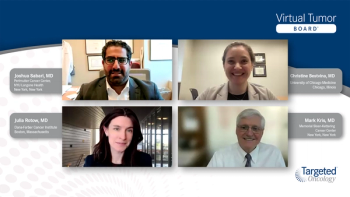
Panelists discuss second-line treatment options and emerging approaches for HER2-mutated non–-small cell lung cancer (NSCLC), highlighting novel therapies and clinical strategies.
Panelists discuss the role of HER2 mutations in non–-small cell lung cancer (NSCLC), focusing on diagnostic approaches, clinical implications, and targeted treatment strategies.

Bernd Kasper, MD, PhD, provides an overview of the phase 3 DeFi trial of nirogacestat for the treatment of patients with progressing desmoid tumors.
Yelena Y. Janjigian, MD, discusses the standard approval of pembrolizumab plus trastuzumab and chemotherapy for the treatment of patients with HER2-positive gastric or gastroesophageal junction adenocarcinoma.
Panelists discuss how optimizing shared-care models between academic and community centers enhances continuity in complex hematologic malignancies. Key monitoring parameters for tagraxofusp include capillary leak syndrome risk. Timely transplant referral depends on disease kinetics. Novel therapies are among the unmet needs in plasmacytoid dendritic cell neoplasm. Support resources aid patient management. Emerging treatments and clinical insights continue to advance care.
Regina Barragan-Carrillo, MD, evaluates the current state of the global availability of clinical trials for patients with renal cell carcinoma.
Jennifer Chan, MD, MPH, discussed the findings from the phase 3 CABINET trial leading to the FDA approval of cabozantinib in patients with neuroendocrine tumors.
A panelist discusses how graft-vs-host disease (GVHD) manifests through a complex constellation of symptoms affecting multiple organ systems, including the skin (rash, itching), gastrointestinal tract (diarrhea, nausea, abdominal pain), liver (elevated enzymes, jaundice), and lungs (shortness of breath, cough), with severity assessment typically following established criteria.
Experts discuss how the 5-year outcomes of polatuzumab have influenced its position in current NCCN guidelines for diffuse large B-cell lymphoma (DLBCL) treatment, offering insights on how to interpret and apply these recommendations in various patient scenarios.
Experts discuss the 5-year efficacy and safety outcomes of polatuzumab in diffuse large B-cell lymphoma (DLBCL), highlighting its meaningful progression-free survival (PFS) and overall survival (OS) results for first-line patients with DLBCL and emphasizing key long-term safety considerations for clinicians.

Marleen I. Meyers, MD, emphasizes prioritizing whole foods, particularly fruits and vegetables, over relying on supplements for patients with cancer.

Douglas A. Tremblay, MD, discusses the long-term data supporting ropeginterferon alfa-2b-njft as treatment in patients with polycythemia vera.
Bernd Kasper, MD, PhD, discusses the key efficacy results from the updated analysis of the phase 3 DeFi trial of nirogacestat in desmoid tumors.

Trisha Wise-Draper, MD, PhD, discusses anticipated data on head and neck cancers and their potential impact on the field.
