
Panelists discuss how overall survival and event-free survival data presented at ESMO 2024 demonstrate promising outcomes in cancer treatment.

Panelists discuss how overall survival and event-free survival data presented at ESMO 2024 demonstrate promising outcomes in cancer treatment.

Yoshiaki Nakamura, MD, PhD, discusses how the use of tissue-free circulating tumor DNA (ctDNA) analysis for detecting minimal residual disease (MRD) can enhance the prediction of recurrence in stage II to III colorectal cancer (CRC), particularly when tumor specimens are limited.

Partow Kebriaei, MD, discusses what factors may influence the decision for transplant in patients with acute lymphoblastic leukemia and how experts determine who is best fit for transplant.

Noah M. Merin, MD, PhD, discusses approved therapies in acute and chronic graft-vs-host disease.
Missak Haigentz, MD, highlights some of the significant unmet needs for patients with small cell lung cancer.

Michael J. Mauro, MD, discusses decision-making for patients with chronic myeloid leukemia.
Binod Dhakal, MD, MS, discusses some of the challenges often seen in the myeloma space, particularly those with lenalidomide-refractory multiple myeloma.
Saad Z. Usmani, MD, MBA, FACP, FASCO, discusses the phase 3 CEPHEUS trial of daratumumab with bortezomib, lenalidomide, and dexamethasone in patients with newly diagnosed multiple myeloma.
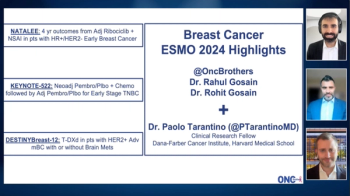
Panelists discuss how ESMO 2024 presented important updates on primary end points and progression-free survival data from recent clinical studies.
Panelists discuss how updates from KEYNOTE-522 at ESMO 2024 revealed important data on overall survival and event-free survival outcomes.
Panelists discuss how the NATALEE study at ESMO 2024 presented updates on primary, secondary, and exploratory end points for evaluating a new cancer treatment.

David Sallman, MD, discusses some of the innovative therapies and strategies being investigated in myelodysplastic syndromes studies.
Christos Vaklavas, MD, discusses the results of the TROPION-Breast01 trial of datopotamab deruxtecan in patients with metastatic breast cancer.
Arnab Basu, MD, MPH, FACP, discusses his research on high sensitivity circulating tumor DNA assays in genitourinary malignancies.

Panelists discuss how axatilimab emerges as a promising later-line treatment option for patients with refractory or recurrent chronic graft-versus-host disease (cGVHD), highlighting its potential in challenging cases.
Panelists discuss how belumosudil serves as a third-line therapy option for patients with chronic graft-versus-host disease (cGVHD), exploring its role in advancing treatment when earlier options have been exhausted.
Suresh S. Ramalingam, MD, FACP, FASCO, discusses the background and next steps of the LAURA study which evaluated osimertinib for the treatment of patients with unresectable stage III non–small cell lung cancer with EGFR mutations.

Nancy Lin, MD, discusses the efficacy of T-DXd for brain metastases as seen in DESTINYBreast-12 compared with other agents.
Prithviraj Bose, MD, provides an overview of the different JAK inhibitors currently available for patients with myeloproliferative neoplasms.
Sun Gwe Ahn, MD, discusses an exploratory analysis of the HERA trial at the 2024 ESMO Congress.

Anil Parwani, MD, PhD, discusses the challenges and opportunities he has encountered in either implementing or utilizing artificial intelligence technology in the clinical setting.

Hamlet Gasoyan, MD, discusses what to know from a study that found there to be disparities in time to treatment with oral antimyeloma medications when used in patients with newly diagnosed multiple myeloma.
Jacob E. Berchuck, MD, discusses research behind using a blood-based liquid biopsy over traditional PSMA PET scans presented at the 2024 ESMO Congress.
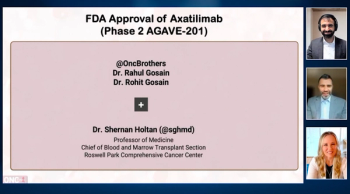
Panelists discuss where and when sequencing axatilimab becomes appropriate within the clinical setting, as well as safety precautions associated with the drug.
Panelists discuss what the AGAVE-201 study displayed.
Panelists give an overview of chronic graft-vs-host disease, its history of treatment, how it is handled in the modern day, and the study design of AGAVE-201.
Panelists give an overview of Graft-vs-host Disease and the modern landscape of treatment.

Francis P. Worden, MD, discusses a real-world study evaluating lenvatinib for the treatment of patients with radioiodine-refractory differentiated thyroid cancer.
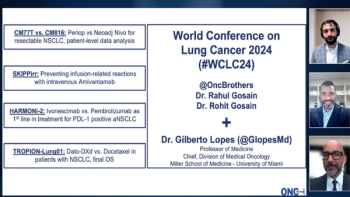
Panelists discuss how the TROPION-Lung01 study results presented at World Conference on Lung Cancer 2024 shed light on overall survival outcomes in patients with lung cancer, with a particular focus on survival rates across different histological subtypes.
Panelists discuss how the HARMONi-02 trial presented at World Conference on Lung Cancer 2024 revealed key lung cancer insights, focusing on progression-free survival and immune-related response criteria end points, while emphasizing the trial’s significance for specific patient subgroups.