Yanghee Woo, MD, discusses the details and lasting impact of the CROSS trial in the treatment of gastroesophageal junction and esophageal cancers.

Yanghee Woo, MD, discusses the details and lasting impact of the CROSS trial in the treatment of gastroesophageal junction and esophageal cancers.
Hatim Husain, MD, discusses how the implementation of proactive prophylaxis strategies for patients taking amivantamab, including prophylactic antibiotics, good skin hygiene, and insights from the phase 2 COCOON study, can help manage potential adverse effects and improve treatment outcomes.
Yanghee Woo, MD, provides an overview of the CROSS trial which focused on treating patients with gastroesophageal junction cancers.
Ariel Lopez-Chavez, MD, discusses the current approach to managing recurrent small cell lung cancer especially in patients who have progressed after first-line chemotherapy.
Elizabeth A. Brem, MD, discusses the familiarity of treatments among oncologists for patients with diffuse large B-cell lymphoma in a Case-Based Roundtable event.
Arnab Basu, MD, MPH, FACP, explains why sensitivity might be higher in urothelial cancer vs other genitourinary cancers.
Alessandra Ferrajoli, MD, discusses the importance of supportive care in the management of patients with chronic lymphocytic leukemia with comorbidities.

Joshua K. Sabari, MD, discusses the potential treatment synergies expected from combining MK-6070, a trispecific T-cell engager, with ifinatamab deruxtecan, noting that specific patient and disease factors (eg, tumor expression profiles and previous treatment responses) could influence the decision to pursue dual T-cell engager therapy in early clinical development.
Joshua K. Sabari, MD, discusses how the dosing schedule of ifinatamab deruxtecan offers advantages in terms of simplicity and treatment adherence vs topotecan and lurbinectedin, suggesting that it may enhance the overall quality of life for patients undergoing treatment for SCLC.
Binod Dhakal, MD, MS, discusses some of the next steps for evaluating ciltacabtagene autoleucel in multiple myeloma and the CARTITUDE-4 trial.

Samer A. Al'Hadidi, MD, MS, discusses the response and survival of 2 quadruplet therapy trials for patients with transplant-ineligible multiple myeloma.

Craig A. Portell, MD, discusses the current standard of care for patients with relapsed/refractory mantle cell lymphoma and how sequencing therapies changed the landscape of mantle cell lymphoma treatment.
Ticiana Leal, MD, discusses how emerging targeted therapies for extensive-stage small cell lung cancer (ES-SCLC) are showing promising objective clinical outcomes that may surpass those of second-line treatments such as topotecan and CAV regimens, particularly highlighting the need to evaluate specific compounds based on platinum-sensitive vs platinum-resistant disease profiles and the potential role of TIGIT inhibitors in future treatment lines.
Panelist discusses how the second interim overall survival data from MARIPOSA-2, presented at the European Society for Medical Oncology Congress 2024, affect treatment strategies for patients with non–small cell lung cancer that has developed resistance to osimertinib.
Ariel Lopez-Chavez, MD, discusses the efficacy of immunotherapy for the potential treatment of extensive-stage small cell lung cancers.
Targeted Oncology co-hosts Kristie L. Kahl and Andrew Svonavec talk to program co-chair Benjamin P. Levy, MD, to highlight what to expect in the latest oncology developments from the 42nd Annual Chemotherapy Foundation Symposium to be held in New York City.
Christopher R. Flowers, MD, MS, discusses what the current treatment landscape of follicular lymphoma looks like.
Amer Zeidan, MBBS, discusses how ring sideroblasts status affects using luspatercept in patients with myelodysplastic syndromes.
Prithviraj Bose, MD, discusses the most critical adverse effects seen with each of the 4 approved JAK inhibitors for the treatment of myeloproliferative neoplasms.
Abdulraheem Yacoub, MD, discusses the adverse event profile of imetelstat when treating patients with myelodysplastic syndromes.
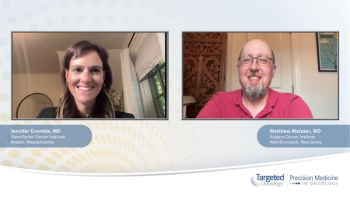
Dr Graff discusses perceptions of the future for patients treated with bispecific antibodies for non-Hodgkin lymphoma, highlighting key unmet needs and sharing clinical pearls for community oncologists.
Panelists discuss their perceptions of the future for patients treated with bispecific antibodies for non-Hodgkin lymphoma, highlighting key unmet needs and sharing clinical pearls for community oncologists.
Panelists discuss how they collaborate with community oncology centers when receiving patient referrals for initial or step-up dosing, returning patients to community practices for maintenance dosing, and managing grade 3/4 adverse events related to cytokine release syndrome or neurotoxicity.
Dr Graff discusses her standard approach when initiating bispecific antibody treatment for patients, including whether to refer to an academic center or provide treatment in the community setting and how to manage hospitalization if required.
Dr Graff discusses the differences and similarities in managing adverse events associated with bispecific antibodies in non-Hodgkin lymphoma compared to other therapeutic indications, such as multiple myeloma and non–small cell lung cancer.
Dr Graff discusses the recommendations for identifying, evaluating, and managing neurological toxicities, including workup and evaluation, grading of toxicity, and overall management, also addressing other important toxicities.
Panelists discuss the recommendations for identifying, evaluating, and managing neurological toxicities, including workup and evaluation, grading of toxicity, and overall management. They also address other important toxicities.
Dr Graff discusses the recommendations for evaluating, identifying, and managing cytokine release syndrome (CRS), covering the pretreatment phase, patient education, treatment location, premedications, CRS management, dose modifications, and the community oncology perspective.
Panelists discuss the recommendations for evaluating, identifying, and managing cytokine release syndrome (CRS), covering the pretreatment phase, patient education, treatment location, premedications, CRS management, dose modifications, and the community oncology perspective.
Panelists discuss how they manage cytokine release syndrome and the necessary pretreatment testing to ensure patient safety and effective therapy.