Hope S. Rugo, MD, FASCO, discusses key takeaways from SABCS 2024 conference.

Hope S. Rugo, MD, FASCO, discusses key takeaways from SABCS 2024 conference.
Mark Agulnik, MD, discusses the efficacy and adverse events in the DeFi trial for patients with desmoid tumors given nirogacestat.
A panelist discusses how various antibody-drug conjugates, including polatuzumab vedotin, pinatuzumab vedotin, and loncastuximab, have been studied in combination with rituximab for relapsed/refractory follicular lymphoma. Recent data from ASH 2024 highlight important patient considerations for these treatment approaches.
Cedric Pobel, MD, discusses the design and objectives of the phase 3 PEACE-1 trial for patients with de novo metastatic castration-sensitive prostate cancer.

Experts discuss the comparative efficacy of sonrotoclax plus zanubrutinib vs venetoclax in chronic lymphocytic leukemia treatment based on updates presented at the 66th American Society of Hematology Annual Meeting and Exposition 2024.

Panelists discuss how guideline-recommended treatment regimens for patients with transplant-ineligible or transplant-deferred newly diagnosed multiple myeloma should be evaluated and selected based on patient characteristics, efficacy data, and safety profiles to achieve optimal outcomes.
Thomas W. LeBlanc, MD, MA, discusses how erythroid maturation agents (EMAs), such as luspatercept, are increasingly important in the anemia management landscape for low-risk myelodysplastic syndromes (LR-MDS), with a focus on achieving hemoglobin levels ≥ 10, as highlighted by Santini et al in their ASH 2024 abstract, demonstrating the clinical significance of this target for improving patient outcomes.

Matthew R. Zibelman, MD, discusses treatment options in muscle-invasive, perioperative, and metastatic bladder cancer.
Aimee Merino, MD, discusses how the latest efficacy outcomes from the CARTITUDE-4 trial, evaluating ciltacabtagene autoleucel (cilta-cel) in relapsed/refractory multiple myeloma, have influenced her approach to patient selection and referral for chimeric antigen receptor T-cell therapy in early relapse cases.
Aimee Merino, MD, discusses how the referral process for chimeric antigen receptor T-cell therapy in early relapsed/refractory multiple myeloma involves assessing eligibility, identifying potential roadblocks, and determining which patients may not be suitable for referral based on clinical factors and treatment goals.
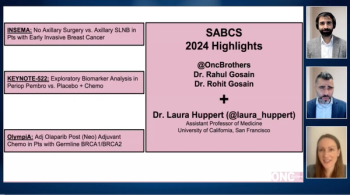
Panelists discuss the OlympiA trial, evaluating adjuvant olaparib post-neoadjuvant chemotherapy in patients with germline BRCA1/BRCA2 mutations and high-risk HER2-negative breast cancer, and its impact on treatment outcomes.
Panelists discuss the exploratory biomarker analysis from the KEYNOTE-522 trial, comparing perioperative pembrolizumab versus placebo plus chemotherapy in early-stage breast cancer, and its implications for treatment strategies.
Panelists discuss the INSEMA trial, comparing no axillary surgery versus axillary sentinel lymph node biopsy (SLNB) in patients with early invasive breast cancer, exploring the implications for treatment decisions and patient outcomes.

John Seymour, MBBS, FRACP, PhD, explains the mechanism of action of BCL-2 inhibitors like venetoclax.
Evan Y. Yu, MD, discusses how the ARANOTE study, which evaluated androgen deprivation therapy (ADT) plus darolutamide for metastatic hormone-sensitive prostate cancer (mHSPC), aimed to assess the efficacy of this combination therapy in a patient population with newly diagnosed mHSPC. He compares its design and objectives with other established ADT plus androgen receptor pathway inhibitor (ARPI) doublet regimens such as LATITUDE, STAMPEDE D, ENZAMET, ARCHES, and TITAN, and how the study’s results, particularly its efficacy data, compare with those from other trials using abiraterone, enzalutamide, and apalutamide in the first-line setting.

James J. Harding, MD, discusses the primary (overall survival [OS]) and secondary end points (overall response rate [ORR], duration of response [DOR]) of the CheckMate 9DW trial, and explores how the inclusion of the lenvatinib (LEN) arm informs the treatment landscape, as well as the safety profiles of first-line systemic immunotherapy in patients with uHCC, focusing on the most significant adverse events seen with nivolumab plus ipilimumab (NIVO + IPI).
Evan Y. Yu, MD, discusses how the presentation of a patient with metastatic hormone-sensitive prostate cancer (mHSPC) involves evaluating key clinical features such as disease extent, symptoms, and performance status to guide treatment decisions and the selection of appropriate systemic therapies.
Samer A. Al’Hadidi, MD, discusses social determinants and resources that can help patients receive chimeric antigen receptor T-cell therapy for relapsed/refractory multiple myeloma.
Martin Dreyling, MD, discusses how the safety and efficacy results from the TRIANGLE study in mantle cell lymphoma differ from prior expectations.
A panelist discusses updates from from the phase 2 study of loncastuximab + rituximab from ASH 2024.
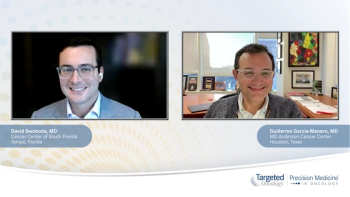
Panelists discuss real-world evidence on dose escalation of luspatercept in lower-risk myelodysplastic syndrome (LR-MDS) (Patel et al, EHA 2024), highlighting its clinical benefits in improving patient outcomes, and share insights from the MAXILUS trial (Della Porta et al, EHA 2024), considering how this dosing strategy could influence clinical practice and enhance patient care.
A panelist discusses how molecular testing results, including ESR1 mutations, PIK3CA alterations, and other genomic findings, directly inform treatment decisions and sequencing of therapies for patients with MBC.
Hope S. Rugo, MD, FASCO, discusses how circulating tumor DNA testing enables real-time monitoring of disease progression, detection of emerging mutations, and assessment of treatment response in patients with MBC.
Panelists discuss dosing strategies for frontline luspatercept in lower-risk myelodysplastic syndrome, emphasizing individualized approaches to optimize efficacy and minimize adverse effects based on patient response and clinical factors.
Luis E. Raez, MD, discusses when minimal residual disease testing can be performed as an option for patients with lung cancer.
Manmeet Ahluwalia, MD, MBA, FASCO, discusses the prevalence of brain metastases in patients with primary renal cell carcinoma.
Panelists discuss how intravenous immunoglobulin (IVIG) therapy may reduce infection risk in patients with multiple myeloma who are receiving teclistamab treatment.
Panelists discuss how minimal residual disease assessment demonstrates superior depth of response with ciltacabtagene autoleucel compared with standard of care in patients who have lenalidomide-refractory multiple myeloma and received 1 to 3 prior therapies.
Panelists discuss how adding a fourth drug (daratumumab) to standard triplet induction therapy may improve outcomes for patients with newly diagnosed, transplant-eligible multiple myeloma.
Panelists discuss how the AQUILA trial evaluated whether daratumumab monotherapy provides superior outcomes compared with active monitoring in high-risk smoldering multiple myeloma patients.