
Ashraf Z. Badros, MB, ChB, discusses the next steps following the phase 3 AURIGA trial of daratumumab and lenalidomide vs lenalidomide maintenance in patients with newly diagnosed multiple myeloma.

Ashraf Z. Badros, MB, ChB, discusses the next steps following the phase 3 AURIGA trial of daratumumab and lenalidomide vs lenalidomide maintenance in patients with newly diagnosed multiple myeloma.

David B. Zhen, MD, discusses the results of the phase 3 CheckMate 649 trial in patients with advanced gastric cancer, gastroesophageal junction cancer, and esophageal adenocarcinoma.
Susumu Hijioka, MD, discusses the key takeaways from the phase 3 STARTER-NET trial evaluating the combination of everolimus with lanreotide when used for the first-line treatment of patients with unresectable or recurrent gastroenteropancreatic neuroendocrine tumors.
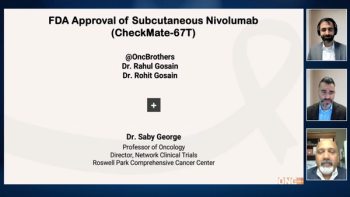
Panelists discuss common adverse events associated with subcutaneous nivolumab, emphasizing the importance of monitoring for immune-related adverse effects and managing them proactively to ensure patient safety and treatment adherence.
Panelists discuss common adverse events associated with subcutaneous nivolumab, emphasizing the importance of monitoring for immune-related adverse effects and managing them proactively to ensure patient safety and treatment adherence.
Panelists discuss the FDA approval of subcutaneous nivolumab based on the CheckMate-67T trial findings, highlighting its potential to improve patient convenience and treatment adherence while maintaining efficacy in the treatment of melanoma.

Panelists discuss how the PERSEUS trial demonstrated superior progression-free survival with daratumumab-VRd compared to VRd alone in patients with transplant-eligible newly diagnosed multiple myeloma (NDMM), potentially establishing a new standard of care in this setting.
Panelists discuss how to navigate and choose among multiple guideline-recommended induction regimens for patients with transplant-eligible newly diagnosed multiple myeloma (NDMM) by considering factors such as efficacy data, toxicity profiles, and individual patient characteristics.
Thomas W. LeBlanc, MD, MA, discusses key clinical pearls for community oncologists in the treatment of anemia in patients with low-risk myelodysplastic syndromes (LR-MDS), including the importance of early and accurate diagnosis, considering newer therapies like luspatercept, monitoring hemoglobin levels, and incorporating patient-reported outcomes to tailor individualized treatment plans for better outcomes.

Paolo Tarantino, MD, PhD, discusses the approval of the oral therapy elacestrant for patients with estrogen receptor-positive, HER2-negative advanced or metastatic breast cancer with ESR1 mutations.

Alexander I. Spira, MD, PhD, FACP, discusses the next steps in the clinical development of zoldonrasib for patients with KRAS G12D pancreatic ductal adenocarcinoma based on preliminary findings.

James J. Harding, MD, discusses the remaining unmet needs in the first-line (1L) treatment space for unresectable hepatocellular carcinoma (uHCC) and how 1L immunotherapy (IO) combinations like nivolumab plus ipilimumab (NIVO + IPI) may help address these gaps, while highlighting unanswered questions and offering clinical pearls for managing uHCC.
Alexander I. Spira, MD, PhD, FACP, discusses the clinical implications of ctDNA for treatment decisions and monitoring in patients with KRAS G12D pancreatic ductal adenocarcinoma treated with zoldonrasib.

Alec Kimmelman, MD, PhD, and Shridar Ganesan, MD, PhD, discuss the institution's new molecular oncology program.
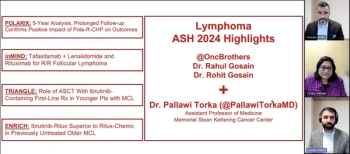
Panelists discuss the ENRICH study, focusing on the efficacy and safety of enzalutamide in combination with standard therapies for metastatic castration-resistant prostate cancer and its potential to improve progression-free survival.
Panelists discuss the TRIANGLE study, examining the efficacy and safety of the combination of rituximab, lenalidomide, and chemotherapy in treating high-risk diffuse large B-cell lymphoma and its potential to improve patient outcomes.
Panelists discuss the inMIND study, exploring the efficacy and safety of mindetuximab for the treatment of relapsed or refractory non-Hodgkin lymphoma and its potential impact on future therapeutic strategies.
Panelists discuss the findings from the POLARIX study, focusing on the efficacy and safety of polatuzumab vedotin in combination with rituximab and chemotherapy for untreated diffuse large B-cell lymphoma.

Alan Tan, MD, discusses factors influencing the choice of immunotherapy plus tyrosine kinase inhibitor vs dual IO in patients with metastatic renal cell carcinoma.
Panelists discuss how health care providers can optimize quality-of-life and treatment outcomes for patients with myelofibrosis through comprehensive symptom management, shared decision-making, and careful attention to patient goals and expectations.
Panelists discuss how myelofibrosis progresses from its molecular and genetic origins through various clinical manifestations, ultimately informing the development of targeted therapeutic approaches for this bone marrow disorder.
The panelist discusses how real-world evidence for CAR T in relapsed/refractory multiple myeloma shows promising efficacy but with some differences from clinical trials. Ide-cel demonstrates effectiveness in patients with prior BCMA exposure, though responses may be impacted. Compared with standard of care (SOC), both ide-cel and cilta-cel show superior outcomes in terms of response rates and progression-free survival, though long-term data are still emerging in real-world settings.
The panelist discusses how the KarMMa-3 trial data demonstrated the superior efficacy of ide-cel vs standard regimens in triple-class exposed R/R MM, with a median progression-free survival of 13.3 vs 4.4 months and an overall response rate of 71% vs 42%. The favorable safety profile and significant survival benefit support ide-cel as a preferred option for third-line and greater treatment, particularly in patients with good performance status who can tolerate bridging therapy.
Virginia G. Kaklamani, MD, DSc, discusses datopotamab deruxtecan and other antibody-drug conjugates available for patients with unresectable or metastatic hormone receptor-positive, HER2-negative breast cancer.
Ajay Goel, PhD, AGAF, discusses how the development and validation of novel non-invasive biomarkers can improve early detection and ultimately impact patient outcomes for patients.
Panelists discuss how to optimize treatment selection and sequencing for a 65-year-old patient with standard-risk, transplant-eligible newly diagnosed multiple myeloma (NDMM) through assessment of disease characteristics, patient factors, and available therapeutic options.
Thomas W. LeBlanc, MD, MA, discusses how treatment regimens for low-risk myelodysplastic syndromes (LR-MDS) significantly impact health-related quality of life (HRQOL), with data from the COMMANDS study (Oliva et al, ASH 2024, Abstract 3216) highlighting the correlation between HRQOL and clinical end points, and explore how incorporating HRQOL data into clinical decision-making can guide more patient-centered treatment choices in community settings.
Panelists discuss how the IMROZ trial demonstrated improved outcomes with quadruplet therapy combining daratumumab, lenalidomide, melphalan, and prednisone in patients with transplant-ineligible newly diagnosed multiple myeloma (NDMM), highlighting its potential as a new treatment standard.
David M. Waterhouse, MD, MPH, and Molly Mendenhall, MBOE, LSSBB, BSN, RN, discuss how the implementation of Lean Six Sigma methodology at Oncology Hematology Care in Cincinnati, Ohio, has transformed clinical operations and elevated the quality of patient care.
Panelists discuss the future treatment landscape for early relapsed/refractory multiple myeloma, emphasizing the evolving role of community providers, the implications for patient access to care, and how emerging data will influence treatment sequencing in subsequent lines of therapy.